 Ring Studio
Around the world
Engagement Rings in the Netherlands
Engagement rings in the Netherlands are usually sized by inner diameter in millimetres, often bought as matching rings for both partners, and worn on the left or the right hand depending on family tradition. Here is how it all works, with rough costs.
On this page
- Which hand: left, right, or both over time?
- Do both partners get a ring?
- How do Dutch ring sizes work?
- What does WaarborgHolland do?
- 14k or 18k: which gold do Dutch jewellers use?
- How much do engagement rings cost in the Netherlands?
- Where do people buy rings in the Netherlands?
- Designing a matching pair in Ring Studio
- Size system
- Usually inner diameter in mm (maat 17); sometimes circumference
- Engagement ring
- Verlovingsring, often worn by both partners
- Wedding ring hand
- Right for many Protestant families, left for many Catholic ones
- Common gold
- 14k (585) and 18k (750)
- Assay office
- WaarborgHolland
- Rough spend
- Often €800 to €3,500 for a ring (estimate)
Which hand: left, right, or both over time?
There is no single Dutch answer, which surprises a lot of people. The pattern you will hear most often goes like this: during the engagement the verlovingsring is worn on the left ring finger, and at the wedding the trouwring goes on the right. This is especially common in families with a Protestant background. In Catholic families, historically concentrated in the south (Limburg and Noord-Brabant), the wedding ring is more often worn on the left. Both customs are now mixed together, and many couples pick whichever hand suits them.
If you plan to wear the engagement ring and wedding ring together on one finger, decide early, because it affects how you design them. A ring that will live alone on the left hand can have a wider or lower setting than one that must sit flush beside a band. For a wider view, see which hand an engagement ring goes on.
Do both partners get a ring?
Often, yes. A traditional Dutch engagement involves rings for both partners, frequently a matching pair of plain or lightly decorated bands. These can later move to the other hand to serve as wedding rings, or a separate pair of trouwringen is bought for the wedding. The international pattern, a diamond ring for one partner and bands for both at the wedding, has become common too, and many couples combine them: a solitaire for one partner and a plain matching band for the other.
That makes the Netherlands a natural market for matching sets and ring stacks, and for designing the two rings together rather than separately.
How do Dutch ring sizes work?
Most Dutch jewellers measure ringmaat as the inner diameter of the ring in millimetres, typically in quarter or half-millimetre steps. A size 17 is a ring 17 mm across the inside. Some shops, particularly international chains and websites, use circumference instead, which gives numbers in the 40s to 60s. If you see a number below about 25, it is a diameter; above about 40, it is a circumference.
| Dutch size (diameter) | Circumference | US | UK |
|---|---|---|---|
| 16 | 50.3 mm | 5½ | K½ |
| 16.5 | 51.8 mm | 6 | L½ |
| 17 | 53.4 mm | 6½ | M½ |
| 17.5 | 55.0 mm | 7¼ | O |
| 18 | 56.5 mm | 7¾ | P |
| 19 | 59.7 mm | 9 | R½ |
| 20 | 62.8 mm | 10¼ | U |
Equivalents are approximate. If you have an existing ring, measuring its inside diameter with a ruler or calliper is the most reliable home method; our ring size by diameter page shows how, and the printable ring sizer helps if you have no ring to measure.
What does WaarborgHolland do?
The Netherlands has an independent hallmarking system, which is less common in continental Europe than many people assume. WaarborgHolland is the Dutch assay office: it tests precious-metal items and applies hallmarks confirming their fineness. Under Dutch rules, gold, silver and platinum jewellery sold in the Netherlands generally needs to be hallmarked, with exemptions for very light items; check official sources if you need the exact thresholds.
A typical Dutch gold ring therefore shows a fineness mark (585 or 750), a maker's or responsibility mark and an assay mark. The Netherlands is also a member of the international Hallmarking Convention, so you may see the Common Control Mark, which other member countries recognise. Our hallmarks guide explains these marks in more detail.
14k or 18k: which gold do Dutch jewellers use?
Fourteen carat (585) gold is very common in the Netherlands for engagement and wedding rings. It is harder-wearing and cheaper than 18k, and for bands worn every day that is a sensible trade-off. Eighteen carat (750) is chosen for a deeper yellow colour or a more premium feel, and platinum (950) for a naturally white metal that does not need re-plating. The comparison of 14k vs 18k gold covers colour, durability and allergy questions.
How much do engagement rings cost in the Netherlands?
We do not know of a reliable Dutch survey on this, so the ranges below are rough estimates of what jewellers commonly sell. They depend on the gold price, the stone's quality and the shop. Lab-grown diamonds have fallen sharply in price, which has made larger stones far more affordable than a few years ago.
| What you buy | Rough range (EUR, estimate) |
|---|---|
| Pair of plain 14k engagement or wedding bands | €600 to €2,000 |
| 14k solitaire with a small natural diamond | €500 to €1,500 |
| Natural diamond around 0.5 ct | €1,800 to €4,500 |
| Lab-grown diamond around 1 ct | €900 to €2,500 |
See engagement ring cost for how stone size and quality drive price, and lab-grown diamond prices for current trends.
Where do people buy rings in the Netherlands?
The main options are high-street juweliers, independent goudsmeden (goldsmiths) who design and make rings in their own workshop, and online sellers. Many goudsmeden specialise in trouwringen and will make a matching pair to your design, often with a fingerprint or handwriting engraving.
In very general terms, Dutch consumer law says a product must last as long as you could reasonably expect, rather than setting a short fixed guarantee period, and EU rules give a 14-day withdrawal right for most online purchases, usually excluding made-to-measure items. The government consumer information service ConsuWijzer is the official place to check; this is not legal advice.
Designing a matching pair in Ring Studio
Ring Studio is a 3D ring designer for iPhone, iPad and Android, free to download, with the app content in English. You design and visualise the ring; a goudsmid or juwelier then makes it. For a Dutch-style pair:
- Design the engagement ring: choose a stone shape, carat, prong or bezel setting and metal.
- Design the partner's band on its own, picking the same metal and adjusting the width.
- Stack a wedding band with the engagement ring, with a straight, curved or chevron contour, to check they sit together.
- Engrave the inside of each band, and add hidden initials under the stone if you like.
- Share ring codes with your partner or goldsmith so they see exactly what you designed.
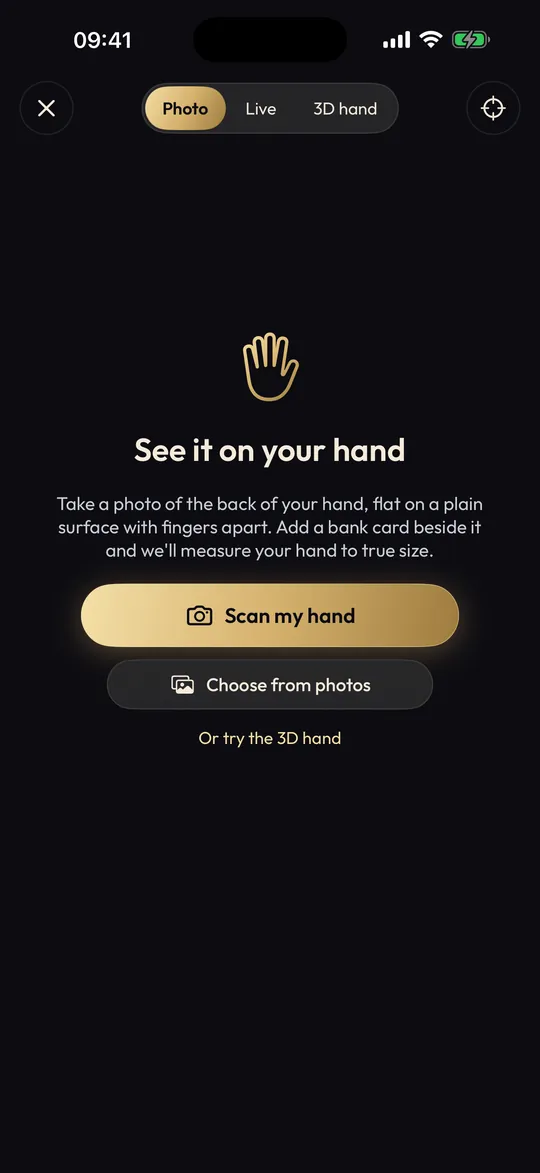
You can also describe a ring in words and let the AI build it, or scan your hand with a bank card for scale to estimate your size. The core designer is free; Pro unlocks the AI, try-on, stacks and advanced options. The app shows metal colour, not karat, so tell the jeweller whether you want 14k or 18k. More on pairing in the wedding ring designer.
Frequently asked questions
Which hand do Dutch people wear their wedding ring on?
It varies. Many couples, particularly from Protestant backgrounds, wear the engagement ring on the left and move to the right hand at the wedding. Many Catholic families wear the wedding ring on the left. Today plenty of couples simply choose.
How are ring sizes measured in the Netherlands?
Dutch jewellers usually quote the inner diameter in millimetres, so maat 17 means a 17 mm diameter, about a US 6.5 to 7. Some shops use circumference instead, so check before ordering.
Do both partners wear an engagement ring in the Netherlands?
Often, yes. A long-standing Dutch custom is for both partners to wear an engagement ring, frequently a matching pair of bands, though a diamond solitaire for one partner is also common now.
What is WaarborgHolland?
WaarborgHolland is the Dutch assay office that tests and hallmarks precious metals. Its marks show that a piece has been independently checked for its stated fineness.
Is 14 carat gold common in the Netherlands?
Yes. 14k (585) is widely used for Dutch engagement and wedding rings because it is harder and less expensive than 18k. 18k (750) is chosen for a richer colour.