 Ring Studio
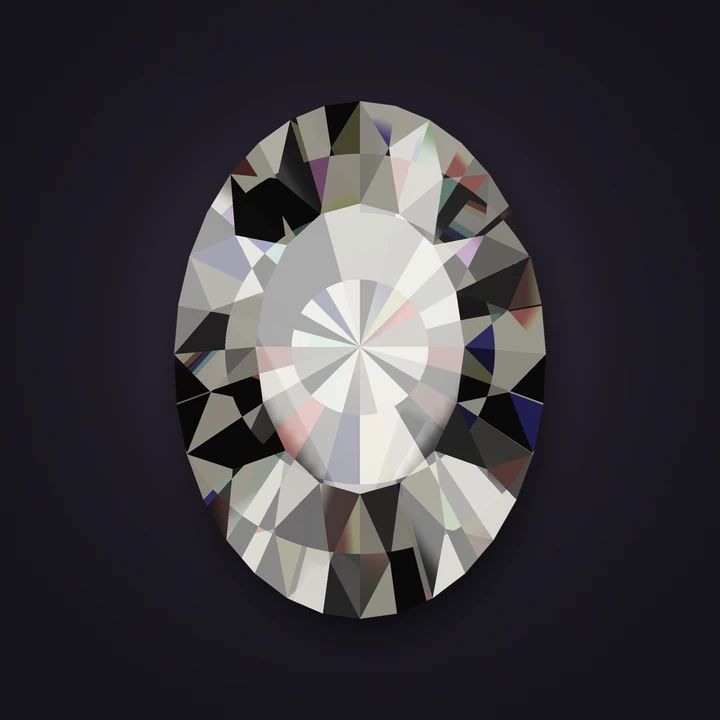
Oval Engagement Rings: How to Choose a Beautiful One
An oval engagement ring gives you the sparkle of a brilliant cut in an elongated outline that looks larger than a round of the same weight. The key is choosing the right ratio and a stone with a gentle bow-tie.
On this page
- Why ovals became the shape of the decade
- Oval diamond size chart: carat to mm
- The oval bow-tie: what it is and how to judge it
- Best settings for an oval diamond
- Wedding bands for an oval engagement ring
- Pros and cons of oval engagement rings
- Oval engagement ring prices
- Who suits an oval engagement ring?
- How to design an oval engagement ring in Ring Studio
- Oval vs other shapes
- Facets
- Usually 56 to 58, modified brilliant
- Length-to-width
- 1.30 to 1.55; most popular 1.35 to 1.45
- Look
- Elongated, soft and bright; flatters the finger
- Best settings
- 4 or 6 prong solitaire, hidden halo, east-west, three stone
- Price vs round
- Generally lower per carat than an equivalent round
Why ovals became the shape of the decade
The oval brilliant was developed in the late 1950s, and it sat in the shadow of the round for decades. Over the last ten years it has become one of the most requested engagement ring shapes, and the reasons are practical. An oval spreads its weight over a longer outline, so it looks bigger for the money. It elongates the finger. And it keeps almost all the sparkle of a round while feeling a little more personal.
Ovals are also easy to wear. There are no sharp tips like a pear or marquise, and the rounded ends sit comfortably in most settings.
Oval diamond size chart: carat to mm
Every oval is cut to its own ratio, so these are approximate typical sizes for stones around 1.40. A slimmer stone of the same weight will be longer and narrower.
| Carat | Approx. dimensions (L x W) | Compared with a round |
|---|---|---|
| 0.50 ct | 6.0 x 4.2 mm | Longer than a 5.1 mm round |
| 0.75 ct | 7.0 x 5.0 mm | Similar length to a 1.25 ct round |
| 1.00 ct | 7.7 x 5.6 mm | Looks larger than a 6.5 mm round |
| 1.50 ct | 8.8 x 6.3 mm | Length close to a 2 ct round |
| 2.00 ct | 9.8 x 7.0 mm | Very visible across the finger |
| 3.00 ct | 11.2 x 8.0 mm | Covers most of the finger width |
For side-by-side outlines at true scale, try our carat size visualiser.
The oval bow-tie: what it is and how to judge it
Almost every oval shows a darker band running across its width, shaped like a bow-tie. It happens because the facets in the middle of an elongated brilliant can't return light as efficiently as those at the ends. You cannot buy an oval without one, but you can buy one where it is faint and lively.
- Look at video, not a still photo. A good bow-tie flickers and breaks up as the stone rocks; a bad one stays solid black from every angle.
- Watch the depth. Ovals around 58 to 63% depth with a table of 53 to 63% tend to perform well. Very shallow stones look glassy; very deep ones hide weight and darken the centre.
- Check the shoulders. Flat or bulging shoulders near the ends spoil the outline. You want smooth, symmetrical curves.
- Colour shows at the tips. Elongated stones concentrate colour at the ends. If you want a white look, G or better is a safe target in a white metal.
Lab reports don't give fancy shapes an overall cut grade, so judging the stone visually matters more than with a round.
Ask your jeweller for a video of the stone on a white background and under normal room light. A bow-tie that disappears in a studio light box can be much more obvious at home.
Best settings for an oval diamond
Prong count and placement
Four prongs placed slightly in from each end show the most stone. Six prongs, with one pair holding each end, add security and stop the ends catching. For stones of 2 carats or more, double prongs or a sturdier claw tip are sensible.
Halo or hidden halo
A classic halo exaggerates size and softens the outline, while a hidden halo keeps the clean solitaire look from above and adds a flash of sparkle from the side. Both are very common with ovals.
East-west orientation
Turning the oval sideways makes a lower, more modern ring that catches less. Our east-west guide explains when it works best.
Side stones
Pear or tapered baguette side stones turn an oval into a three stone ring that reads as both classic and current.
Wedding bands for an oval engagement ring
A low four-prong oval usually sits flush against a straight band. If you have a halo or a deep stone, the band may need a gentle curve to tuck around the head. Thin pavé bands are the most popular match because they echo the brilliant faceting without competing.
Pros and cons of oval engagement rings
| Pros | Cons |
|---|---|
| Looks larger than a round of the same carat | Every oval has some bow-tie |
| Lengthens and slims the finger | Colour can gather at the ends |
| Brilliant sparkle with a softer outline | No overall cut grade on the report, so more judgement needed |
| No sharp points to chip | Ratio preference is personal and hard to guess |
Oval engagement ring prices
As of late 2026, ovals typically cost less per carat than rounds of similar colour and clarity, although well-proportioned stones with faint bow-ties are priced at a premium within the shape. Lab-grown ovals are now inexpensive enough that many couples choose 2 carats or more. Gold and platinum prices also move, so treat any quote as a snapshot. For budgeting, see engagement ring costs and lab-grown diamonds.
Who suits an oval engagement ring?
Ovals are one of the easiest shapes to recommend because they flatter most hands. On shorter or wider fingers, a north-south oval with a ratio of 1.40 or more adds visual length. On long, slim fingers, a fuller 1.30 to 1.35 stone balances the proportions, and an east-west oval can look especially elegant. If your partner wears a lot of rings or uses their hands for work, a low four-prong basket or a bezel keeps the ends from catching. Our hand shape guide goes into more detail.
How to design an oval engagement ring in Ring Studio
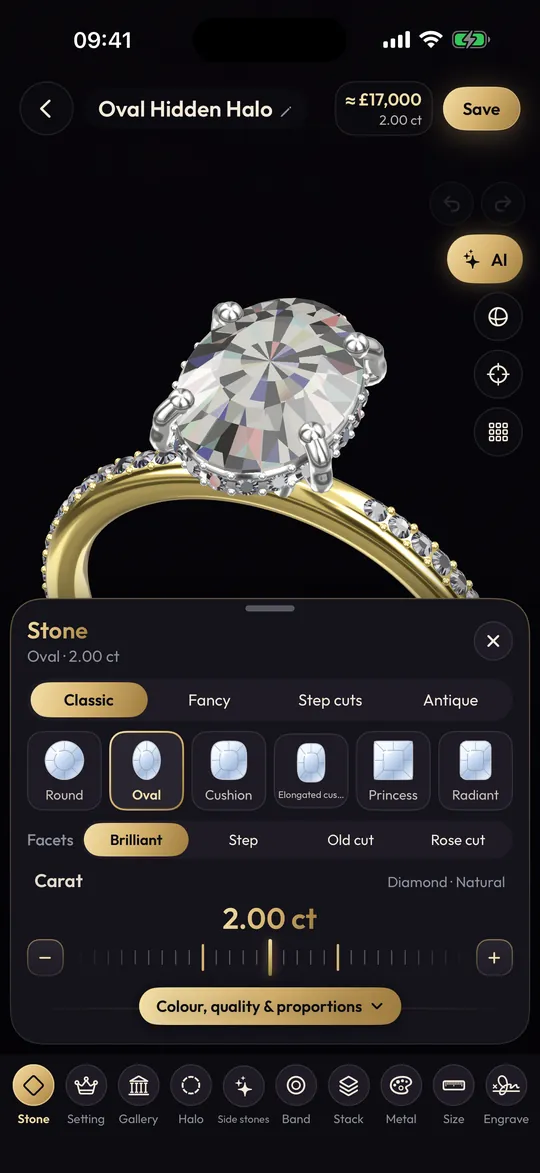
Oval is one of the free shapes in Ring Studio.
- Choose Oval in the stone tray and set your carat.
- Toggle north-south and east-west to see which suits your hand.
- Compare 4 prong and 6 prong heads, then try double prong tips on larger stones.
- Add a hidden halo, then switch to a classic halo and compare the outline.
- Choose a band: a thin pavé or plain band in yellow gold, white gold, rose gold or platinum.
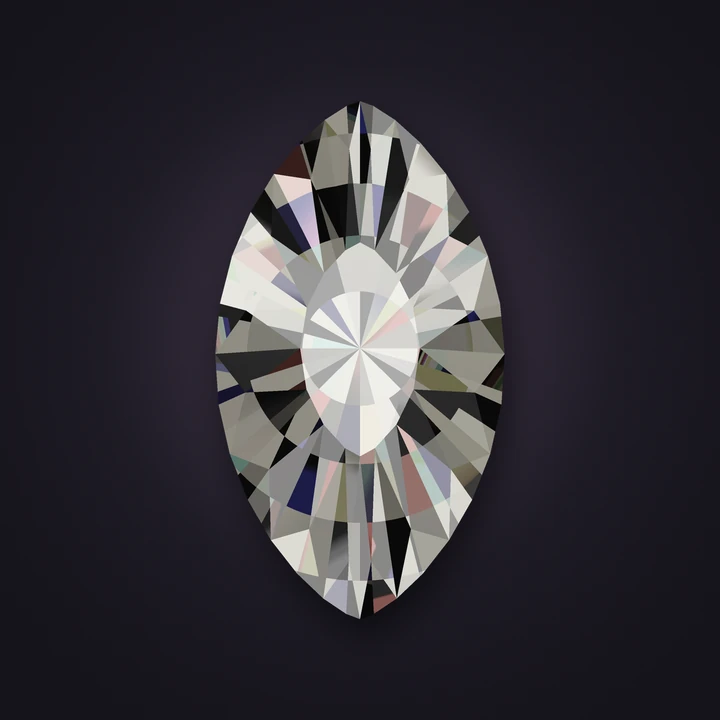
Want to see how a slimmer silhouette compares? The moval and elongated cushion are both in the app as Pro shapes, so you can flick between them on the same setting.
Oval vs other shapes
If you are torn, read oval vs round for sparkle and value, oval vs pear if you like a teardrop, and oval vs elongated cushion if you want something chunkier and more vintage in feel.
Frequently asked questions
What is the best length-to-width ratio for an oval diamond?
Most people prefer 1.35 to 1.50. Below about 1.30 the stone starts to look chubby and round-ish; above about 1.55 it looks long and narrow, which some people love and others find too slim.
What is a bow-tie in an oval diamond?
It is a dark, bow-tie shaped area across the centre of the stone where light leaks out instead of returning to the eye. Nearly every oval has one; you want it faint and changing as the stone moves, not a solid black band.
Does an oval diamond look bigger than a round?
Yes. A 1 carat oval of around 7.7 x 5.7 mm has a longer face-up outline than a 6.5 mm round of the same weight, so it tends to look larger, especially set north-south.
Is an oval cheaper than a round diamond?
Usually. Ovals of similar quality generally cost less per carat than rounds because cutting them wastes less rough and demand is a little lower, though popular ratios with weak bow-ties command a premium.
How many prongs should an oval diamond have?
Four prongs show the most stone and six prongs give extra security. Many jewellers also like a double-claw or six-prong head on ovals above 1.5 carats to protect the narrow ends.
Keep reading
 Moval Engagement Rings: Between Marquise and OvalMoval engagement ring guide: what a moval cut is, typical ratios and sizes, sourcing, bow-tie checks, best settings and …East-West Engagement RingsEast-west engagement ring guide: which elongated shapes work turned sideways, how it changes finger coverage and size, s…Hidden Halo Engagement RingsHidden halo engagement ring explained: where the stones sit, which shapes suit it, how it looks from above vs the side, …