 Ring Studio
Pear Engagement Rings: Choosing a Teardrop Diamond
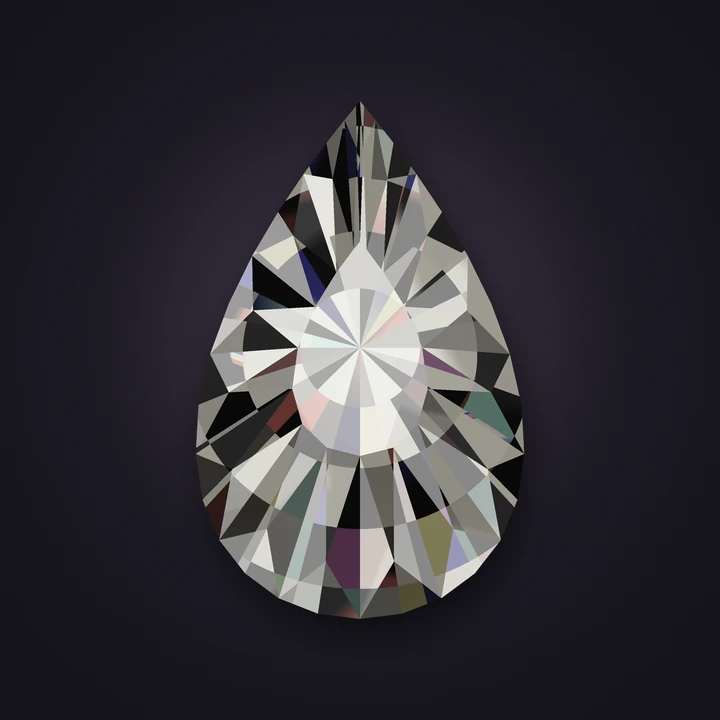
A pear engagement ring sets a teardrop-shaped brilliant cut with one rounded end and one point. It combines the sparkle of a round with the length of a marquise, and it looks larger on the finger than most shapes of the same carat.
On this page
- The appeal of a pear shaped diamond
- Pear diamond size chart: carat to mm
- How to judge a pear: shoulders, wings and bow-tie
- Best settings and prong placement for pears
- Wedding bands for a pear engagement ring
- Pros and cons of pear engagement rings
- Pear engagement ring cost
- Who looks best in a pear engagement ring?
- How to design a pear engagement ring in Ring Studio
- Pear compared with oval and marquise
- Facets
- Usually 56 to 58, modified brilliant
- Length-to-width
- 1.45 to 1.75; most popular 1.50 to 1.70
- Look
- Teardrop outline, bright sparkle, elegant and slightly romantic
- Best settings
- 5 or 6 prong with a protected tip, bezel, halo, toi et moi
- Price vs round
- Usually noticeably lower per carat than a comparable round
The appeal of a pear shaped diamond
The pear is one of the older fancy shapes, with roots in fifteenth-century Flemish cutting, though the modern brilliant version is far more fiery than its ancestors. Its outline does two things well: it lengthens the finger like an oval, and its single point adds direction and a touch of drama. It is also one of the best shapes for making a modest carat look generous.
Pear diamond size chart: carat to mm
Approximate dimensions for stones around a 1.55 ratio. Longer and slimmer stones will measure more in length and less in width.
| Carat | Approx. L x W | Face-up impression |
|---|---|---|
| 0.50 ct | 6.9 x 4.5 mm | Longer than a 0.75 ct round |
| 0.75 ct | 7.8 x 5.1 mm | Generous for the weight |
| 1.00 ct | 8.7 x 5.7 mm | Reads larger than a 1 ct round |
| 1.50 ct | 9.9 x 6.5 mm | Elegant statement size |
| 2.00 ct | 10.9 x 7.1 mm | Covers most of the finger length |
| 3.00 ct | 12.5 x 8.1 mm | Very large; tip protection is essential |
How to judge a pear: shoulders, wings and bow-tie
Pears are hard to cut beautifully, and small flaws in the outline are easy to see. Check these points before price:
- Shoulders: the curves where the round end meets the sides should be full and even. Flat, high shoulders make the stone look stubby.
- Wings: the sides running down to the point should be gently curved. Bulging wings look fat; flat wings look thin and angular.
- Symmetry: draw an imaginary line from the point through the centre of the round end. Both halves should mirror each other.
- Bow-tie: present in most pears. You want it soft and changing, not a solid dark band.
- Depth: roughly 58 to 64% is a common target; table roughly 53 to 63%.
- Tip: check the report for inclusions or chips near the point, which matters for durability.
Colour tends to gather at the point, so in white metal G or H is a safe choice. Our 4Cs guide covers the trade-offs.
A pear that looks perfect in a photo can still have uneven shoulders. Ask for a top-down image on a grid or a video turned slowly, and compare the two halves.
Best settings and prong placement for pears
Five prongs
The classic pear setting uses one prong at the point and two pairs around the round end, or one at the point and four spaced around the stone. Ideally the tip prong is a V-shape that wraps the point. Ring Studio doesn't have a dedicated V-prong, so use a 5 or 6 prong head with claw tips and ask your jeweller for a V-tip at the point.
Bezel
A full or partial bezel protects the tip completely and suits a modern, minimalist look.
Halo
A pear halo amplifies the length and gives the point extra protection. It is one of the most popular ways to make a 1 carat pear look closer to 1.5 carats.
Toi et moi and east-west
Pears are a favourite in two-stone toi et moi rings, often paired with an oval or round. Ring Studio doesn't have a dedicated toi et moi option yet; the closest is placing your own extra stone with Pro. Set east-west, a pear looks unusual and modern.
Wedding bands for a pear engagement ring
Because of its asymmetric outline, a pear often leaves an awkward gap against a straight band. Curved or notched bands that follow the head are very popular. A chevron that points the same way as the tip can echo the shape nicely. See curved wedding bands for options.
Pros and cons of pear engagement rings
| Pros | Cons |
|---|---|
| Looks large for its carat | Point is vulnerable without protection |
| Flatters and lengthens the finger | Bow-tie and symmetry issues are common |
| Good value per carat | Straight wedding bands may not sit flush |
| Distinctive but still classic | Colour gathers at the tip |
Pear engagement ring cost
Pears usually cost less per carat than rounds of similar colour and clarity, which, combined with their spread, makes them strong value. Exceptionally symmetrical stones with faint bow-ties sell at a premium. Lab-grown pears are widely available at a fraction of natural prices. All prices are estimates that vary by retailer and market; our engagement ring cost guide has wider context.
Who looks best in a pear engagement ring?
Pears flatter a wide range of hands. On shorter fingers, a slimmer stone around 1.65 elongates the finger; on longer fingers, a fuller 1.50 balances it. A pear also suits someone who wants a classic diamond but with a hint of individuality. The main practical consideration is the tip: if your partner is hard on their hands, a bezel or halo protects it better than a prong alone. Our guide to the best engagement ring for your hand shape covers this in more depth.
How to design a pear engagement ring in Ring Studio
Pear is one of Ring Studio's free shapes.
- Choose Pear in the stone tray and set the carat.
- Pick a 5 prong head, then compare it with 6 prong and a bezel.
- Rotate the 3D view to see the point from every angle, then switch the stone to east-west.
- Add a classic halo or hidden halo and look at the side profile.
- Pick a band, then stack a curved or chevron wedding band (a Pro feature) to see whether it sits flush.
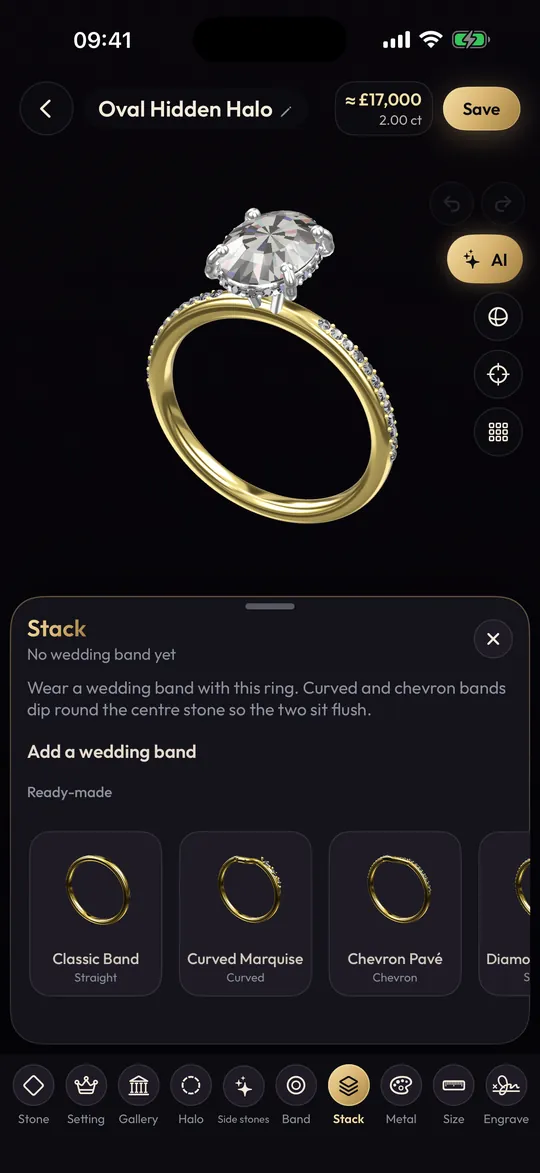
You can also describe it to the AI ring designer: "a 1.5 carat pear on a thin rose gold band with a hidden halo". Share the result as a ring code with your jeweller.
Pear compared with oval and marquise
The pear sits between the oval's softness and the marquise's drama. Read oval vs pear and pear vs marquise to see which outline suits your hand, or explore the marquise in more detail.
Frequently asked questions
Which way should a pear engagement ring face?
Traditionally the point faces towards the fingertips, which lengthens the finger. Pointing it towards the wrist is equally valid and some people find it more comfortable; there is no rule, only preference.
What is a good ratio for a pear shaped diamond?
Most buyers like 1.50 to 1.70. Below about 1.45 the stone looks short and wide; above about 1.75 it becomes slender and needle-like.
How do you protect the point of a pear diamond?
Set the tip in a V-shaped prong or a bezel so metal covers the point. The tip is the thinnest part of the stone and the most likely to chip if exposed.
How big is a 1 carat pear diamond?
Roughly 8.5 to 9 mm long and 5.5 to 6 mm wide, depending on the ratio. That is noticeably longer than a 6.5 mm round of the same weight.
Do pear diamonds have a bow-tie?
Most do, because the shape is elongated. A faint bow-tie that shifts as the stone moves is normal; a dark, fixed band across the middle is worth avoiding.
Keep reading
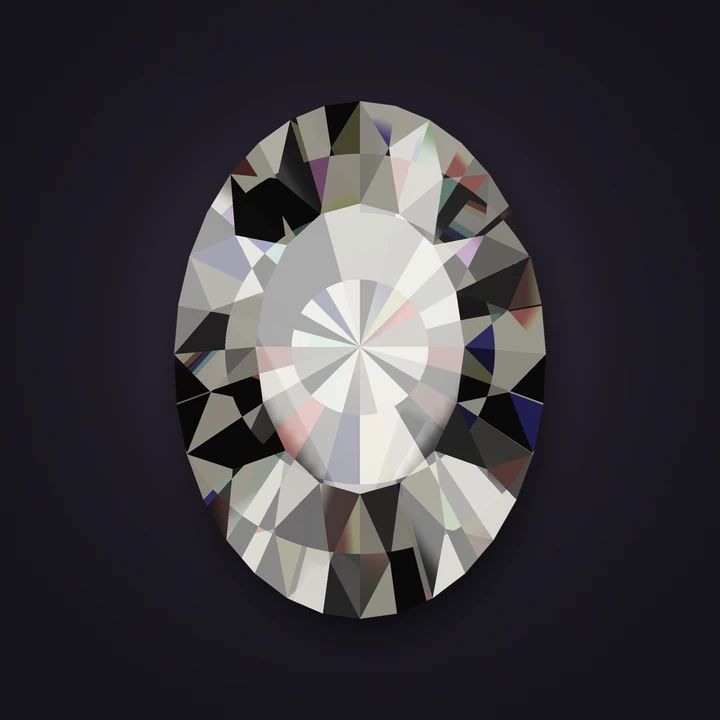 Oval Engagement Rings: How to Choose a Beautiful OneOval engagement ring guide: the best length-to-width ratio, judging the bow-tie, carat-to-mm sizes, flattering settings …
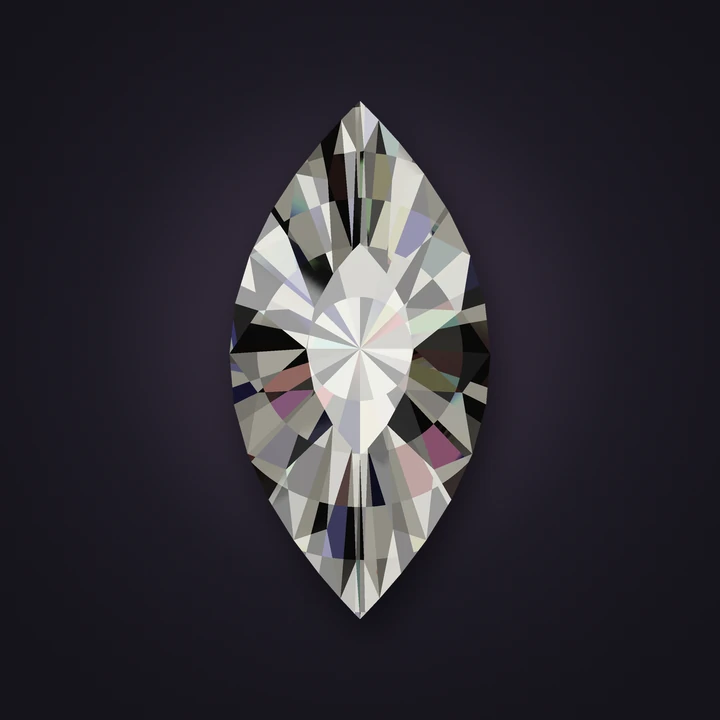 Marquise Engagement Rings: The Shape That Looks BiggestMarquise engagement ring guide: the ideal 1.85 to 2.10 ratio, bow-tie and symmetry checks, carat-to-mm sizes, tip protec…Toi et Moi Engagement RingsToi et moi engagement ring guide: classic two-stone pairings, how to balance shapes and sizes, wedding band fit, cost an…Curved and Contour Wedding BandsCurved and contour wedding bands follow your engagement ring so they sit flush. See which rings need one, curve depth, w…