 Ring Studio
Which Hand Does an Engagement Ring Go On?
In the UK, Ireland, the US, Canada and Australia, the engagement ring goes on the ring finger of the left hand, the finger next to the little finger. In many other countries, including Germany, Norway, Russia, Poland and parts of India, the right hand is common, and customs often change between engagement and wedding.
On this page
- UK, Ireland, US, Canada, Australia, NZ
- Left hand, ring finger
- Often right hand
- Germany (after the wedding), Norway, Russia, Poland, Greece, parts of India
- Switches at the wedding
- Common in Germany, the Netherlands and Brazil
- Ring finger
- The fourth finger, next to the little finger
- Real rule
- There isn't one: local custom, religion and comfort all count
Left or right hand: customs by country
Customs vary between families, regions and religions, so read this table as "what is common" rather than a rule. Where engagement and wedding customs differ, both are shown.
| Country or region | Engagement ring | Wedding ring | Notes |
|---|---|---|---|
| UK and Ireland | Left | Left | Wedding band usually worn below the engagement ring |
| United States and Canada | Left | Left | Same as the UK |
| Australia and New Zealand | Left | Left | Same as the UK |
| France and Italy | Left | Left | Left-hand custom is widespread |
| Germany and Austria | Often left | Often right | Many couples wear the engagement band on the left, then move to the right hand once married |
| Netherlands | Varies | Varies | Traditionally linked to religion: Catholic families often left, Protestant families often right |
| Norway and Denmark | Often left | Often right | Practice varies; the right hand for married couples is common |
| Russia, Ukraine, Serbia, Greece | Right | Right | Strongly associated with Eastern Orthodox tradition |
| Poland | Often right | Often right | Right hand is traditional, though some couples choose the left |
| Spain | Varies | Often right | Differs by region; the left is common in some areas such as Catalonia |
| Brazil | Right | Left | Rings are often moved from the right to the left hand at the wedding |
| India | Often right, varies | Varies | Many Hindu families favour the right hand for auspicious occasions; urban couples often follow the Western left-hand custom |
| Jewish weddings | Varies | Right index finger in the ceremony | The ring is often moved to the left ring finger afterwards |
The country guides cover local customs in more depth, for example engagement rings in Germany, India, Brazil and Poland.
Why the left hand? The vena amoris story
The left-hand custom is usually traced to an ancient belief, repeated by Roman writers, that a vein ran directly from the fourth finger of the left hand to the heart. Later writers called it the vena amoris, the "vein of love". Anatomy does not support it, since the veins of every finger connect to the heart in much the same way, but the symbolism survived and spread through Western Christian wedding rites. The history of the engagement ring covers how the tradition developed.
In Eastern Orthodox countries the right hand carries its own significance, as the hand used for blessings and oaths, which is one reason the right hand is common across Russia, Greece and much of Eastern Europe.
Which order: engagement ring or wedding band first?
In the UK and US the common custom is to wear the wedding band closest to the hand, so it sits "nearer the heart", with the engagement ring stacked above it. On the day, many brides move the engagement ring to the right hand, receive the wedding band on the left, then slip the engagement ring back on top.
Plenty of people do the opposite because it looks better with their particular rings, or wear the engagement ring on the right hand after the wedding. If your engagement ring sits low or has a halo, the band may need a curve or notch to sit flush. See bridal sets and matching stacks and curved wedding bands.
Practical reasons to choose the other hand
- Dominant hand work. If you work with your hands, a raised centre stone on the dominant hand takes more knocks. See engagement rings for an active lifestyle.
- Fit. Fingers on the dominant hand are often slightly larger, so a ring sized for one hand may not fit the other. Measure the finger you will actually wear it on; the ring size chart shows how small the steps between sizes are.
- Family tradition. Couples from two cultures often blend customs, for example wearing engagement rings on the left and wedding rings on the right.
Switching hands? Get each ring finger sized separately. The difference between left and right is often a quarter to half a size, enough to make a ring spin or stick at the knuckle.
Plan your ring and stack in Ring Studio
Whichever hand you choose, Ring Studio lets you design the ring in 3D on iPhone, iPad or Android and see it on a hand before a jeweller makes it.
- Design the engagement ring in the engagement ring designer: stone shape, setting, halo, band and metal.
- With Pro, add a wedding band above or below it in the wedding band stack designer, with a straight, curved or chevron contour so it sits flush.
- Try it on live with your phone camera, on whichever hand you plan to wear it, or on a 3D hand. The hand scan, with a bank card beside your hand for scale, gives a ring size estimate (Pro).
- Share the ring code with your jeweller so they open the exact design.
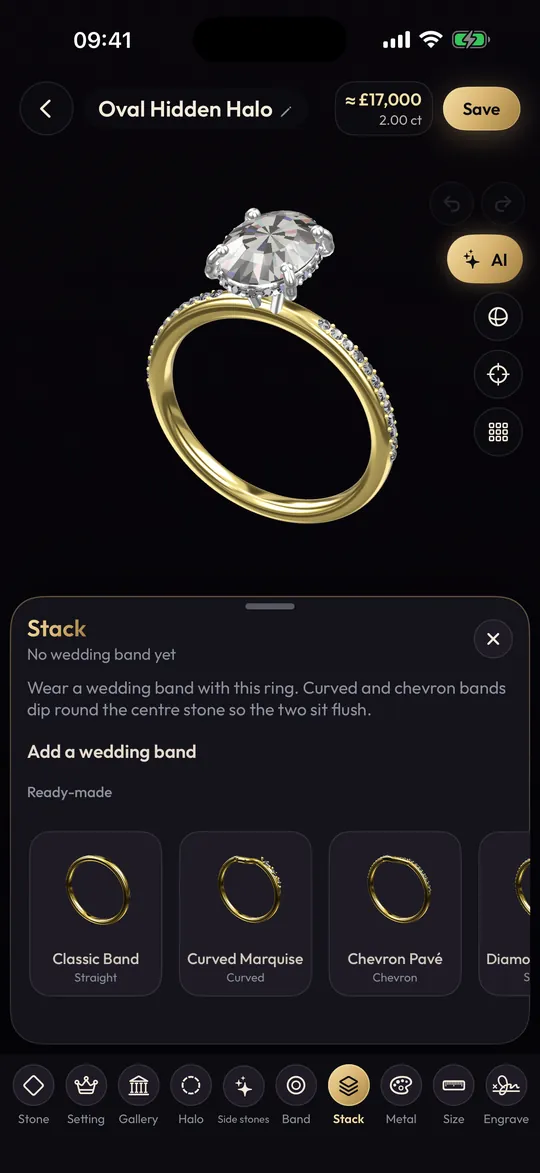
Engagement ring versus wedding ring
The engagement ring marks the promise and is usually given at the proposal; the wedding ring is exchanged during the ceremony. Many couples wear both together on the same finger, while some wear only the wedding band day to day. The differences in style, cost and custom are covered in engagement ring vs wedding ring.
Frequently asked questions
Which finger is the ring finger?
The fourth finger, between the middle finger and the little finger. In most traditions the engagement ring and wedding band are worn on this finger, on either the left or the right hand depending on the country.
Does the engagement ring go on before or after the wedding band?
A common Western custom is to wear the wedding band closest to the heart, with the engagement ring on top, so the engagement ring is moved to the right hand during the ceremony and put back afterwards. Many people simply wear whichever order looks and feels best.
Why is the engagement ring worn on the left hand?
The usual story is the Roman idea of a vein running from the fourth finger of the left hand to the heart, the vena amoris. It is not anatomically true, but the custom stuck in much of Western Europe and the English-speaking world.
Can men wear an engagement ring on either hand?
Yes. Men's engagement rings follow the same local customs as women's, and plenty of people choose a hand for comfort, especially if they work with their dominant hand.
Is it wrong to wear an engagement ring on the right hand in the UK?
No. It is unusual, so people may assume it is a fashion ring, but there is no rule against it. Left-handed people, those with a family tradition from another country and those whose rings get in the way at work often choose the right hand.