 Ring Studio
How to Choose an Engagement Ring
To choose an engagement ring, set a budget first, work out the wearer's taste from what they already wear, then decide in this order: stone shape, stone type and size, setting, band and metal, and finally ring size. Get those six decisions right and the rest is detail.
On this page
- Step 1: Set a budget you are genuinely comfortable with
- Step 2: Work out their style before you look at rings
- Step 3: Choose the stone shape
- Step 4: Choose the stone type and size
- Step 5: Choose the setting style
- Step 6: Choose the band and metal
- Step 7: Get the ring size right
- Step 8: Decide where to buy
- How to choose an engagement ring together, or keep it a surprise
- Design and preview the ring in Ring Studio
- A quick checklist before you commit
- Decide in this order
- Budget, style, shape, stone, setting, metal, size
- Biggest value lever
- Lab-grown vs natural, then carat just under round numbers
- Most practical setting
- Solitaire with 4 or 6 prongs, or a bezel for active hands
- Time needed
- 2-4 weeks ready-made, 6-10 weeks custom
Step 1: Set a budget you are genuinely comfortable with
Every other decision flows from the number you are willing to spend, so fix it before you look at a single ring. Old rules such as "three months' salary" were marketing lines rather than advice, and our page on the three months' salary rule explains where it came from. A better approach is to start from savings you can spare without debt, then decide how much of that goes on the ring versus the wedding, a honeymoon or a deposit.
As a rough guide, as of late 2026 a well-made 1 carat lab-grown diamond solitaire in 18k gold can cost from roughly £1,000 to £2,500, while a comparable natural diamond ring often sits somewhere between £4,000 and £9,000. Those are estimates: prices vary by retailer, stone quality and the metal market, and lab-grown diamond prices have fallen sharply over recent years. Our guide to engagement ring cost breaks it down further, and the ring budget calculator helps you split a total.
Decide your ceiling, then aim about 10% below it. Engraving, resizing, insurance and a matching wedding band all add up, and they are easy to forget.
Step 2: Work out their style before you look at rings
The single best predictor of whether someone will love a ring is the jewellery they already wear every day. Spend a week noticing it:
- Metal colour. Mostly silver-toned jewellery points to white gold or platinum. Warm gold pieces point to yellow gold. Pinkish or mixed pieces suggest rose gold or two-tone.
- Scale. Fine chains and small studs suggest a slim band and a modest stone. Bold cuffs and statement earrings suggest they would enjoy a larger centre stone or a halo.
- Era. Do they collect vintage pieces, antique-shop finds or Art Deco prints? Then look at vintage-style rings. Clean, architectural pieces lean towards minimalist designs.
- Daily life. Surgeons, climbers, nurses, gardeners and musicians often prefer a low profile and a protective setting.
If you are still stuck, the engagement ring style quiz turns a few quick preferences into a starting direction. Friends and siblings are also a good source, as long as they can keep a secret.
Step 3: Choose the stone shape
Shape is the most visible decision and the one people have the strongest feelings about. It also affects price, how big the stone looks and which settings suit it.
| Shape | Look | Looks larger per carat? | Good to know |
|---|---|---|---|
| Round | Classic, maximum sparkle | No, the benchmark | Usually the highest price per carat |
| Oval | Soft, elongating | Yes | Check for a dark "bow tie" across the middle |
| Cushion | Pillowy, romantic | Slightly smaller | Comes square or elongated |
| Emerald cut | Long step facets, quiet glamour | Yes, by length | Shows inclusions, so prioritise clarity |
| Pear | Teardrop, elegant | Yes | The point needs protection |
| Princess | Square, crisp | Similar to round | Protect the four corners |
| Radiant | Rectangular with brilliant sparkle | Yes | Hides inclusions better than emerald |
| Marquise | Long, pointed, dramatic | Yes, the most | Two points to protect |
If you are torn between two, our comparisons such as oval vs round and emerald vs radiant go deeper. The section index for all engagement ring shapes covers rarer options such as kite, hexagon and old mine cuts.
Step 4: Choose the stone type and size
Most engagement rings use a diamond, but you have real choices here.
Natural or lab-grown diamond
Lab-grown diamonds are real diamonds with the same chemistry, hardness and optical properties as mined ones; they cost far less for the same size and quality. Natural diamonds are rarer and are often chosen for their geological origin and longer-term value story. Neither is the "wrong" choice; our guide to lab-grown vs natural diamonds lays out the trade-offs honestly.
Coloured gemstones and alternatives
Sapphires and rubies (9 on the Mohs scale) are hard enough for daily wear. Emeralds (7.5-8) and morganite (7.5-8) are softer and benefit from a protective setting. Moissanite (9.25) is a popular budget-friendly diamond alternative. See sapphire engagement rings if colour appeals.
The 4Cs, in order of importance
- Cut drives sparkle more than anything else. For round diamonds, aim for an Excellent or Ideal cut grade.
- Colour: G-H looks white to most eyes in white metal; I-J can look lovely in yellow gold, which warms the stone anyway.
- Clarity: VS2 or SI1 is usually "eye clean" in brilliant cuts. Step cuts such as emerald and asscher show more, so go higher.
- Carat: buying just under round numbers (0.9 ct instead of 1.0 ct) can save meaningfully with no visible difference.
The diamond 4Cs guide explains each grade, and the carat size chart shows how big each weight looks in millimetres. For reference, a 1 carat round brilliant measures about 6.4-6.5 mm across.
Step 5: Choose the setting style
The setting is how the stone is held and what surrounds it. It shapes the ring's personality as much as the stone does.
- Solitaire: one stone, nothing to compete with it. Easy to pair with any wedding band.
- Halo: a ring of small diamonds around the centre makes it look larger and adds sparkle.
- Hidden halo: small stones under the centre, visible from the side. Subtle sparkle with a clean top view.
- Three stone: a centre stone flanked by two side stones, often read as past, present and future.
- Bezel: a metal rim around the stone. Very secure and modern.
- Pavé band: small diamonds along the band for extra sparkle.
Prong count matters too. Four prongs show more of the stone; six prongs hold it more securely and make round stones look rounder. Our 4 prong vs 6 prong comparison covers the trade-off, and bezel vs prong helps if security is the priority.
Step 6: Choose the band and metal
Metal choice is part looks, part practicality.
| Metal | Colour | Upkeep | Price |
|---|---|---|---|
| Platinum (950) | Naturally white | Develops a soft patina; no plating needed | Highest |
| 18k white gold | White when rhodium plated | Re-plating every year or two | Mid-high |
| 18k yellow gold | Rich yellow (75% gold) | Polish occasionally | Mid-high |
| 14k gold | Slightly paler (58.3% gold) | Harder wearing than 18k | Mid |
| Rose gold | Warm pink from copper | Low; colour is in the alloy | Mid |
For the full argument, read platinum vs white gold and 14k vs 18k gold. Band width matters too: very thin bands (under about 1.8 mm) look delicate but can bend over years of wear. The ring width guide explains what suits different fingers.
Think about the wedding band now rather than later. Some engagement ring shapes and low settings leave no room for a straight band to sit flush, which is why curved and contour wedding bands exist.
Step 7: Get the ring size right
A ring that is the wrong size is a fixable problem, but some designs (full eternity bands, tension settings, very intricate pavé) are hard or impossible to resize. If the proposal is a surprise, borrow a ring they wear on the right finger, or use one of the methods in how to find their ring size secretly. When in doubt, size slightly larger: it is easier to make a ring smaller than bigger. The ring size chart converts between UK, US and EU systems.
Step 8: Decide where to buy
You have three broad routes:
- Ready-made from a jeweller's stock. Fastest, and you can try it on. Limited to what is in the case.
- Custom made by an independent jeweller. You get exactly what you want, often for similar money, but it takes six weeks or more. Our guide to working with a jeweller on a custom ring walks through the process.
- Online retailers. Wide choice and often keen pricing, but check certificates, returns and insurance carefully. See buying an engagement ring online safely.
Whichever route you choose, insist on an independent grading report for any significant diamond (GIA and IGI are the most widely recognised; see GIA vs IGI), and in the UK check for a hallmark on any gold or platinum ring.
How to choose an engagement ring together, or keep it a surprise
There is no single right answer. Some couples shop together and treat it as a shared project; others want a full surprise. A popular middle path is for the wearer to share a few non-negotiables (shape, metal, a "please not this") and leave the rest. If you are the one hoping for a particular ring, our page on how to drop a hint has tactful ways to do it.
Design and preview the ring in Ring Studio
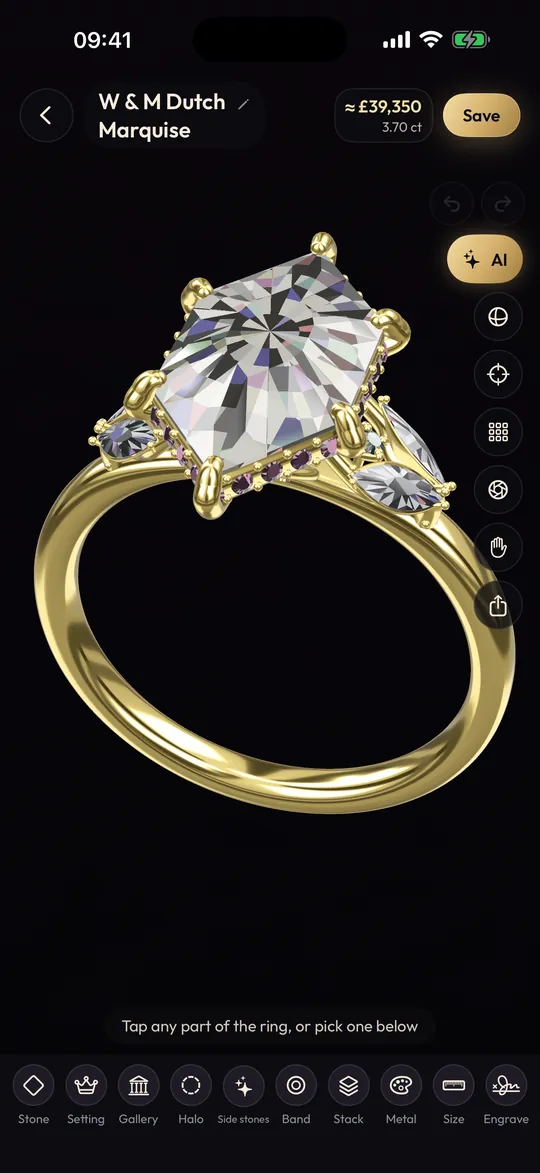
Choosing gets much easier when you can see the combinations rather than imagine them. Ring Studio is a free 3D ring design app for iPhone, iPad and Android that lets you work through the steps above and see the result from every angle:
- Pick a stone shape and set the carat size. Free covers 12 popular shapes; Pro opens all 28, including elongated cushion, moval and old mine.
- Choose the stone: natural or lab-grown diamond, yellow or black diamond, blue or pink sapphire, emerald, ruby or morganite. Turn it north-south or east-west.
- Pick a setting (4, 5, 6 or 8 prong, bezel, lotus or compass), a halo (none, hidden or classic) and a gallery.
- Choose a band style (plain, pavé, knife edge, twisted, bypass and more), its width and taper, and a metal.
- Watch the live price estimate change as you swap stone, carat and metal. It is an estimate for comparison, not a quote.
If you would rather describe it, the AI designer builds a ring from a sentence such as "oval lab diamond, hidden halo, thin yellow gold band" and lets you refine it by chatting. With Pro you can try the ring on your own hand through the camera, and share a ring code so a jeweller opens the exact design.
A quick checklist before you commit
- Is the total, including band, engraving and insurance, inside your budget?
- Does the metal match the jewellery they already wear?
- Is the diamond graded by a recognised lab, and does the report number match the stone?
- Will a wedding band sit next to it, straight or contoured?
- Is the setting practical for their work and hobbies?
- Do you know the ring size, and can this design be resized?
- What are the return, resizing and warranty terms?
Once the ring is chosen, plan how you will give it with our guide to planning a proposal, and look after it with engagement ring care tips.
Frequently asked questions
What is the first thing to decide when choosing an engagement ring?
Your budget. It narrows every other choice, from natural versus lab-grown diamond to carat size and metal, and stops you falling for something you can't comfortably afford.
Should I choose the engagement ring together with my partner?
Many couples now do, at least partly. A common middle ground is to agree the shape, metal and budget together and leave the final design and the moment as a surprise.
What is the most popular engagement ring shape?
Round brilliant has long been the most commonly chosen shape because it sparkles the most. Oval has become a very popular alternative because it looks larger per carat and flatters the finger.
How do I choose an engagement ring if I don't know their style?
Look at the jewellery they already wear: metal colour, chunky or delicate, modern or vintage. Ask a trusted friend, check saved images on social media, or let them drop a hint with a design they've made themselves.
Is it better to spend more on the diamond or the setting?
Usually the centre stone takes the larger share, but a well-made setting matters for security and comfort. Prioritise cut quality in the stone and solid prongs in the setting over extra carat weight.
How long does it take to choose and buy an engagement ring?
Allow at least six to ten weeks if you want a custom design or need resizing, and a few weeks for a ready-made ring. Rushing is the most common cause of compromises.