 Ring Studio
Yellow Gold Engagement Rings
Yellow gold engagement rings are back in a big way: warm, easy to repair and kind to slightly warmer diamonds. Here is how to pick the right karat, the stones that suit it and what to expect after years of wear.
On this page
- Why yellow gold engagement rings are popular again
- Which karat of yellow gold should you choose?
- Diamonds and gemstones that suit yellow gold
- Styles that work well in yellow gold
- How yellow gold wears over the years
- How much does a yellow gold engagement ring cost?
- Designing a yellow gold engagement ring in Ring Studio
- Yellow gold vs the other metals
- Common karats
- 9k, 14k, 18k (22k for some traditional rings)
- Typical alloy
- Gold with silver and copper
- Plating needed
- No, the colour runs all the way through
- Best with
- Warmer or near-colourless diamonds, coloured gemstones
- Maintenance
- Occasional polish; prongs checked yearly
Why yellow gold engagement rings are popular again
For much of the 2000s and 2010s, white metals dominated engagement rings. Yellow gold never went away, but it has returned to the front of the jeweller's window as couples look for rings that feel warmer and less clinical. It also suits the current interest in antique-inspired cuts such as the old European cut and elongated shapes such as the oval.
The practical case is just as strong. Yellow gold is the colour gold naturally is, so unlike white gold it never needs rhodium plating to look right. A scratch is the same colour as the rest of the ring, and any jeweller can size, polish or repair it.
Which karat of yellow gold should you choose?
Karat tells you how much of the metal is pure gold. The rest is alloy, which changes the colour, hardness and price. Our full guide to gold karats goes deeper, but here is how they behave in a yellow engagement ring.
| Karat | Gold content | Colour | Wear | Where it is common |
|---|---|---|---|---|
| 9k | 37.5% | Pale, slightly muted yellow | Hard, but can dull over time | UK budget rings |
| 10k | 41.7% | Pale yellow | Hard | US budget rings |
| 14k | 58.3% | Clear, mid yellow | Good balance of hardness and colour | US standard |
| 18k | 75% | Rich, buttery yellow | Softer, shows wear a little sooner | UK and Europe standard |
| 22k | 91.6% | Deep, saturated yellow | Soft; not ideal for holding stones | Traditional South Asian and Middle Eastern jewellery |
For a ring worn every day with a diamond in prongs, 14k and 18k are the sweet spots. If you love the deepest colour, 18k is worth it; if you work with your hands a lot, 14k gives a little more resistance to knocks. The side-by-side detail is in 14k vs 18k gold.
Diamonds and gemstones that suit yellow gold
Diamond colour
A yellow setting reflects warm light into the stone. That makes a top-colour D or E diamond look slightly less icy than it would in platinum, and it makes a G to J diamond look whiter than its grade suggests. In practice that means you can often move down a few colour grades and put the saving into carat or cut.
If you want a bright white look, the classic trick is a yellow gold band with white gold or platinum prongs holding the stone. That is effectively a two-tone ring.
Coloured stones
Yellow gold flatters green emeralds, red rubies and deep blue sapphires, and it intensifies a yellow diamond. Pale pink stones such as morganite can look slightly peachy against it, so try them side by side before deciding.
Styles that work well in yellow gold
- Solitaires with a slim band. The warm metal does a lot of the visual work, so a plain solitaire looks finished rather than bare.
- Bezel settings. A yellow gold rim around the stone reads as modern and graphic; see bezel engagement rings.
- Vintage and engraved bands. Yellow gold is the metal of most antique rings, so engraved and milgrain-style details feel authentic.
- Chunky or knife-edge bands. More metal on show means more of that colour.
How yellow gold wears over the years
All gold is softer than platinum. Over years of daily wear a yellow gold band thins slowly, and the polished surface softens to a satin glow. Prong tips wear too, which is why jewellers recommend checking claws once a year. The upside is that gold is easy to work: prongs can be re-tipped, a thinning band can be built up, and a scuffed ring can be polished back to bright.
Yellow gold alloys used for rings in the UK and Europe usually contain silver and copper rather than nickel, so they are generally a good choice if you react to some white gold alloys. If you have a known allergy, ask your jeweller what the alloy contains.
How much does a yellow gold engagement ring cost?
The metal is usually a smaller part of the price than the centre stone. As a rough guide, a plain solitaire mounting in 14k or 18k yellow gold might add a few hundred to a couple of thousand pounds (GBP) to the cost of the diamond, depending on weight, detail and the retailer. 18k costs more than 14k because it contains more gold, and gold prices move daily. Our gold ring price guide breaks this down by karat. Treat any figure as an estimate and get quotes.
Designing a yellow gold engagement ring in Ring Studio
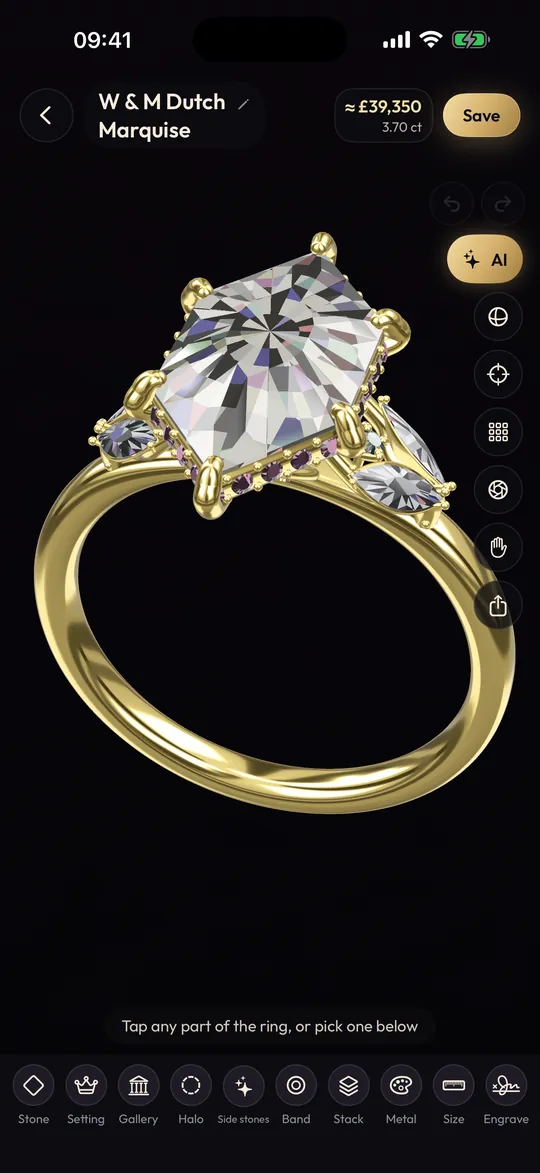
Ring Studio is a 3D ring designer for iPhone, iPad and Android. Yellow gold is one of its metal options, so you can see exactly how warm the band looks against different stones before you speak to a jeweller.
- Pick a stone shape and carat size, then set it to natural or lab-grown diamond.
- Choose yellow gold as the metal, then rotate the ring to see how the colour reflects into the stone from every angle.
- Try a plain, knife edge or engraved band, and compare 4 and 6 prong settings or a bezel.
- Swap the stone to an emerald, ruby or yellow diamond to compare colour combinations.
- Switch the metal to white gold or platinum for a moment to compare, or try two-tone with Pro.
The app does not have a karat choice, so the yellow you see is a representative gold colour; tell your jeweller whether you want 9k, 14k or 18k. You can also describe the ring in words, for example "18k yellow gold oval solitaire with a thin band", and the AI ring designer builds a starting point in 3D.
Yellow gold vs the other metals
| Metal | Look | Upkeep | Relative cost |
|---|---|---|---|
| Yellow gold | Warm, classic | Low; occasional polish | Mid |
| White gold | Bright white (plated) | Re-plating every few years | Mid |
| Rose gold | Pink, soft | Low | Mid |
| Platinum | Naturally white, grey sheen | Low; develops a patina | Higher |
If you are torn between warm and white, read white gold vs yellow gold, or design both versions and share them with a ring code so someone you trust can give an honest opinion.
Frequently asked questions
Is 14k or 18k better for a yellow gold engagement ring?
18k (75% gold) has a richer, deeper yellow and is the usual choice in the UK and Europe. 14k (58.3% gold) is a little paler but harder wearing and cheaper, which is why it is the default in the US.
Does yellow gold tarnish?
Higher karat yellow gold does not tarnish in normal wear. Lower karats such as 9k contain more copper and silver and can darken slightly over time, but a jeweller's clean and polish restores them.
What colour diamond goes best with yellow gold?
Yellow gold is forgiving of warmer colours, so near-colourless grades such as G to J usually look white in a yellow setting. Many people set a whiter diamond in white gold or platinum prongs on a yellow band.
Is yellow gold good for everyday wear?
Yes. Gold is a durable, long-lived ring metal. It scratches and wears down slowly over decades, but it can be polished, resized and re-tipped easily by any bench jeweller.
Can I be allergic to yellow gold?
Pure gold is rarely an issue. Reactions usually come from the alloy metals, and yellow gold alloys normally contain silver and copper rather than nickel, so they are generally a safe choice for sensitive skin.