 Ring Studio
Hidden Halo Engagement Rings
A hidden halo engagement ring has a row of small diamonds wrapped around the base of the centre stone, below its girdle. From above it looks like a clean solitaire; from the side it flashes a ring of sparkle.
On this page
- What it is
- Small stones around the base of the centre stone
- Visible from
- Mainly the side and at angles
- Best shapes
- Oval, round, pear, radiant, elongated cushion
- Size boost
- Small; adds edge sparkle rather than width
- Band pairing
- Good; usually works with a straight band
- Cost impact
- Modest uplift over a solitaire
Where the stones actually sit
On a classic halo, the frame of stones sits around the top of the centre stone, level with or just below the table. On a hidden halo engagement ring, the frame moves down to the stone's girdle and below it, set into the collar of metal that cradles the pavilion. The prongs rise through or past it to hold the stone.
The result is a ring with two personalities. Face-up, it reads as a solitaire with a thin glint of light at the edge. Turn your hand and the side view reveals a full ring of diamonds, which is why the style has been so popular in the last few years: it pleases people who want restraint and people who want sparkle.
Hidden halo vs classic halo vs solitaire
| Solitaire | Hidden halo | Classic halo | |
|---|---|---|---|
| Top view | Stone only | Stone with a faint sparkling edge | Stone framed by diamonds |
| Side view | Metal gallery | Ring of diamonds | Halo plus gallery |
| Face-up size boost | None | Slight | Significant |
| Small stones to maintain | None | Some | Most |
| Straight band fit | Easy | Usually easy | Often needs curve |
For a deeper comparison, read hidden halo vs halo.
Which stone shapes suit a hidden halo?
Elongated shapes benefit most, because their long sides give the hidden halo more length to show off from the side:
- Oval: the most popular pairing; the side view is a long, curved line of sparkle. See oval engagement rings.
- Elongated cushion and radiant: straight sides make a crisp, rectangular sparkle line.
- Pear: the hidden halo follows the curve and the point.
- Round: works well and looks especially neat on a six-prong head.
- Emerald: attractive, though some prefer the clean metal of a plain basket under a step cut.
Very small centre stones (under about half a carat) leave little room for the halo, and the effect can look crowded.
Does a hidden halo add size?
A little, but that is not its purpose. Because the stones are tucked below the girdle, they add perhaps a fraction of a millimetre of visible sparkle at the edge in the top view. If you want the centre stone to read noticeably bigger, a classic halo, an elongated shape or a slimmer band will do more.
Durability, cleaning and upkeep
The hidden halo is fairly well protected because it sits under the overhang of the centre stone. The stones are small, though, and set with tiny beads, so they still need an annual check. Dirt collects in the narrow space between the halo and the pavilion and dulls the stone from below. A soft toothbrush and warm soapy water, angled up under the stone, keeps it bright.
Wedding band compatibility
Since the hidden halo sits inside the stone's footprint, most straight wedding bands slide under the head without a gap. If the setting is very low, the bottom of the halo can touch the wedding band and wear both surfaces over time; ask your jeweller to raise the head slightly or use a gently curved band.
Cost of a hidden halo
A hidden halo uses fewer stones than a classic halo but involves fiddly setting work in a confined space, so the uplift over a plain solitaire head is usually modest, often in the low hundreds of pounds as an estimate. Platinum, larger halo stones or pairing it with a pavé band push it higher. Prices vary by retailer, quality and market.
Designing a hidden halo in Ring Studio
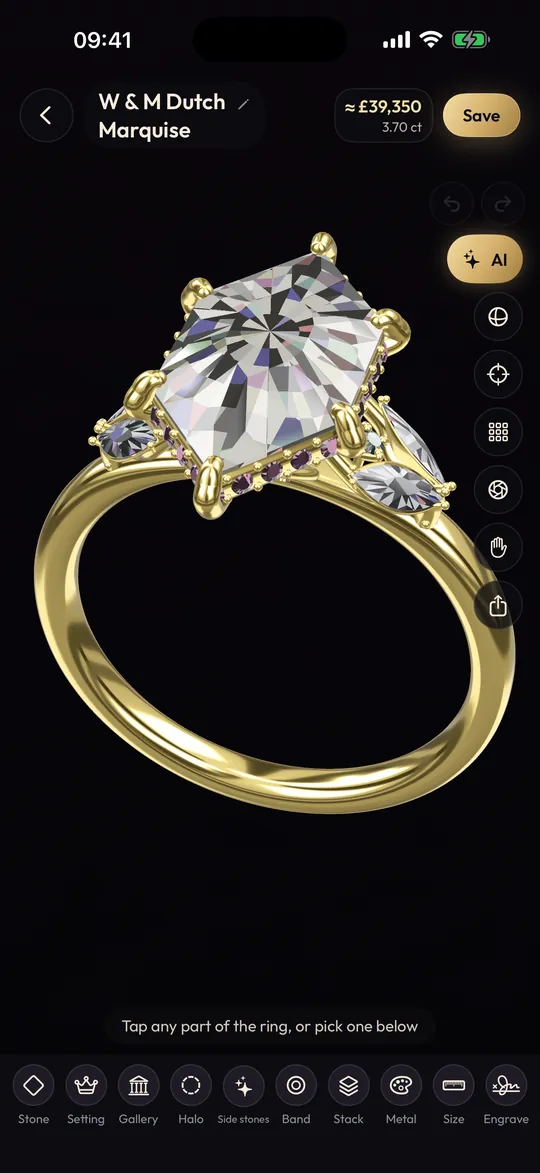
- Pick your centre stone shape and carat. Oval, elongated cushion and pear show the effect best.
- Choose a prong setting; six prongs on a round or four on an oval both look tidy.
- Set the halo to hidden halo, then rotate the ring to the side to see it.
- Pair it with a plain band for a solitaire look from above, or a pavé band for sparkle all round.
- Add a gallery: a rail gallery under the hidden halo keeps the side view clean.
Want another secret detail? Ring Studio can place hidden initials under the stone in the gallery, where only the wearer sees them. The hidden halo and hidden initials are Pro features; the core designer is free.
Is a hidden halo right for you?
Choose a hidden halo if you love the clean top view of a solitaire but want the ring to look special from every angle, especially in photos where the hand is turned. Skip it if you want maximum face-up size or minimal maintenance. Looking at gallery options alongside it helps too; our gallery styles guide shows how the side profile changes.
Frequently asked questions
What is a hidden halo?
It is a band of small stones set around the basket of the centre stone, just under the girdle. Because it sits below the stone, it is mostly invisible from the top and shows when the ring is viewed from an angle.
Does a hidden halo make the diamond look bigger?
Only slightly from above, and mainly by adding a glint of light around the edge at an angle. If face-up size is your main goal, a classic halo does much more.
Is a hidden halo worth it?
It is worth it if you want a solitaire look with a private detail and extra sparkle from the side. It adds cost and some maintenance, so it is not worth it if you only care about the top view.
Can you add a hidden halo to an existing ring?
Usually it means replacing the head, because the halo is built into the basket. A jeweller can often move your existing stone into a new hidden halo head while keeping the band.
Does a hidden halo stop a wedding band sitting flush?
Generally no. It sits within the footprint of the stone, so most straight bands can still sit close, although a very low setting can make the halo touch the band.
Keep reading
 Oval Engagement Rings: How to Choose a Beautiful OneOval engagement ring guide: the best length-to-width ratio, judging the bow-tie, carat-to-mm sizes, flattering settings …