 Ring Studio
Ring size
Ring Size Chart: US, UK, EU, Japan and India
This ring size chart converts US sizes 3 to 13 in half sizes to UK letters, EU (ISO), Japanese, Indian and Swiss sizes, with the inside diameter and circumference in millimetres. Find your row by measurement, then confirm with a jeweller before ordering.
On this page
- Most common women's sizes
- Roughly US 5 to 8 (UK J½ to P½)
- Most common men's sizes
- Roughly US 8 to 12 (UK P½ to X½)
- One US size
- About 0.81 mm diameter, 2.55 mm circumference
- EU size
- Inner circumference in mm
- Accuracy
- Treat as approximate: confirm with a jeweller
Full ring size chart (US 3 to 13)
Every row is calculated from the US standard (inner diameter ≈ 11.63 mm + 0.8128 mm × US size) and cross-checked against widely published jewellers' charts. Retailers round differently, so treat neighbouring rows as a possible match and use the millimetre columns when in doubt.
| US / Canada | UK / Australia / Ireland | EU / ISO | Japan | India | Swiss | Inner diameter (mm) | Circumference (mm) |
|---|---|---|---|---|---|---|---|
| 3 | F | 44 | 4 | 4 | 4 | 14.1 | 44.2 |
| 3.5 | G | 45 | 5 | 5 | 5.5 | 14.5 | 45.5 |
| 4 | H | 47 | 7 | 7 | 7 | 14.9 | 46.8 |
| 4.5 | I | 48 | 8 | 8 | 8 | 15.3 | 48.0 |
| 5 | J½ | 49 | 9 | 9 | 9.5 | 15.7 | 49.3 |
| 5.5 | K½ | 51 | 10 | 11 | 10.5 | 16.1 | 50.6 |
| 6 | L½ | 52 | 12 | 12 | 12 | 16.5 | 51.9 |
| 6.5 | M½ | 53 | 13 | 13 | 13 | 16.9 | 53.1 |
| 7 | N½ | 54 | 14 | 14 | 14.5 | 17.3 | 54.4 |
| 7.5 | O½ | 56 | 15 | 16 | 15.5 | 17.7 | 55.7 |
| 8 | P½ | 57 | 16 | 17 | 17 | 18.1 | 57.0 |
| 8.5 | Q½ | 58 | 17 | 18 | 18 | 18.5 | 58.2 |
| 9 | R½ | 60 | 18 | 20 | 19.5 | 18.9 | 59.5 |
| 9.5 | S½ | 61 | 19 | 21 | 21 | 19.4 | 60.8 |
| 10 | T½ | 62 | 20 | 22 | 22 | 19.8 | 62.1 |
| 10.5 | U½ | 63 | 22 | 23 | 23.5 | 20.2 | 63.3 |
| 11 | V½ | 65 | 23 | 25 | 24.5 | 20.6 | 64.6 |
| 11.5 | W½ | 66 | 24 | 26 | 26 | 21.0 | 65.9 |
| 12 | X½ | 67 | 25 | 27 | 27 | 21.4 | 67.2 |
| 12.5 | Y½ | 68 | 26 | 28 | 28.5 | 21.8 | 68.5 |
| 13 | Z½ | 70 | 27 | 30 | 29.5 | 22.2 | 69.7 |
Need a size between rows, or the other direction (UK letter or EU number to US)? The ring size converter handles quarter sizes and every system on this page.
How to read the chart
Ring sizing systems describe the same thing, the inside of the ring, in different ways:
- US and Canada use numbers in quarter and half steps. Size 0 is about 11.6 mm across, and each full size adds roughly 0.81 mm of diameter.
- UK, Ireland, Australia and New Zealand use letters A to Z with half letters. Each full letter adds about 1.25 mm of circumference, so one UK letter is roughly half a US size. Past Z, sizes continue as Z+1, Z+2 and so on.
- EU and ISO 8653 sizes are the inner circumference in millimetres. Germany, France, Italy, Spain and much of continental Europe use them, sometimes in half sizes.
- Switzerland often uses the circumference minus 40, so EU 54 becomes Swiss 14.
- Japan uses a numbered scale (the JIS system) that also covers China and much of East Asia. Steps are smaller than US sizes in the middle range.
- India uses numbers that track the circumference minus about 40 mm, though individual jewellers' charts vary by a size or so. Quote millimetres if you are ordering from India.
If you are buying from a particular country, the country guides go further into local customs, for example engagement rings in the UK, Germany or Japan.
Measure first, then find your row
A chart is only as good as the measurement you bring to it. In order of reliability:
- A jeweller's sizing. Metal sizing rings, tried on at a normal temperature, give a definitive answer. Most jewellers will do it free.
- An existing ring that fits the right finger. Measure its inner diameter with a ruler or calipers and read across using the diameter column, or see ring size by diameter for a finer table.
- A printed sizer. Our printable ring sizer works if you print at 100% scale and check the calibration line with a ruler.
- String or paper strip. Easy but the least reliable, because paper stretches and it is hard to keep it level. The steps are in how to measure your ring size at home.
Measure at the end of the day when fingers are slightly larger, and not when you are very cold or have just exercised. If your knuckle is much wider than the base of your finger, size for the knuckle: the ring has to get over it.
Women's and men's ring sizes at a glance
There is no official average, but jewellers commonly report that most women's engagement rings fall somewhere around US 5 to 8 and most men's wedding bands around US 8 to 12. Your own measurement always beats an average. The average ring size guide explains why these are rules of thumb rather than statistics.
| Typical range | US | UK | EU |
|---|---|---|---|
| Smaller women's sizes | 4 to 5 | H to J½ | 47 to 49 |
| Middle women's sizes | 5.5 to 7 | K½ to N½ | 51 to 54 |
| Larger women's / smaller men's | 7.5 to 9 | O½ to R½ | 56 to 60 |
| Middle men's sizes | 9.5 to 11 | S½ to V½ | 61 to 65 |
| Larger men's sizes | 11.5 to 13+ | W½ to Z½+ | 66 to 70+ |
Does band width change your ring size?
Yes. The same size feels tighter as the band gets wider, because more of the finger is covered and the ring has to pass the knuckle over a longer length. As a rule of thumb, many jewellers suggest going up about a quarter to half a size for bands of 6 mm or more, but try a wide sizing ring if you can. The ring width guide covers band widths in detail.
Profile matters too. A rounded inside edge slides on more easily than a flat inside, so two rings marked the same size can feel different. That is one reason a jeweller's fitting, done with a band close to your final style, is worth the trip.
Ring size in Ring Studio
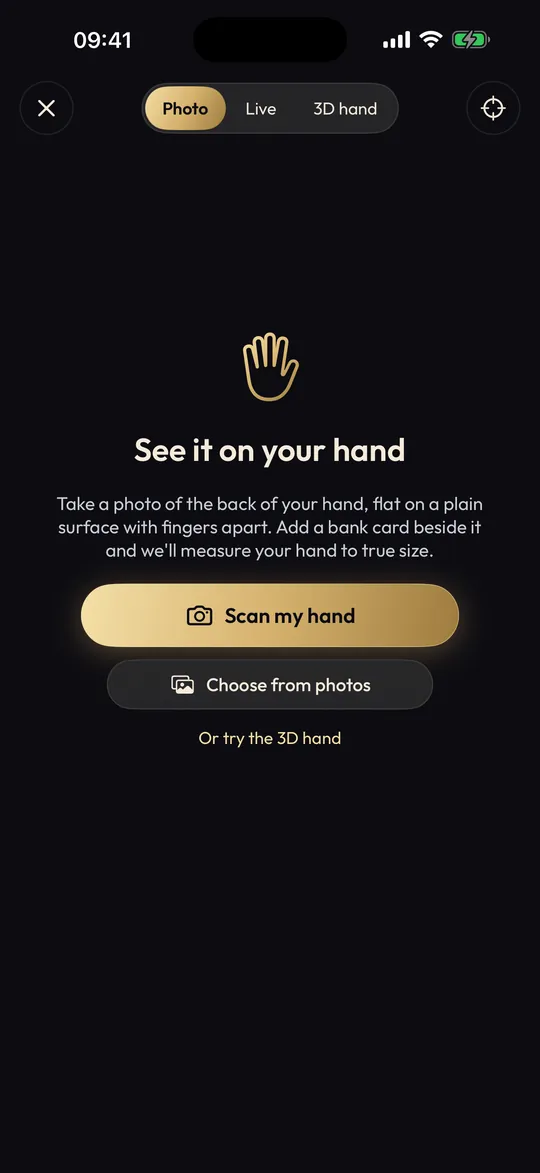
Ring Studio is a 3D ring designer for iPhone, iPad and Android. With Ring Studio Pro you can scan your hand with a bank card beside it for scale, and the app estimates your ring size, then lets you try the design on your own hand live through the camera or on a 3D hand. It is an estimate to get you in the right row of this chart, not a replacement for a jeweller's sizing.
To use it while planning a ring:
- Design the ring in the 3D ring designer, or describe it and let the AI ring designer build it.
- Open try-on, place a bank card next to your hand and scan to get a size estimate.
- Check how the stone and band width look on your finger with virtual ring try-on.
- Share the ring code with your jeweller and ask them to confirm the size with sizing rings before they make it.
Can a ring be resized later?
Most plain gold, platinum and simple solitaire rings can be resized by about one or two sizes either way. Full eternity bands, some channel-set designs, and tungsten or titanium rings are difficult or impossible to resize, so getting the size right first matters more for those. See what to do if a ring is too big or too small and typical ring resizing costs.
Frequently asked questions
What is the most accurate way to find my ring size?
Being sized by a jeweller with a set of metal sizing rings, ideally in a band of similar width to the ring you will buy. Home methods using string, paper or a printed sizer can be off by half a size or more.
Is EU ring size the same as circumference?
Yes, broadly. The European (ISO 8653) size is the inner circumference of the ring in millimetres, so an EU 54 ring measures about 54 mm around the inside. Some retailers round to whole numbers and others use half sizes.
How many millimetres is one US ring size?
Each full US size adds about 0.81 mm to the inner diameter, which is roughly 2.55 mm of circumference. A half size is about 0.4 mm of diameter.
Are Japanese and Indian ring sizes the same?
They are close in the small and middle range but drift apart in larger sizes, and Indian jewellers do not all use exactly the same scale. Quote a millimetre circumference when ordering from either country.
Why do ring size charts online disagree?
Charts round differently, some are based on diameter and some on circumference, and UK half letters fall between US quarter sizes. Differences of a quarter to half a size between charts are normal.