 Ring Studio
Comparisons
Oval vs Round Diamond
In the oval vs round diamond debate, the oval looks bigger and usually costs less per carat, while the round sparkles the most and has no bow-tie to worry about. A 1 ct oval measures about 7.7 x 5.7 mm; a 1 ct round is about 6.5 mm across.
On this page
Oval vs round: side-by-side comparison
| Oval | Round brilliant | |
|---|---|---|
| Look | Elongated, soft and elegant | Symmetrical, classic, maximum sparkle |
| Size of 1 ct | About 7.7 x 5.7 mm | About 6.5 mm |
| Face-up area of 1 ct | Slightly larger (around 34 to 35 mm²) | Around 33 mm² |
| Sparkle | Bright, but may show a bow-tie | The brightest, most even sparkle |
| Durability | No points; very wearable | No points; very wearable |
| Maintenance | Standard prong checks and cleaning | Standard prong checks and cleaning |
| Price per carat | Usually noticeably lower | Highest of all shapes |
| Best for | Looking bigger, slimming the finger, value | Pure sparkle and a shape that never dates |
Sizes are typical for well-proportioned stones; actual measurements vary with cut depth and, for ovals, length-to-width ratio.
Which looks bigger: oval or round?
The oval, and not only because of the numbers. A 1 ct oval at a 1.35 ratio measures about 7.7 x 5.7 mm, which gives it a face-up area very slightly larger than a 6.5 mm round. The bigger effect is length: the eye reads the longest dimension, and 7.7 mm along the finger looks more substantial than 6.5 mm. An oval also draws a vertical line on the hand, so fingers look longer and slimmer.
| Carat | Oval (about 1.35 ratio) | Round |
|---|---|---|
| 0.50 ct | About 6.0 x 4.5 mm | About 5.1 to 5.2 mm |
| 1.00 ct | About 7.7 x 5.7 mm | About 6.4 to 6.5 mm |
| 1.50 ct | About 8.8 x 6.5 mm | About 7.3 to 7.4 mm |
| 2.00 ct | About 9.7 x 7.1 mm | About 8.0 to 8.2 mm |
For more sizes see the diamond carat size chart, or try the carat size visualiser.
Sparkle: round wins, but not by much
The round brilliant's 57 or 58 facets were refined over a century to return as much light as possible, and its symmetry means every direction is optimised. It is the only shape with a standard GIA cut grade, which makes shopping simpler; see diamond cut grades.
An oval uses a similar brilliant facet pattern stretched into an ellipse, which is why it sparkles so well. Stretching it creates one compromise: the bow-tie, a darker band across the width where light escapes. Almost every oval has one; the goal is a faint bow-tie that flickers as the stone moves rather than a fixed black stripe. View videos or the stone itself before buying, because a grading report will not describe it.
Price: why ovals cost less
Round brilliants are cut from octahedral rough in a way that loses a lot of material, and they are the most requested shape. Both push the price up. Ovals use rough more efficiently and are slightly less in demand, so an oval of the same carat, colour and clarity is typically noticeably cheaper per carat. Combined with the larger look, that makes the oval one of the best-value shapes. Exact gaps vary a lot by stone and by whether it is natural or lab-grown; compare real listings and see the 1 carat ring price guide.
Colour, clarity and setting
Rounds hide colour well, so you can often go a grade lower. Ovals show a little more colour at the tips, so many buyers stay in the near-colourless range or choose yellow gold, which flatters a warmer stone. Both shapes hide inclusions well. Neither has fragile points, so four or six prongs both work; ovals sit well in a hidden halo or east-west orientation for something different.
Which suits your hand: oval or round?
Hand shape is a useful tiebreaker. An oval set north-south lengthens the finger, which flatters shorter or wider fingers and smaller hands. A round sits neatly on almost any hand and looks especially balanced on slim, long fingers. If you want something more unusual, an oval set east-west gives a modern sideways line. Our guide to the best engagement ring for your hand shape goes into more detail.
Both shapes suit nearly every setting, from a plain solitaire to a halo or three-stone design, so you will not be boxed in either way.
Choose oval if... choose round if...
- Choose oval if you want the most visible size for your budget, you like a finger-lengthening look, or you want something a little less expected.
- Choose round if sparkle is your priority, you want a perfectly symmetrical shape with no bow-tie to judge, or you want the ring least likely to ever look dated.
Compare them side by side in Ring Studio
Size differences of a millimetre are hard to imagine; on your own hand they are obvious. Both round and oval are free shapes in Ring Studio, so you can run this comparison without upgrading.
- Design a solitaire with a round centre stone at your target carat.
- Open the stone tray and switch the shape to oval; the setting and band stay the same.
- Rotate in 3D to compare the profile, and note how the live price estimate changes.
- Try both on your hand with the camera, or on a 3D hand (Pro), to see the size and finger-slimming effect.
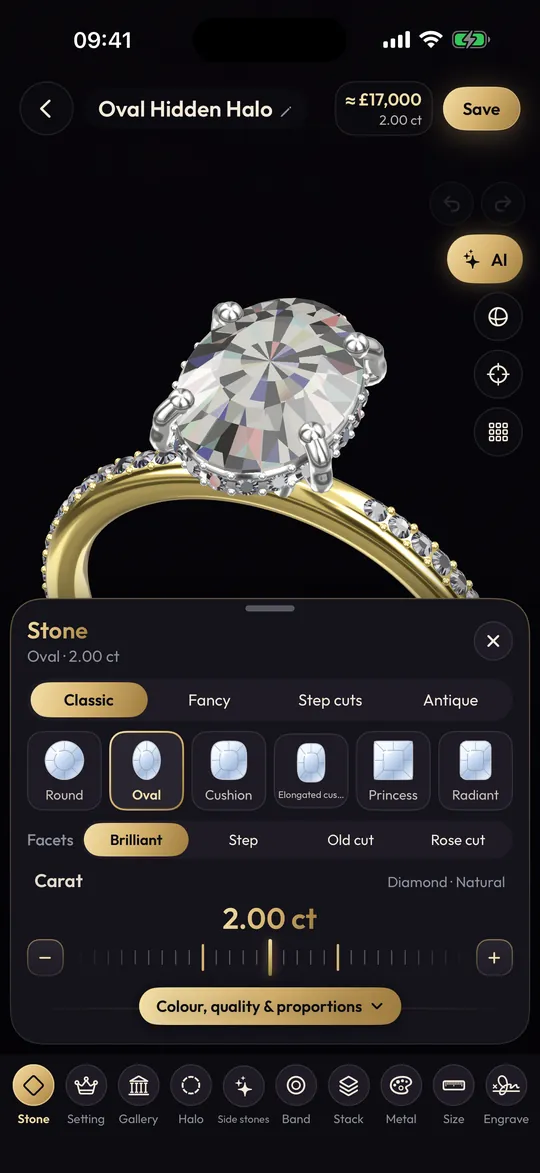
Save both versions and share the ring codes with your partner or jeweller. Start in the engagement ring designer.
Verdict
Choose the oval for size and value: it looks bigger, costs less per carat and flatters the hand, provided you pick one with a mild bow-tie. Choose the round if sparkle and symmetry come first and the budget allows. If you are torn, put them side by side on your own hand; most people know within seconds.
Frequently asked questions
Does an oval diamond look bigger than a round?
Yes. At the same carat weight an oval has a slightly larger face-up area and noticeably more length: about 7.7 x 5.7 mm for 1 ct against 6.5 mm for a round. Its length also makes the finger look slimmer.
Is an oval diamond cheaper than a round diamond?
Usually. Round brilliants carry a premium because cutting them wastes more rough and demand is highest, so an oval of the same weight and grades typically costs noticeably less.
Do oval diamonds sparkle as much as round?
A well-cut oval sparkles beautifully, but a well-cut round brilliant returns the most light of any shape. The round's sparkle is also more even, with no bow-tie.
What is the bow-tie effect in oval diamonds?
It is a dark, bow-tie-shaped area across the middle of some ovals, caused by facets that leak light. Nearly every oval has some; look for one where it is faint and shifts as the stone moves.
What is the best length-to-width ratio for an oval?
Most people like 1.30 to 1.50. Around 1.35 to 1.40 gives the classic oval; above 1.50 looks long and slender.
Keep reading
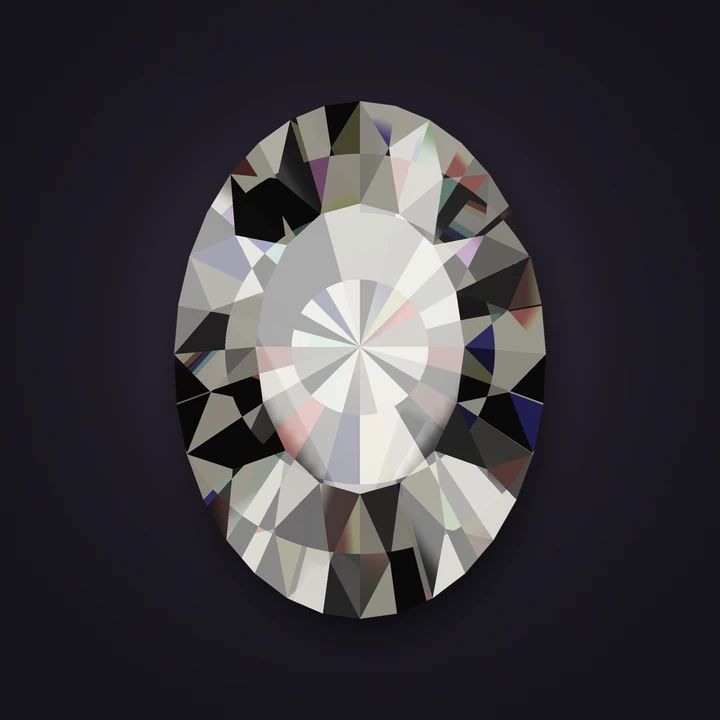 Stone shapesOval Engagement Rings: How to Choose a Beautiful OneOval engagement ring guide: the best length-to-width ratio, judging the bow-tie, carat-to-mm sizes, flattering settings …
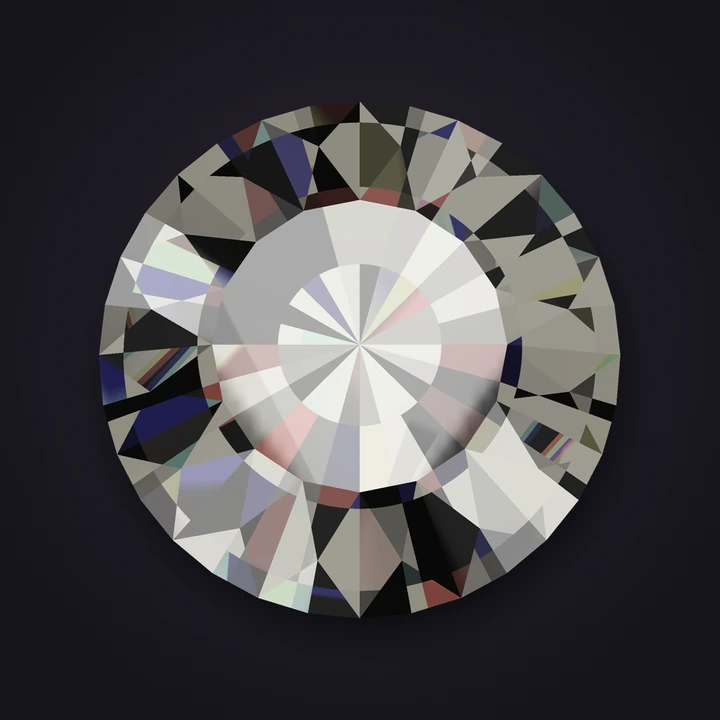 Stone shapesRound Engagement Rings: The Complete Buyer's GuideRound engagement ring guide: carat-to-mm sizes, cut grades that matter, best prong settings, band pairings and prices, p…GemstonesDiamond Carat Size Chart (mm)Diamond carat size chart in mm: approximate sizes for round diamonds from 0.25 to 5 carats, plus oval, cushion, princess…ComparisonsOval vs Pear DiamondOval vs pear diamond: both look large per carat, but the pear has a fragile point and a bolder look, while the oval is s…ComparisonsOval vs Elongated CushionOval vs elongated cushion: both are long and flattering, but the oval looks bigger per carat while the cushion has softe…GemstonesDiamond Cut GradesDiamond cut grades explained: what GIA Excellent to Poor means, ideal proportions for round diamonds, how fancy shapes a…