 Ring Studio
Around the world
Engagement Rings in India: Sizes, Prices & Traditions
Engagement rings in India are exchanged by both partners at a ring ceremony, sized on the Indian number scale, and, if gold, must carry a BIS hallmark with a six-digit HUID. Diamond rings are usually 18k, while traditional bridal jewellery stays in 22k.
On this page
- The ring ceremony: two rings, not one
- Which hand? Left, right and family preference
- Indian ring sizes and conversions
- BIS hallmarking and HUID: how to check your ring
- 22k, 18k, 14k or platinum?
- Natural and lab-grown diamonds
- Rough price ranges in rupees
- Where couples buy
- Designing a couple's set in Ring Studio
- Before you pay
- Ring size scale
- Indian numbers, roughly circumference in mm minus 40
- Ceremony
- Ring exchange (sagai / mangni) by both partners
- Hand
- Mostly left today; right preferred by some families
- Gold rules
- BIS hallmark with six-digit HUID on gold jewellery
- Gold for diamond rings
- 18k or 14k; 22k reserved for plain bridal pieces
- GST
- 3% on jewellery value (making charges taxed separately)
The ring ceremony: two rings, not one
In much of India the engagement is a family event rather than a private proposal. Known as sagai, mangni, nischayathartham, ashirbad or by other names depending on region and community, it typically brings both families together, often on an auspicious date chosen with a priest or astrologer. The couple exchange rings, so both partners receive one. Western-style surprise proposals have become popular in cities too, and many couples now do both: a private proposal, then the formal ring exchange.
A few points that differ from Western practice:
- The rings may be a pair. Matching couple bands, often platinum or 18k, are common, with the bride's set with a diamond or solitaire and the groom's plainer.
- The engagement ring is not the main symbol of marriage. For many Hindu women that role belongs to the mangalsutra (or thaali in much of the south), sindoor, toe rings (bichiya, or metti in Tamil Nadu) and bangles, which vary by region.
- Gold carries family meaning. Bridal jewellery in 22k is often bought over years, gifted by relatives and passed down. Days like Akshaya Tritiya and Dhanteras are considered auspicious for buying it.
- Communities differ. Sikh, Muslim, Christian, Parsi and Jain weddings each have their own customs. In Muslim families, many men avoid gold rings for religious reasons and choose platinum, silver or other white metals. Christian weddings in India often follow the Western ring exchange closely.
Which hand? Left, right and family preference
Most urban couples now wear engagement rings on the fourth finger of the left hand, following international custom. That said, the right hand is traditionally associated with auspicious acts in Hindu practice, and some families prefer rings exchanged and worn on the right. Neither is wrong. If you are planning a surprise, ask a sibling or friend what the family expects. Our page on which hand the engagement ring goes on covers customs in other countries too.
Indian ring sizes and conversions
Indian jewellers use a numbered scale that roughly equals the inside circumference in millimetres minus 40. It runs close to the Japanese and Swiss scales, but charts differ by up to a size between brands, so treat the table as approximate and confirm with the jeweller's own sizer.
| Indian size (approx.) | Circumference (mm) | US | UK |
|---|---|---|---|
| 9 | 49.3 | 5 | J½ |
| 12 | 51.9 | 6 | L½ |
| 13 | 53.1 | 6½ | M½ |
| 14 to 15 | 54.4 | 7 | N½ |
| 17 | 57.0 | 8 | P½ |
| 19 to 20 | 59.5 | 9 | R½ |
| 22 | 62.1 | 10 | T½ |
| 24 to 25 | 64.6 | 11 | V½ |
Fingers swell in humid summer and monsoon weather, so avoid measuring right after a hot afternoon outdoors. Use the ring size converter when a family member abroad is buying, and the complete ring size chart for other systems.
BIS hallmarking and HUID: how to check your ring
Hallmarking of gold jewellery became mandatory in phases from June 2021, under the Bureau of Indian Standards (BIS), and the six-digit alphanumeric HUID (Hallmark Unique Identification) became compulsory from April 2023. A correctly hallmarked gold ring carries three marks:
- the BIS standard mark (the triangular BIS logo);
- the purity grade, written as karat and fineness, for example 22K916, 18K750 or 14K585;
- the HUID, a six-character code unique to that piece.
You can type the HUID into the government's BIS CARE app to see details recorded at hallmarking, such as purity and the jeweller's registration. Ask for a bill that lists the gross weight, net gold weight, purity, stone details, making charges and GST separately. Rules evolve, so check BIS's official guidance for the latest. Our general hallmarks guide explains hallmarks in other countries.
22k, 18k, 14k or platinum?
| Metal | Gold content | Typical use in India | Notes |
|---|---|---|---|
| 22k (916) | 91.6% | Bridal sets, bangles, plain bands | Rich colour; too soft for prong-set diamonds |
| 18k (750) | 75% | Diamond engagement rings | The standard for stone-set rings |
| 14k (585) | 58.5% | Lighter, everyday diamond jewellery | Harder and cheaper; slightly paler |
| Platinum (950) | About 95% platinum | Couple bands, solitaires | Naturally white; popular with men |
Resale works differently by metal. Many Indian buyers think of 22k as savings as well as adornment, while diamonds and platinum usually resell well below retail. Our 14k vs 18k comparison and platinum guide go into wear and colour.
Natural and lab-grown diamonds
India sits at the centre of the diamond trade: Surat, in Gujarat, cuts and polishes a large share of the world's diamonds, and India is also a major producer of lab-grown diamonds. That makes lab-grown stones easy to find here. They are chemically real diamonds and far cheaper than natural ones of the same size, and prices have fallen sharply over recent years. Ask for a grading report and confirm in writing whether a stone is natural or lab-grown; reputable sellers disclose it. See lab-grown diamonds and lab diamond prices.
Rough price ranges in rupees
Gold is priced daily per 10 grams, and making charges and stone quality vary widely, so these are only rough estimates as of late 2026, inclusive of GST.
| Ring | Rough range (INR) |
|---|---|
| 18k ring with small natural diamonds | ₹30,000 to ₹1,00,000 |
| Lab-grown solitaire, about 1 ct, 18k or 14k | ₹50,000 to ₹2,00,000 |
| Natural solitaire, about 0.5 ct | ₹1,50,000 to ₹4,00,000 |
| Natural solitaire, about 1 ct | ₹4,00,000 to ₹15,00,000+ |
| Platinum or gold couple bands (pair) | ₹40,000 to ₹2,00,000 |
Compare jewellers on the same basis: net gold weight, purity, making charge per gram or as a percentage, stone grade and certificate.
Where couples buy
- Large national chains: standardised pricing, buy-back or exchange policies, and hallmarking in place.
- Family jewellers: many households have a trusted local jeweller who makes custom pieces and handles old-gold exchange.
- Online brands: popular for lab-grown and lightweight diamond rings, often with home try-on and exchange programmes.
- Jewellery markets: areas such as Mumbai's Zaveri Bazaar and Delhi's Karol Bagh and Chandni Chowk are dense with jewellers; insist on HUID and an itemised bill.
The Consumer Protection Act 2019 gives remedies for defective goods and misleading claims, and you can file complaints through the National Consumer Helpline. This is general information, not legal advice.
Designing a couple's set in Ring Studio
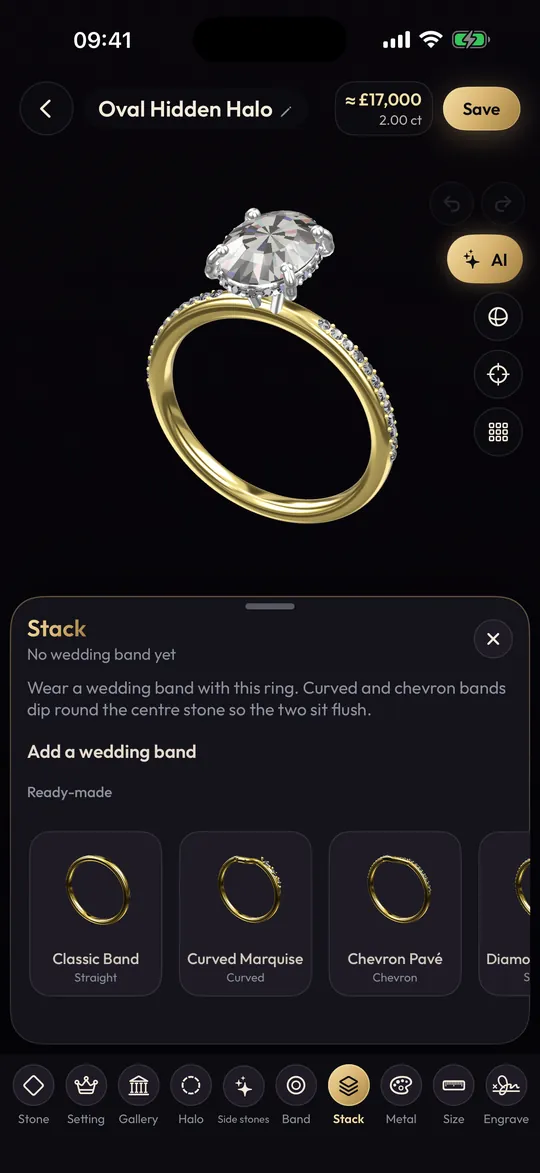
Ring Studio is a free 3D ring designer for iPhone and Android; the app is in English. It is handy for planning a ring ceremony pair before you visit a jeweller.
- Design the bride's ring first: choose a shape (round, oval and princess are popular here), carat and setting, with a halo or plain shoulders.
- Design the groom's band separately, plain or with a knife edge or twist, in platinum or yellow gold. The app shows metal colours but not karat, so specify 18k, 22k or platinum with the jeweller.
- Engrave names or the ceremony date inside the band, and add hidden initials under the stone with Pro.
- Use the live price estimate to compare a natural and lab-grown stone. It is an estimate, not an Indian retail quote.
- Share the ring code with family or your jeweller, who recreates it in their own CAD.
Before you pay
- Check the BIS logo, purity grade and HUID, and verify the HUID in the app.
- Get a diamond grading report and confirm natural or lab-grown in writing.
- Ask about exchange and buy-back terms for both the gold and stones.
- Confirm the size on the jeweller's own scale, and whether resizing is free later.
Frequently asked questions
Which hand is the engagement ring worn on in India?
Most couples today wear it on the ring finger of the left hand, following the international custom. Some families prefer the right hand, which is traditionally considered auspicious in Hindu practice, so it is worth asking.
How do I check a BIS hallmark on a gold ring?
Look for the BIS logo, the purity grade such as 22K916 or 18K750, and a six-character HUID code. You can enter the HUID in the government's BIS CARE app to check the article's details.
Why are diamond engagement rings made in 18k rather than 22k gold?
22k gold is about 91.6% gold and too soft to hold a diamond securely in prongs. 18k (75% gold) and 14k (58.5%) are harder, so jewellers use them for stone-set rings.
What is the average ring size in India?
On the Indian scale many women wear roughly size 10 to 14 and many men roughly 18 to 24. Charts differ slightly between jewellers, so confirm with the store's own sizer.
How much does a diamond engagement ring cost in India?
As a rough estimate, a small natural diamond ring can start around 30,000 rupees, while a 1 carat natural solitaire often runs into several lakh. Lab-grown diamonds cost far less for the same size.