 Ring Studio
Prices
Lab-Grown Diamond Prices
Lab-grown diamond prices have fallen steeply in recent years: as rough late-2026 retail estimates, a good 1 carat lab-grown diamond often costs around £300 to £1,300 ($400 to $1,600) loose, a small fraction of a comparable natural stone. Where you buy now affects the price as much as the grades do.
On this page
- Lab-grown diamond prices by carat
- Why lab-grown diamond prices have fallen so far
- Why the same lab-grown diamond can cost very different amounts
- Lab-grown vs natural vs moissanite: price compared
- What a finished lab-grown ring costs
- Compare lab-grown and natural in your design
- Buying tips for lab-grown diamonds
- Lab-grown diamond prices by shape
- Price trend
- Fallen steeply in recent years; far below natural
- 1 ct loose (good quality)
- Roughly £300-£1,300 / $400-$1,600
- 2 ct loose (good quality)
- Roughly £700-£2,500 / $900-$3,000
- Resale value
- Very limited
- Figures
- Rough retail estimates, late 2026
Lab-grown diamond prices by carat
These ranges are for well-cut round lab-grown diamonds in near-colourless to colourless grades (roughly D-H) with VS or better clarity and a grading report. They are rough retail estimates, late 2026. The low end typically reflects online specialists; the high end reflects high street and brand jewellers.
| Carat (round) | Loose stone (GBP) | Loose stone (USD) | Approx. price per carat |
|---|---|---|---|
| 0.5 ct | £150-£550 | $200-$700 | £300-£1,100 / ct |
| 1 ct | £300-£1,300 | $400-$1,600 | £300-£1,300 / ct |
| 1.5 ct | £500-£1,800 | $600-$2,200 | £330-£1,200 / ct |
| 2 ct | £700-£2,500 | $900-$3,000 | £350-£1,250 / ct |
| 3 ct | £1,200-£4,000 | $1,500-$5,000 | £400-£1,350 / ct |
| 4-5 ct | £2,000-£7,500 | $2,500-$9,500 | Wide range |
Notice how flat the price per carat is compared with natural diamonds, where it rises sharply with size. Large lab-grown stones are no longer rare, so there is little of the size premium that natural diamonds carry. Compare with the natural figures on the diamond price per carat page.
Why lab-grown diamond prices have fallen so far
Lab-grown diamonds are made by two main methods, high pressure high temperature (HPHT) and chemical vapour deposition (CVD). Both have become faster and more efficient, and many more producers have entered the market. Supply has outpaced demand, wholesale prices have dropped, and retail prices have followed. The decline has been steep enough that retail prices from just a few years ago now look very dated.
This matters for two reasons. Old price guides and second-hand listings can be badly out of date, and a lab-grown diamond bought today may cost less to replace in future. Buy one because it gives you the look you want at a price you like, not because you expect it to hold its value. More on the stones themselves in our lab-grown diamonds guide.
Why the same lab-grown diamond can cost very different amounts
Retailer type is now one of the biggest variables in lab-grown pricing:
- Online specialists list large inventories with grading reports, often at the lowest prices.
- Independent jewellers source stones on request; prices vary and often include setting and service.
- High street and brand jewellers may price lab-grown stones well above online sellers, partly for showroom service and brand.
Grades still matter, but less than with natural stones: top colour and clarity are common in lab production, so the premium for D colour or VVS clarity is small. Cut quality still decides brightness, and a few lab-grown stones show post-growth treatment or slight tints that are worth asking about. Make sure the stone has a report that clearly states it is laboratory-grown; diamond certificates explains what to look for.
Lab-grown vs natural vs moissanite: price compared
| Stone (about 1 ct look, round) | Rough price (GBP) | Rough price (USD) | Mohs hardness |
|---|---|---|---|
| Natural diamond, G-H VS | £4,500-£8,000 | $5,500-$10,000 | 10 |
| Lab-grown diamond, F-H VS | £400-£1,000 | $500-$1,200 | 10 |
| Moissanite, about 6.5 mm | £100-£600 | $150-$700 | 9.25 |
Loose stone prices, rough retail estimates, late 2026. See lab-grown vs natural and moissanite vs lab-grown for how they differ in look and wear.
What a finished lab-grown ring costs
Because lab-grown stones are now so affordable, the setting is often the largest part of a ring's price. A simple 14k or 18k gold solitaire setting typically adds £500-£1,500 ($600-$1,800); platinum, pavé or a halo add more. A complete lab-grown 1 carat solitaire is roughly £900-£2,500 ($1,100-$3,000) as of late 2026. If you are deciding where to spend, upgrading the setting or the metal now often changes the look more than a higher stone grade. The 1 carat ring price page shows the natural equivalent.
Compare lab-grown and natural in your design
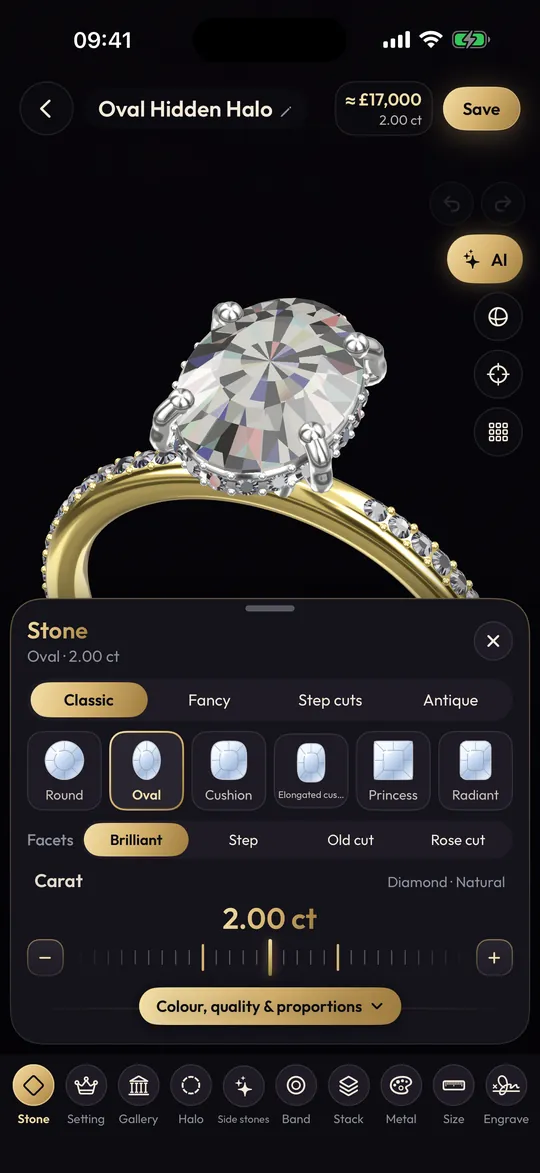
Ring Studio lets you choose natural or lab-grown diamond for the centre stone and see the live price estimate change instantly, along with carat and metal. It is an estimate for comparing designs, not a quote, but it makes the size of the gap obvious. Try a 1 carat natural against a 2 carat lab-grown in the same setting, then rotate both in 3D to see the size difference. Share your favourite with a jeweller using a ring code. See the ring price estimator for more.
Buying tips for lab-grown diamonds
- Compare several sellers for the same carat, colour, clarity and cut; price gaps can be large.
- Do not overpay for D colour or flawless clarity; the visual difference from G and VS is negligible.
- Prioritise excellent cut for brightness.
- Consider spending the savings on a better setting, platinum, or a matching band.
- Use the ring budget calculator to keep the total in check.
Lab-grown diamond prices by shape
In the natural market, rounds carry a clear premium over fancy shapes. In lab-grown, the gap is often smaller, because cutting losses matter less when the rough is cheaper. Ovals, emeralds, radiants and pears of the same weight are frequently priced close to rounds, and sometimes the more fashionable shapes cost a little more where demand is high. Elongated shapes still look larger from above for the same weight. The oval vs round and emerald vs radiant comparisons cover the look of each.
Verdict
As of late 2026, lab-grown diamonds give the look of a large diamond at a small fraction of the natural price, with flat pricing across sizes and grades. Shop around, prioritise cut, and treat the stone as something to enjoy rather than an asset.
Frequently asked questions
How much is a 1 carat lab-grown diamond?
As a rough late-2026 retail estimate, about £300 to £1,300 ($400 to $1,600) for a well-cut loose round stone with a grading report. Some high street jewellers charge more for similar stones.
Why are lab-grown diamonds so cheap now?
Production capacity has grown quickly and growing techniques have improved, so supply has risen far faster than demand. Prices have fallen steeply as a result, and they are now far below natural diamonds of the same grade.
Will lab-grown diamond prices keep falling?
Nobody can say for certain. Many observers expect continued pressure on prices, so it is wise to buy a lab-grown diamond because you like it, not as a store of value.
Do lab-grown diamonds have resale value?
Very little in most markets. Treat a lab-grown diamond as a purchase for wearing, not an investment. Natural diamonds also resell well below retail, but usually for more than lab-grown.
Are lab-grown diamonds real diamonds?
Yes. They are carbon crystallised in the diamond structure, with the same hardness of 10 on the Mohs scale and the same optical properties. Grading reports identify them as laboratory-grown.