 Ring Studio
1.5 Carat Diamond Ring Price
A 1.5 carat diamond ring price runs from roughly £1,100 to £3,000 ($1,300 to $3,700) with a lab-grown stone to around £6,000 to £30,000+ ($7,500 to $38,000+) with a natural diamond, as rough late-2026 estimates. At this size, cut and clarity start to show, so the grades you choose matter more.
On this page
- Size (round)
- About 7.3-7.4 mm across
- Lab-grown 1.5 ct ring
- Roughly £1,100-£3,000 / $1,300-$3,700
- Natural 1.5 ct ring
- Roughly £6,000-£30,000+ / $7,500-$38,000+
- Grades to watch
- Cut and clarity become more visible
- Figures
- Rough retail estimates, late 2026
1.5 carat diamond prices by tier
These are loose stone prices for a well-cut round diamond around 1.50 ct. Add a setting for a finished ring. All numbers are rough retail estimates, late 2026, and vary with retailer, grading lab and market conditions.
| Tier | Grades | Natural (GBP) | Natural (USD) | Lab-grown (GBP / USD) |
|---|---|---|---|---|
| Commercial | I-J, SI1-SI2 | £5,000-£8,500 | $6,000-$11,000 | £500-£1,100 / $600-$1,400 |
| Mid | G-H, VS1-VS2 | £8,500-£15,000 | $11,000-$19,000 | £600-£1,400 / $750-$1,800 |
| Fine | D-F, VVS-VS1 | £15,000-£30,000 | $19,000-$38,000 | £800-£1,800 / $1,000-$2,200 |
The natural column climbs much faster than the lab-grown one. Lab-grown prices have fallen steeply in recent years, and colour and clarity carry far less premium in lab production. For natural stones, larger sizes are rarer, so the price per carat rises with every step up in weight.
What 1.5 carats looks like by shape
| Shape | Typical size at 1.5 ct |
|---|---|
| Round | About 7.3-7.4 mm |
| Oval | About 9 x 6.5 mm |
| Elongated cushion | About 8 x 6 mm |
| Radiant | About 7.5 x 6 mm |
| Emerald | About 8 x 6 mm |
| Pear | About 10 x 6.5 mm |
Measurements are typical and depend on the stone's proportions. Use the carat size visualiser to compare sizes on screen, and see oval vs round if you are deciding between the two most popular shapes.
Why grades matter more at 1.5 carats
A bigger table facet is a bigger window. Inclusions that hide in a half carat can be visible in a 1.5 carat stone, and a slight tint becomes easier to notice in a large stone, especially in white metal. That changes the buying strategy:
- Clarity: aim for eye-clean, and ask to see the stone or a high-resolution video. VS2 is a safer default than SI2. See the clarity chart.
- Step cuts: emerald and asscher cuts show everything; budget for higher clarity.
- Colour: G-H usually looks white in platinum or white gold; I-J can look lovely in yellow gold.
- Cut: still the top priority for brightness. A deep or shallow stone can look smaller than its weight.
The setting for a 1.5 carat stone
A larger stone sits higher and catches more knocks, so the setting deserves a little more budget. Six prongs give extra security over four, and a bezel protects the girdle fully; 4 prong vs 6 prong explains the trade-off. A setting in 18k gold or platinum adds roughly £600-£2,000 ($700-$2,500) for a solitaire, more for pavé or a halo. Metal cost is the ring's weight times the current price per gram of the alloy, so a sturdier mount in platinum, which is denser than gold, costs more.
Saving money on a 1.5 carat diamond
- Look at 1.40-1.49 ct stones: just below the 1.5 ct band, often cheaper for an invisible difference.
- Choose an oval, pear or elongated cushion for more spread per carat.
- Compare natural and lab-grown honestly: for many budgets, lab-grown makes this size easy.
- Check the same grades across several retailers, including independent jewellers.
The diamond price per carat page explains why weight bands affect price so much.
Design a 1.5 carat ring before you buy
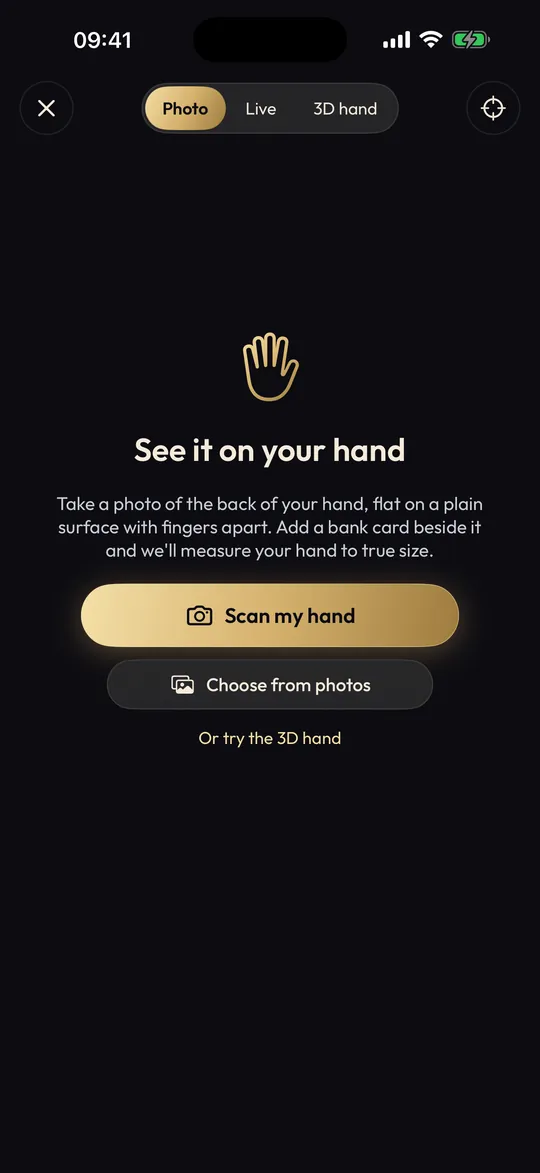
Ring Studio lets you set the centre stone to exactly 1.5 carats, choose from round, oval, radiant and many more shapes, and test 4, 6 or 8 prongs, a bezel or a halo in real-time 3D. Switch natural and lab-grown diamond, and the live price estimate updates as you go. It is for comparing designs, not a quote. With Pro, try the ring on your hand with the camera to see whether 1.5 carats feels right or whether 1.2 would do. When you are happy, share the ring code with your jeweller. More on the ring price estimator.
1.5 carats vs 1 or 2 carats
On most hands, 1.5 carats looks clearly bigger than 1 carat without the bulk of a 2 carat. If the natural price feels steep, compare a high-quality 1 carat natural stone; if you want more presence, check 2 carat prices. A budget calculator helps you set a firm limit first.
Natural or lab-grown at 1.5 carats?
This is a size where the choice reshapes the whole budget. A natural 1.5 carat stone in sensible grades is a five-figure purchase in many cases, while a lab-grown one of similar quality costs about the same as a good setting. If natural origin matters to you, consider a slightly smaller natural stone in a design that maximises presence. If size and look matter most, lab-grown makes 1.5 carats very accessible. See lab-grown vs natural for the trade-offs, including resale value.
Verdict
As of late 2026, 1.5 carats is affordable in lab-grown and a significant purchase in natural. Spend on cut and eye-clean clarity, protect the stone with a sturdy setting, and look just below 1.5 ct for the best value.
Frequently asked questions
How much is a 1.5 carat diamond ring?
As rough late-2026 estimates, about £1,100 to £3,000 ($1,300 to $3,700) with a lab-grown centre stone and about £6,000 to £30,000 or more ($7,500 to $38,000+) with a natural one, including a simple setting.
How big is a 1.5 carat diamond?
A well-cut 1.5 carat round is about 7.3 to 7.4 mm across, roughly 1 mm wider than a 1 carat. An oval of the same weight is typically around 9 x 6.5 mm.
Is 1.5 carats much more expensive than 1 carat?
For natural diamonds, usually yes: price per carat rises with size, so a 1.5 carat stone typically costs well over one and a half times a 1 carat of the same grade. For lab-grown stones the jump is much smaller.
What clarity is best for a 1.5 carat diamond?
Inclusions are easier to see as stones get larger. VS2 or a carefully chosen eye-clean SI1 suits most round stones; emerald and asscher cuts usually need VS1 or better.
Is 1.5 carats a good engagement ring size?
It is a noticeable but wearable size on most hands. Many people find it gives clear presence without the price or snagging risk of a 2 carat or larger stone.