 Ring Studio
Prices
How Much Do Wedding Rings Cost?
Wedding rings cost much less than most engagement rings: as a rough late-2026 guide, a plain gold band is often £200 to £1,200 ($250 to $1,500), platinum a little more, and diamond eternity bands from several hundred to several thousand. The metal, the width and any diamonds decide where a band lands.
On this page
- Why a wedding band is priced differently from an engagement ring
- How much do wedding rings cost by metal?
- Diamond wedding band prices
- Men's wedding ring costs
- Shaped and fitted bands
- Design and price your wedding bands together
- Ways to keep wedding ring costs down
- Matching sets vs buying separately
- Ongoing costs to expect
- Plain gold band
- Roughly £150-£1,200 / $200-$1,500
- Plain platinum band
- Roughly £500-£2,000 / $600-$2,500
- Half-eternity, lab-grown
- Roughly £500-£1,800 / $600-$2,200
- Half-eternity, natural
- Roughly £1,000-£4,000 / $1,200-$5,000
- Main driver
- Metal weight and current gold or platinum price, then diamonds and labour
Why a wedding band is priced differently from an engagement ring
A plain wedding band is mostly metal. There is no centre stone, so its price tracks how many grams of gold or platinum it contains, the alloy, the finish and the jeweller's labour and margin. Once diamonds are added, the band starts behaving more like an engagement ring: stone count, size and quality take over.
That makes wedding rings one of the few jewellery purchases where you can estimate the cost of materials yourself. Multiply the weight of the band by the price per gram of the alloy (which depends on the day's gold or platinum price and the karat), then add making costs, hallmarking where required, and the retailer's margin.
How much do wedding rings cost by metal?
Rough retail estimates, late 2026, for plain court or D-shape bands in a typical width. Precious metal prices move constantly, so treat these as a starting point.
| Metal | Slim band, 2-3 mm | Medium band, 4-5 mm | Wide band, 6-8 mm |
|---|---|---|---|
| 9k / 10k gold | £150-£400 / $200-$500 | £300-£700 / $350-$850 | £500-£1,100 / $600-$1,400 |
| 14k gold | £250-£600 / $300-$750 | £450-£1,000 / $550-$1,300 | £800-£1,700 / $1,000-$2,100 |
| 18k gold | £400-£900 / $500-$1,100 | £700-£1,500 / $850-$1,900 | £1,100-£2,500 / $1,400-$3,100 |
| Platinum (950) | £500-£1,100 / $600-$1,400 | £800-£1,800 / $1,000-$2,300 | £1,300-£3,000 / $1,600-$3,800 |
| Palladium, titanium, tungsten | Often lower; see alternative metals and palladium | ||
The gap between 9k and 18k gold comes from gold content: 9k is 37.5% gold and 18k is 75%. Platinum jewellery is about 95% pure and denser than gold, so an identical band weighs noticeably more. The gold karats guide covers how each alloy wears.
Diamond wedding band prices
Once stones come in, the cost depends on how many diamonds there are, their size and quality, natural or lab-grown, and the labour to set them. Lab-grown diamond prices have fallen steeply in recent years, so lab-set bands can be much cheaper than their natural equivalents.
| Band type | Lab-grown diamonds | Natural diamonds |
|---|---|---|
| Thin pavé band (stones across the top) | £400-£1,200 / $500-$1,500 | £700-£2,500 / $900-$3,000 |
| Half eternity, around 0.3-0.5 ct total | £500-£1,800 / $600-$2,200 | £1,000-£4,000 / $1,200-$5,000 |
| Full eternity, around 1 ct total | £900-£2,800 / $1,100-$3,500 | £2,000-£7,000 / $2,500-$9,000 |
| Full eternity, 2 ct+ total | £1,500-£4,500 / $1,800-$5,500 | £4,500-£15,000+ / $5,500-$19,000+ |
Full eternity bands also have a hidden cost: they are difficult or impossible to resize, because stones run all the way round. Get the size right first with the ring size chart, and see ring resizing costs for what to expect later.
Men's wedding ring costs
Men's bands are usually wider (often 5-8 mm) and thicker, so they can contain several times the metal of a slim women's band. That is why a plain 18k men's band can cost more than a delicate diamond-set women's band. Profile matters too: a heavy comfort-fit or flat court band uses more metal than a light D-shape of the same width. Our men's wedding band styles page covers the options, and the ring width guide helps pick a width.
Shaped and fitted bands
If the engagement ring has a low setting, a large halo or an east-west stone, a straight band may not sit flush against it. A curved, notched or chevron band shaped to fit usually costs more than a straight one because it is often made to order. Expect a premium of a few hundred pounds or dollars over a standard band in the same metal, more for diamond-set versions. See curved and contour wedding bands.
Design and price your wedding bands together
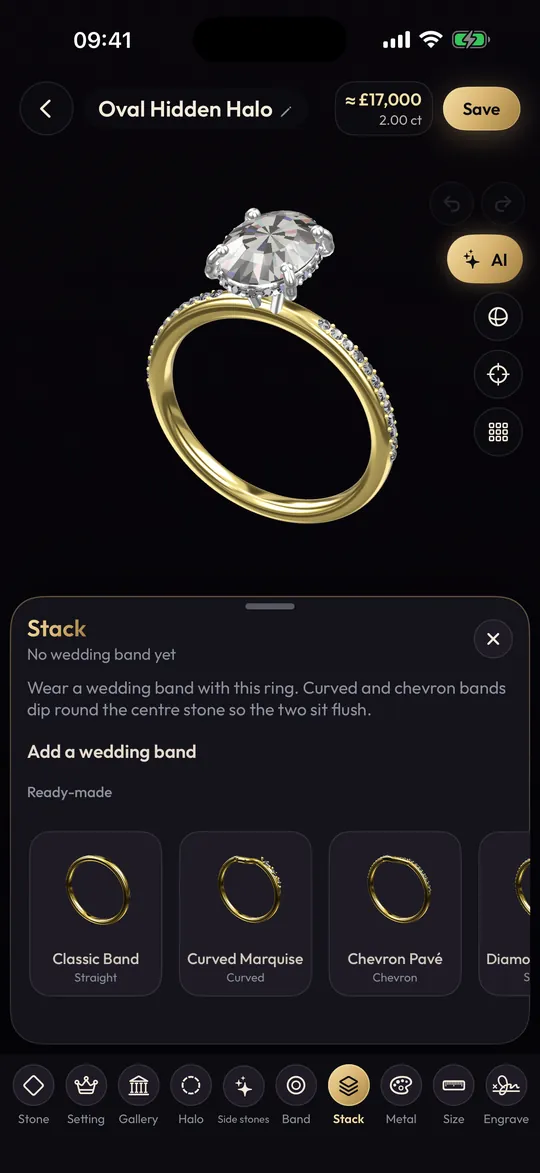
In Ring Studio you can design a wedding band on its own, or stack it with the engagement ring above or below and choose a straight, curved or chevron contour so it sits flush. Change the band style (plain, pavé, eternity, twisted, knife edge), the width and the metal, and the live price estimate updates as you go. It is an estimate to compare options, not a quote, but it shows quickly how much a wider band or a switch to platinum might add; see the ring price estimator, and plan both rings together with the ring budget calculator. Stacks are part of Ring Studio Pro; more on that at the wedding band stack designer.
Ways to keep wedding ring costs down
- Choose a slightly slimmer or lighter profile: less metal is the quickest saving on a plain band.
- Consider 9k or 14k gold, which are harder wearing and cheaper than 18k.
- Pick a half eternity instead of full: fewer stones, and it can be resized.
- Choose lab-grown diamonds for pavé and eternity bands.
- Buy both bands from the same jeweller; some will offer a better price on a pair.
Matching sets vs buying separately
Some jewellers sell the engagement ring and wedding band as a bridal set, designed to fit together. A set can be convenient and sometimes priced slightly below buying the two separately, but it limits your choice of band. Buying separately gives more freedom, and a jeweller can make a fitted band later. If the engagement ring has a halo or a low setting, check now whether a straight band will sit flush; if it will not, budget for a shaped band. See bridal sets and matching stacks and engagement ring vs wedding ring for how the two rings work together.
Ongoing costs to expect
Plain bands are low maintenance, but white gold needs occasional rhodium replating, and any band may need resizing over the decades. Pavé and eternity bands should have their stones checked periodically. These costs are modest compared with the ring, but worth knowing about when choosing between metals.
Verdict
A plain wedding band is mainly a metal purchase, so width, weight and karat decide its price, along with the current gold or platinum price. Diamond bands follow stone count and quality, with lab-grown versions far cheaper. Budget for both rings together and design them as a pair.
Frequently asked questions
How much does a plain gold wedding band cost?
Roughly £150 to £400 ($200 to $500) for a slim 9k or 10k band and £400 to £1,200 ($500 to $1,500) for 18k, as rough late-2026 estimates. Wider and heavier bands cost more because they contain more gold.
Why do men's wedding rings often cost more?
Men's bands are usually wider and heavier, and the metal content is the main cost of a plain band. A 6 mm band can easily contain two or three times the gold of a 2 mm band.
Is platinum worth it for a wedding band?
Platinum is dense, naturally white and very durable, and it suits a platinum engagement ring. It usually costs more than 18k gold for the same design because the ring weighs more, though this depends on current metal prices.
Should the wedding band match the engagement ring metal?
It is usually wise. Different metals can wear against each other over time, and matching colours look cohesive. Mixed metal stacks are a style choice that some people love.
Do both wedding rings have to cost the same?
No. Most couples simply choose the bands they like. Width, metal and diamonds make prices differ naturally between partners' rings.