 Ring Studio
Curved and Contour Wedding Bands
Curved and contour wedding bands are shaped to follow the outline of an engagement ring, so the two sit together without a gap even when the stone or halo overhangs the band. If your engagement ring has a low head, a halo or side stones, a contour band is often the neatest solution.
On this page
- Purpose
- Lets a wedding band sit flush against an engagement ring that overhangs the shank
- Shapes
- Gentle curve, chevron (V), notched, fully custom
- Needed for
- Low settings, classic halos, side stones, wide bezels
- Not needed for
- Higher heads with a clear gap under the stone
- Width
- Usually matched to the engagement ring's band
- In Ring Studio
- Straight, curved or chevron contour, stacked above or below (Pro)
Why straight wedding bands do not always fit
A wedding band slides along the finger until it meets the engagement ring. If the engagement ring's head sits well above the band, the wedding band can slip a little way underneath it and the two shanks touch along their length. That is the flush fit most people imagine.
When something on the engagement ring hangs lower or wider than its shank, the straight band hits that point first and stops, leaving a sliver of finger showing between the rings. The usual culprits:
- Low settings: the stone's girdle sits close to the finger.
- Classic halos: the halo is wider than the band and often sits low. See halo engagement rings.
- Side stones and baguettes: they widen the head on both sides.
- Bezels and cathedral shoulders: solid metal that reaches down to the band line.
- Large stones: a 2 carat oval is simply wide enough to overhang most bands.
Types of contour band
| Type | Shape | Best with | Worn alone |
|---|---|---|---|
| Gentle curve | Smooth, shallow arc | Round, oval, cushion, hidden halos | Looks graceful |
| Deep curve | Pronounced arc | Classic halos, large stones | Obviously shaped |
| Chevron (V) | Pointed dip | Pear, marquise, tall or pointed heads | A statement shape |
| Notched | Straight with a small cut-out | Rings with one low point, such as a single prong | Can look like a gap |
| Custom contour | Traces one specific ring | Unusual or very low designs | Looks incomplete |
Chevron bands are covered in depth in our chevron wedding bands guide.
How deep should the curve be?
Just deep enough to clear whatever is overhanging, and no deeper. A curve that is too shallow still leaves a gap; one that is too deep leaves a gap of a different shape and looks forced. The depth depends on how far the stone or halo extends past the shank, which depends on stone size, setting height and band width. This is where seeing both rings together matters: a few tenths of a millimetre change the fit.
A good test: look at the stack from the side and from above. From the side, the bands should touch along most of their length. From above, the curve should follow the halo or stone with an even sliver of metal, not a wedge.
Widths and proportions
Contour bands look best when they match the width of the engagement ring's band, or are a fraction narrower. A wide contour band beside a fine engagement ring feels heavy, and a very narrow one can flex out of shape over time. If the engagement ring's band tapers towards the head, the wedding band can taper to match. For general width advice, see the ring width guide.
Plain, pavé or eternity curved bands
Contour does not limit the style. Curved bands come plain, pavé-set, as half eternity bands, with a knife edge or twisted texture. A pavé curve beside a halo creates a continuous field of sparkle; a plain curve beside a pavé engagement ring gives the eye somewhere to rest. One practical note: a fully stone-set curved band is harder to resize, so confirm your size first.
Should the band go above or below the engagement ring?
Tradition puts the wedding band below, closest to the heart, with the engagement ring above. Many people wear it the other way round, or sandwich the engagement ring between two bands. The contour has to face the right way for each arrangement: a band worn below curves upwards towards the stone, a band worn above curves downwards. Decide before you order. Our ring stacking ideas page shows more combinations.
Designing a curved wedding band in Ring Studio
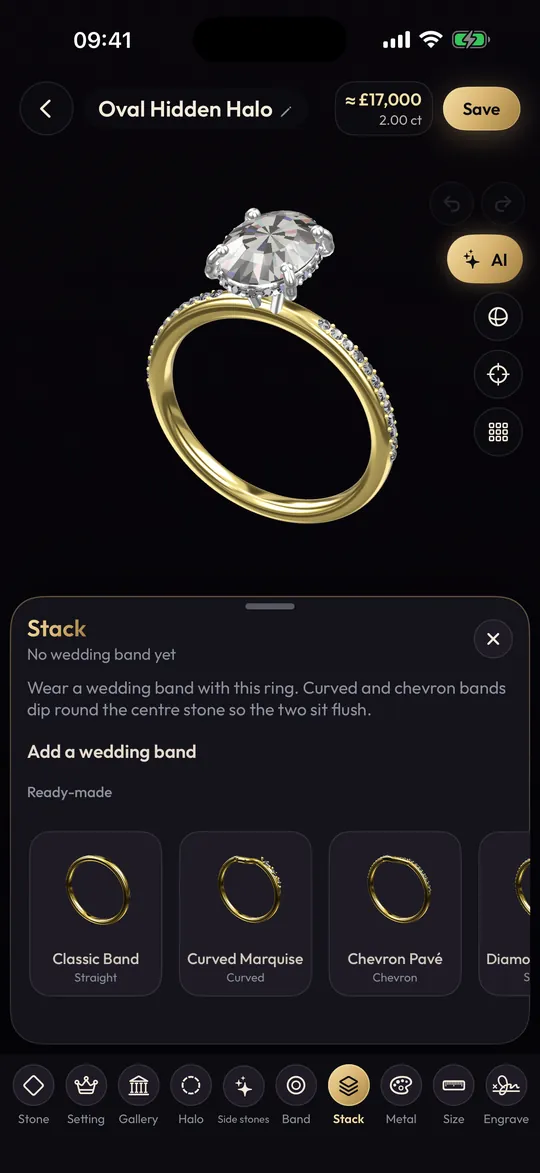
Ring Studio lets you stack a wedding band with your engagement ring and change its contour, so you can see the fit before anyone cuts metal. Wedding band stacks and band curve are part of Pro.
- Open your engagement ring design (or build one; the AI designer can recreate a ring from a photo).
- Add a wedding band to the stack and choose whether it sits above or below.
- Set the contour to straight first to see whether there is a gap.
- Switch to curved, then chevron, and rotate to the side view to compare how each one sits.
- Adjust the band width and style (plain, pavé, eternity, knife edge, twisted and more) and pick a metal.
- Share the ring code with your jeweller so they can see the exact pairing.
The app shows the idea, and your jeweller will fine-tune the exact curve to your finished engagement ring in their own CAD. Read more on the wedding band stack designer page.
When a straight band is the better choice
Contour bands solve a real problem, but they commit the wedding band to its partner. If you want a band that looks right on its own, or you plan to swap rings around over the years, consider a slightly higher head on the engagement ring and a straight band instead. If you are designing both from scratch, plan them together as a bridal set, and compare all the options in our overview of wedding band styles.
Frequently asked questions
What is a contour wedding band?
A contour wedding band is shaped to fit around the engagement ring's head instead of running straight. The most common shapes are a gentle curve and a chevron (V). Some bands are custom-made to trace one specific ring exactly.
Do I need a curved wedding band?
You need one if a straight band leaves a gap you do not want, which usually happens with low-set stones, classic halos, side stones or bezels that overhang the shank. If your stone sits high enough for a band to slip underneath, a straight band works fine.
Can a curved band be worn on its own?
Yes, though the dip in the band is more noticeable without the engagement ring. Gentle curves look elegant alone; deep custom contours look like a gap is missing.
Can curved wedding bands be resized?
Usually yes. Resizing happens at the bottom of the band, away from the curve. Changing the size slightly alters how the curve lines up, so check the fit with the engagement ring afterwards.
What is the difference between curved and chevron wedding bands?
A curved band dips in a smooth arc, which suits round, oval and cushion heads and halos. A chevron band dips in a V, which suits pear, marquise and tall pointed heads, or makes a deliberate geometric statement.