 Ring Studio
Around the world
Engagement Rings in the US: Sizes, Spend and Customs
Engagement rings in the US are sized in whole, half and quarter numbers, usually set in 14k gold or platinum, and worn on the left ring finger with the wedding band added on the same finger. Here is what is normal, what the labels mean and how to plan a ring that fits your budget.
On this page
- How US ring sizes work
- Customs: left hand, solitaires and the modern US proposal
- 14k, 10k or platinum: what Americans usually choose
- Labels, marks and your rights as a buyer
- How much do Americans spend on an engagement ring?
- Where to buy: chains, independents or online
- Design yours in Ring Studio before you shop
- Quick checklist for US buyers
- Ring size system
- US numbers (e.g. 6, 6½, 6¾), roughly 3 to 13
- Which hand
- Left ring finger for both engagement ring and wedding band
- Most common gold
- 14k; 10k at lower prices, 18k at the upper end
- Marking rules
- No mandatory assay; federal law requires accurate karat marks
- Rough spend
- Often $2,000 to $10,000, widely varying (estimate)
- Where people buy
- Mall chains, independents, online retailers, custom jewelers
How US ring sizes work
American jewelers size rings on a numbered scale that goes up in half sizes, with quarter sizes widely available. Each whole size adds about 0.8 mm to the inside diameter, or roughly 2.5 mm of circumference. Canada uses the same numbers, so a size 7 in Toronto is a size 7 in Texas.
If you are buying from a UK, European or Asian seller, convert carefully. The table gives the common equivalents; our ring size converter covers every size in between.
| US size | Inside diameter | Circumference | UK/AU letter | EU/ISO |
|---|---|---|---|---|
| 5 | 15.7 mm | 49.3 mm | J½ | 49 |
| 6 | 16.5 mm | 51.9 mm | L½ | 52 |
| 7 | 17.3 mm | 54.4 mm | N½ | 54 |
| 8 | 18.1 mm | 57.0 mm | P½ | 57 |
| 9 | 19.0 mm | 59.5 mm | R½ | 59-60 |
| 10 | 19.8 mm | 62.1 mm | T½ | 62 |
Measure late in the day when fingers are warm, and size up a quarter or half for bands wider than about 6 mm. For a surprise proposal, our guide to finding a ring size secretly has practical tricks.
Customs: left hand, solitaires and the modern US proposal
Most Americans wear the engagement ring on the fourth finger of the left hand. At the ceremony the wedding band goes on the same finger, and many people restack so the band sits closest to the hand. Men increasingly wear engagement rings too, though it is still less common than for women.
The kneeling proposal with a ring already chosen remains the classic script, but more couples now shop together or propose with a placeholder ring and design the real one afterwards. Round brilliants and ovals are perennial favorites, with elongated shapes, hidden halos and bridal sets that stack neatly all popular as of late 2026.
Religious and cultural practice varies across a diverse country. Some Orthodox Jewish couples use a plain band without stones for the ceremony itself; some couples from South Asian, Latin American or European families follow the right-hand customs of their heritage. There is no single American way, only a common default.
14k, 10k or platinum: what Americans usually choose
14k gold (58.3% gold) is the everyday standard in American jewelry stores because it balances color, hardness and price. 10k (41.7%) is the legal minimum to be called gold in the US and shows up in budget lines and men's bands. 18k (75%) is richer in color and usually sold at higher price points. Platinum, typically marked PLAT or 950, is the premium white metal.
| Metal | Purity | Typical US use |
|---|---|---|
| 10k gold | 41.7% | Budget rings, men's bands, durability |
| 14k gold | 58.3% | The default for engagement rings |
| 18k gold | 75% | Higher-end and designer pieces |
| Platinum 950 | 95% | Premium white metal, heavier and denser |
For a deeper look, compare 10k vs 14k gold and platinum vs white gold.
Labels, marks and your rights as a buyer
The US has no compulsory assay office like the UK. Instead, federal law requires that a karat or platinum mark be accurate, and a stamped quality mark should be accompanied by the maker's or seller's registered trademark. The Federal Trade Commission's Jewelry Guides also govern how stones are described: a lab-grown diamond has to be clearly disclosed with a term such as "laboratory-grown" or "lab-created", not passed off as natural.
Return and exchange rights depend mostly on the store's own policy and on state law, so read the policy before you pay, especially for custom work, which is often non-refundable. Ask for a grading report from a recognized lab for any significant diamond; our guide to diamond certificates explains what to look for. This is general information, not legal advice.
How much do Americans spend on an engagement ring?
There is no official figure, and published averages vary depending on who is surveyed. As a rough guide only, many couples spend somewhere between about $2,000 and $10,000, with plenty spending less and some much more.
| Rough budget (USD) | What it often buys (estimate) |
|---|---|
| $1,000 to $2,500 | Lab-grown 1 ct-plus in 14k, or a smaller natural stone |
| $2,500 to $6,000 | Larger lab-grown stones, or natural around 0.5 to 1 ct |
| $6,000 to $15,000 | Natural 1 ct-plus with good grades, platinum settings |
| $15,000+ | Larger natural diamonds, designer and bespoke work |
These are estimates that vary by retailer, quality and gold and platinum prices. Lab-grown diamond prices have fallen sharply in recent years, which is why the same budget now buys a far bigger lab stone than it did a few years ago. See engagement ring cost and the myth behind the three months' salary rule.
Where to buy: chains, independents or online
- Mall and national chains: easy financing and returns, but compare like-for-like grades.
- Independent and custom jewelers: best for a one-off design; bring a clear reference.
- Online retailers: wide inventory and graded stones; check return windows and insurance in transit. Our guide to buying online safely covers the checks.
- Jewelry districts in big cities: competitive pricing if you know exactly what you want.
Once it is on your hand, consider engagement ring insurance or a rider on your homeowner's or renter's policy.
Design yours in Ring Studio before you shop
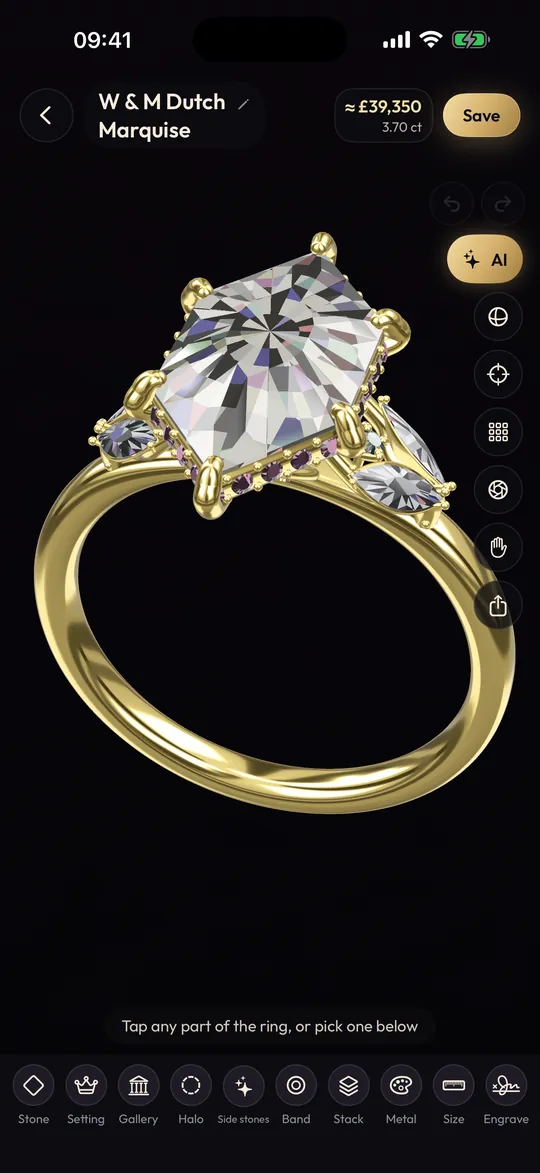
Ring Studio is a free 3D ring design app for iPhone, iPad and Android (the app is in English). It does not sell rings; it helps you decide exactly what you want, then hand that to a jeweler.
- Pick a shape, such as oval or round, and set the carat size to see how it actually looks.
- Choose a setting (4 or 6 prong, bezel) and a band: plain, pavé, twisted or knife edge.
- Switch between yellow, white and rose gold or platinum. The app does not pick karats, so decide 10k, 14k or 18k with your jeweler.
- Watch the live price estimate move as you change stone and metal; treat it as a comparison, not a quote.
- With Pro, describe a ring to the AI ring designer, try it on your own hand with the camera, and share a ring code with your jeweler.
Quick checklist for US buyers
- Confirm the size in US numbers, and whether the price includes one free resize.
- Ask whether the diamond is natural or lab-grown, and get the grading report.
- Check the karat stamp and the store's return policy in writing.
- Plan the wedding band at the same time so the two sit flush.
Frequently asked questions
What is the most common ring size in the US?
Jewelers commonly see women's sizes around 6 to 7 and men's around 9 to 10, but the spread is wide. Measure rather than guess, and remember that wide bands need a slightly larger size.
Which hand does an engagement ring go on in the US?
The left ring finger, the fourth finger of the left hand. At the wedding the band usually goes on the same finger, and many people move the engagement ring to sit above it.
Is 10k gold real gold?
Yes. 10k is 41.7% pure gold alloyed with other metals, and it is the lowest purity that can legally be sold as gold in the US. It is harder and cheaper than 14k but slightly paler in color.
Who keeps the engagement ring if the engagement ends?
It depends on the state. Many courts treat the ring as a conditional gift that goes back to the giver if the wedding does not happen, but rules and outcomes differ, so check local law or ask a lawyer.
Do I have to spend three months' salary on a ring?
No. That rule came from twentieth-century diamond advertising, not from any tradition or law. Pick a figure you can pay without debt and choose the stone and metal around it.