 Ring Studio
Guides
Engagement Ring Trends
The clearest engagement ring trends as of late 2026 are elongated shapes like oval and elongated cushion, stones turned east-west, hidden halos instead of classic halos, bezel settings, toi et moi two-stone rings, coloured gemstones, a big shift to lab-grown diamonds, and the return of warm yellow gold. Here's what each looks like and whether it's likely to last.
On this page
- Elongated shapes: oval, elongated cushion and pear
- East-west settings
- Hidden halos replacing classic halos
- Bezel settings and low profiles
- Toi et moi two-stone rings
- Coloured gemstones and characterful diamonds
- Lab-grown diamonds go mainstream
- The yellow gold revival
- Other directions worth knowing
- How to wear a trend without dating your ring
- Try the trends in Ring Studio
- Trends in wedding bands
- Shapes
- Oval, elongated cushion, pear, emerald, also old-cut and moval
- Settings
- Hidden halo, bezel, east-west, toi et moi
- Stones
- Lab-grown diamonds, sapphires, salt-and-pepper
- Metal
- Yellow gold revival, thin bands, mixed metals
A note on method: we don't publish market-share numbers, because reliable public data is thin and often comes from retailers with an interest in the result. What follows are directions that are clearly visible across jewellers' new collections, bespoke commissions and what people ask for, described honestly with their pros and cons.
Elongated shapes: oval, elongated cushion and pear
The most obvious change of the last decade is the move away from round towards longer stones. Oval leads the way, followed by elongated cushion, pear, emerald cut and radiant.
The appeal is practical as well as visual. An elongated stone covers more of the finger for its weight, so a 1.5 ct oval can look closer to a larger round from above, and it makes the finger look longer. Lab-grown pricing has also made bigger elongated stones affordable. Watch for a bow-tie shadow in ovals and pears, and choose a length-to-width ratio you like (around 1.35-1.50 is common for ovals). If you're between two, oval vs elongated cushion compares them directly.
Will it last? Probably. Ovals have been popular long enough to feel like a modern classic rather than a fad.
East-west settings
Turning an oval, emerald or marquise sideways so it sits across the finger gives a familiar shape a fresh, slightly architectural look. East-west engagement rings also sit lower and catch less, and they stack neatly with bands.
Will it last? It's more distinctive than mainstream, which is part of its charm. It suits people who like a quietly unusual ring.
Hidden halos replacing classic halos
Classic halos defined the 2010s. Now many buyers prefer a hidden halo: a ring of small diamonds tucked under the centre stone, visible only from the side. From above you see a clean solitaire; from the side, a flash of sparkle. See hidden halo vs halo for a direct comparison.
Bezel settings and low profiles
A bezel setting wraps the stone in a thin rim of metal. It used to be seen as the practical choice for nurses and climbers; it's now chosen for its clean, modern look, especially with ovals and pears in yellow gold. Partial bezels and thin "knife" bezels keep it light. Alongside this, there's a general preference for settings that sit closer to the finger.
Toi et moi two-stone rings
Toi et moi ("you and me") rings place two stones side by side, often in different shapes, such as a pear with an oval or an emerald with a round. The style dates back centuries, famously including a sapphire and diamond toi et moi given by Napoleon to Joséphine, and has returned strongly. Read more on toi et moi engagement rings.
Coloured gemstones and characterful diamonds
More couples are choosing sapphires (blue, pink, teal and yellow), emeralds and salt-and-pepper diamonds, either as the centre stone or as side stones. Coloured stones read as personal and are often better value per carat than a top diamond. Sapphire and ruby (9 on Mohs) are robust; emerald (7.5-8) and morganite (7.5-8) need more care.
Lab-grown diamonds go mainstream
The biggest change in the market isn't a design at all. Lab-grown diamonds, chemically and physically the same as mined diamonds, have dropped sharply in price over the past few years. As of late 2026 they're a mainstream option at most jewellers, and they've made larger centre stones accessible to many more budgets. It's worth reading lab-grown vs natural to understand resale and value differences before you decide.
The yellow gold revival
After many years when white gold and platinum dominated, yellow gold is back in a big way. It's often paired with white claws to keep a colourless diamond looking icy, a classic two-tone detail. Thin bands, around 1.6-2 mm, emphasise the stone. Thicker, chunkier "bold" bands are also having a moment among those who want the opposite effect.
Other directions worth knowing
- Vintage and old cuts. Old mine and old European cuts, with their softer, chunkier facets, appeal to people who want character.
- Newer shapes. Moval, kite and hexagon stones for something unusual.
- Personal details. Hidden initials under the stone and engravings inside the band.
- Designed stacks. Engagement ring and wedding band planned together, often with curved bands.
How to wear a trend without dating your ring
Every era has its look: the 1920s' geometric Art Deco, the 1980s' yellow gold and the 2010s' halos. Rings that age well usually combine one trend with a classic foundation. An east-west oval on a plain band, or a hidden halo under a six-prong round, will look current now and still look considered in twenty years. A ring that layers five trends together is the one that dates.
Try the trends in Ring Studio
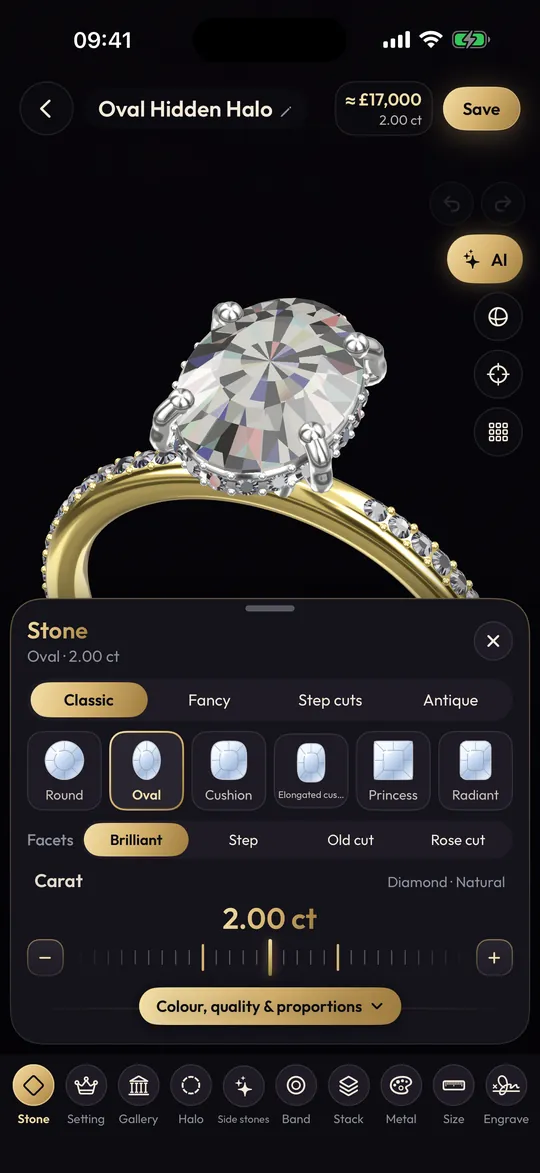
The quickest way to know if a trend suits you is to see it. Ring Studio is a 3D ring design app for iPhone, iPad and Android, and almost every direction above is a few taps away:
- Elongated shapes: oval and pear are free; elongated cushion, moval, kite, hexagon and old cuts are in Pro.
- Rotate any stone east-west with the orientation option.
- Choose no halo, a hidden halo or a classic halo (all halos with Pro), or a bezel setting.
- Pick blue or pink sapphire, emerald, ruby, morganite, or a lab-grown diamond.
- Switch between yellow, white and rose gold or platinum, and try two-tone with Pro.
- Add hidden initials under the stone (Pro).
Toi et moi is one trend Ring Studio doesn't have a dedicated option for yet. With Pro you can place your own extra stones anywhere on the ring to sketch the idea, then ask a jeweller to refine it. Try it on your hand with the camera (Pro) before you commit.
Trends in wedding bands
Bands are following the engagement ring: contoured and chevron bands that hug an unusual centre stone, thin pavé bands, mixed metals in one stack, and textured or brushed men's bands. Our pages on wedding band styles and ring stacking ideas cover these.
Frequently asked questions
What engagement ring shape is most popular right now?
Round remains a perennial favourite, but elongated shapes, especially oval, have become very widely chosen in recent years, alongside elongated cushion, pear and emerald cuts.
Are halo engagement rings out of style?
Classic halos are less dominant than they were in the 2010s. Many buyers now choose a hidden halo, which keeps the extra sparkle under the stone while showing a cleaner solitaire from above.
Is yellow gold back in fashion for engagement rings?
Yes, yellow gold has made a strong return after a long period when white metals dominated, often in thin bands or paired with white claws.
Are lab-grown diamond engagement rings a trend?
They've moved well beyond a trend. As prices have fallen, lab-grown diamonds have become a mainstream choice for engagement rings in many markets.
How do I choose a trendy ring that won't date?
Pair one current detail with a classic foundation, for example an east-west oval on a simple band, or a hidden halo on a traditional solitaire. Rings built entirely on a passing trend date fastest.