 Ring Studio
Heart Shaped Engagement Rings
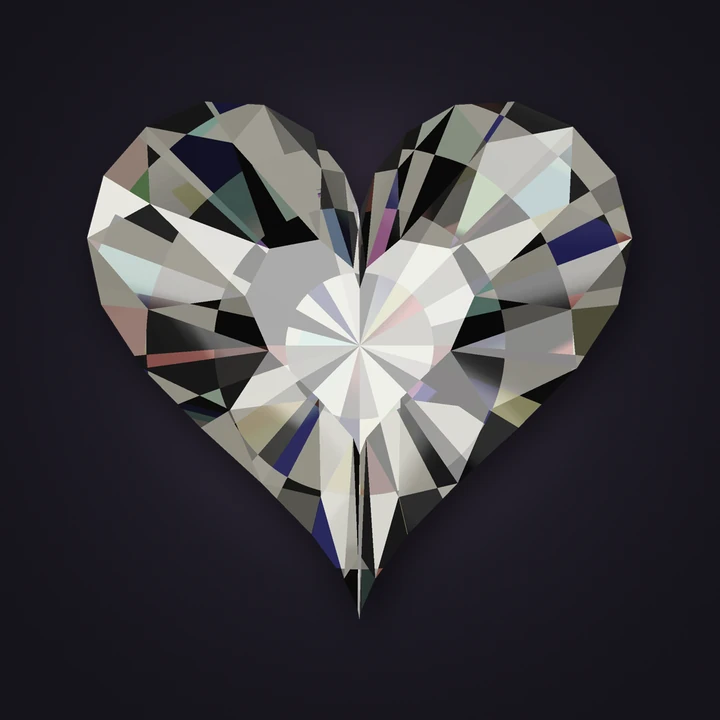
A heart engagement ring features a heart-shaped brilliant with two rounded lobes, a cleft and a point. It is the most openly romantic diamond shape, and getting one right comes down to symmetry, a large enough stone and a setting that protects the tip.
On this page
- A shape with centuries of meaning
- Heart diamond carat to mm chart
- Judging a heart: symmetry above all
- Best settings and prong placement
- Wedding band pairing
- Pros and cons of heart engagement rings
- Heart engagement ring prices
- Heart rings in coloured stones
- Common heart ring mistakes
- Design a heart engagement ring in Ring Studio
- Alternatives to a heart
- Facets
- Usually 56 to 59, modified brilliant
- Length-to-width
- 0.90 to 1.10; around 1.00 is most balanced
- Look
- Unmistakably romantic, bright sparkle, bold outline
- Best settings
- 3 or 5 prong with a protected point, bezel, halo
- Price vs round
- Usually lower per carat; superbly symmetrical hearts are scarce
A shape with centuries of meaning
Heart-shaped jewels have been exchanged as tokens since at least the Renaissance, and a heart-shaped diamond ring sent by Mary, Queen of Scots to Elizabeth I in 1562 is often cited as an early example. Modern heart brilliants, though, are a product of twentieth-century cutting. They are harder to cut well than most shapes, which is why great ones are relatively rare.
A heart is a statement of intent. For some people that is exactly the point; others prefer it in a right-hand or promise ring. If you are unsure, a heart set east-west or in a coloured stone can feel less obvious.
Heart diamond carat to mm chart
Approximate face-up dimensions for well-proportioned hearts near a 1.00 ratio, given as length by width.
| Carat | Approx. L x W | Shape visibility |
|---|---|---|
| 0.50 ct | 5.3 x 5.6 mm | Recognisable, though prongs hide some outline |
| 0.75 ct | 6.0 x 6.4 mm | Clearly a heart |
| 1.00 ct | 6.5 x 7.0 mm | Bold, well-defined lobes |
| 1.50 ct | 7.4 x 8.0 mm | Strong statement |
| 2.00 ct | 8.2 x 8.8 mm | Wide on the finger; check comfort |
| 3.00 ct | 9.3 x 10.0 mm | Very wide; usually a sturdy 5 prong head |
Hearts below about 0.5 carat lose definition. If budget is tight, a halo can help the shape read more clearly.
Judging a heart: symmetry above all
Because the outline is so recognisable, any lopsidedness is obvious.
- Lobes: both should be the same size and roundness. Draw a line from the point through the cleft; the halves should mirror each other.
- Cleft: well defined but not too deep. A shallow cleft makes the heart look like a pear; a deep one wastes weight and can hold inclusions.
- Wings: the sides running to the point should be gently curved, not bulging or flat.
- Point: crisp and centred, with no inclusions at the tip.
- Bow-tie: hearts can show a mild bow-tie across the middle; judge it on video.
- Colour: colour can gather at the point; G to H keeps a white look in white metal.
Look at a heart from about arm's length, as other people will see it. Small asymmetries that are hidden under magnification can be surprisingly visible from a distance.
Best settings and prong placement
Three prongs
One prong on each lobe and one at the point is the most minimal option and shows the most outline. Ring Studio doesn't offer a 3 prong head; the closest is its 5 prong setting.
Five prongs
One at the point, one in the cleft and one on the side of each lobe gives extra security and is the usual choice above a carat. Ideally the point prong is V-shaped; ask your jeweller for it, as Ring Studio doesn't have a dedicated V-tip.
Bezel and halo
A bezel protects the point and cleft completely. A halo sharpens the outline and makes a smaller heart look larger and more defined.
Wedding band pairing
A heart's point can stop a straight band from sitting flush, so a gently curved or notched band is common. A thin pavé band matches the sparkle; a plain band keeps the look sweet and simple.
Pros and cons of heart engagement rings
| Pros | Cons |
|---|---|
| Uniquely romantic and personal | Very sentimental; not to everyone's taste |
| Bright brilliant sparkle | Symmetry is hard to find |
| Usually lower price per carat | Small stones lose their shape |
| Wide outline looks generous | Point needs protection |
Heart engagement ring prices
Hearts generally cost less per carat than rounds, but cutting a highly symmetrical heart wastes material and takes skill, so top-quality stones are scarcer. Lab-grown hearts make larger, better-defined sizes affordable, with lab-grown prices having fallen sharply in recent years. Coloured stones are another route: a pink sapphire heart is a popular romantic alternative. All prices vary by retailer and market.
Heart rings in coloured stones
Hearts are especially popular in coloured gems because the shape and colour reinforce each other. Pink sapphire, ruby and morganite hearts are all common choices. Morganite is softer than sapphire (around 7.5 to 8 on the Mohs scale, against 9 for sapphire and ruby), so a protective setting matters more. A heart-shaped coloured stone can also be a good way to keep the romance while making the ring feel less traditional. See ruby engagement rings and morganite engagement rings for care and durability notes.
Common heart ring mistakes
The most common are choosing too small a stone, so the outline disappears under the prongs, and buying from a single photo that hides uneven lobes. Check a video and a top-down image before committing.
Design a heart engagement ring in Ring Studio
Heart is one of the free shapes in Ring Studio.
- Pick Heart from the stone tray and set the carat; try going above 0.5 ct to see the outline sharpen.
- Choose the 5 prong setting, then compare with a bezel.
- Add a classic halo to see how it defines the lobes.
- Try a diamond, then a pink sapphire or ruby, and switch between rose gold and platinum.
- Add an engraving inside the band for a personal message.
With Pro you can also add hidden initials under the stone, a quiet detail that suits a heart ring. Ideas for wording are in what to engrave in a ring.
Alternatives to a heart
If you want something romantic but subtler, consider a pear, a soft teardrop that hints at a heart, or a trillion for a bolder geometric statement. More ideas are in unique engagement rings.
Frequently asked questions
What size heart diamond should I choose?
Many jewellers suggest at least half a carat for a solitaire, because below that the cleft and lobes become hard to see and the stone can look like a small triangle or round, especially once prongs cover its edges.
How big is a 1 carat heart diamond?
Roughly 6.5 mm long and 7 mm wide, depending on proportions. The width can be slightly larger than the length on a classic heart.
How many prongs should a heart diamond have?
Three or five prongs are typical: one V-shaped prong at the point and either one in each lobe or one at the cleft plus one on each lobe. All styles should cover the point.
Are heart shaped diamonds cheaper than round?
Generally yes per carat, because demand is lower. Well-cut, highly symmetrical hearts are scarcer, so they can cost more than other fancy shapes.
What ratio should a heart diamond have?
Around 0.90 to 1.10, with about 1.00 looking most balanced. Lower ratios look wide and squat; higher ratios look narrow and elongated.
Keep reading
 Pear Engagement Rings: Choosing a Teardrop DiamondPear engagement ring guide: the best ratios, judging the bow-tie and shoulders, carat-to-mm sizes, protecting the tip, b…
 Trillion Engagement RingsTrillion engagement ring guide: curved vs straight triangle cuts, history, sizes in mm, protecting the corners, sourcing…Promise RingsPromise rings explained: what they mean, which finger to wear one on, popular styles, sensible budgets and how a promise…Halo Engagement RingsHalo engagement ring guide: how a halo adds face-up size, which shapes suit one, upkeep of small pavé stones, band pairi…Bezel Set Engagement RingsBezel set engagement ring guide: full vs half bezels, how a metal rim affects sparkle and size, best shapes, durability,…Pink Sapphire Engagement RingsPink sapphire engagement rings guide: pink vs padparadscha vs ruby, treatments, metal pairings and price ranges, plus ho…