 Ring Studio
How to Measure Your Ring Size at Home
To measure your ring size at home, measure an existing ring that fits or wrap a non-stretch strip around the base of your finger, then convert the millimetres with a ring size chart. Here is how to do each method properly and how accurate each one really is.
On this page
- Best home method
- Measure the inside of a ring that already fits
- Quickest method
- Paper strip around the finger
- You need
- Ruler in mm, paper, pen, scissors
- Typical error
- Up to half a size or more with string or paper
- Gold standard
- A jeweller's metal sizing rings
Which home method should you use?
| Method | What you need | Reliability | Best for |
|---|---|---|---|
| Measure an existing ring | A ring that fits the same finger, ruler or calipers | Good | Anyone who already wears a ring on that finger |
| Printable ring sizer | Printer, scissors, ruler to check scale | Fair to good | Quick checks, comparing two fingers |
| Paper strip | Paper, pen, ruler | Fair | No ring to measure, no printer |
| String or thread | Non-stretch string, ruler | Poor to fair | Last resort |
| Plastic ring sizer (reusable belt type) | Bought or free from a retailer | Fair to good | Repeat measurements over a few days |
Method 1: measure a ring that already fits
This is the most dependable way to measure ring size at home, because metal does not stretch and the ring has already proved it can get over your knuckle.
- Choose a ring that fits the same finger comfortably. A ring from your right hand may not fit your left.
- Lay it on a ruler marked in millimetres and measure straight across the inside edge to inside edge, through the centre. Do not include the metal.
- Measure twice at right angles. If the two readings differ, the ring is slightly out of round; use the average.
- Find the diameter in the ring size by diameter table or the main ring size chart.
Digital calipers make this far more precise. A difference of 0.4 mm in diameter is a whole half size, which is about the width of a ruler's printed line.
Method 2: the paper strip method
- Cut a strip of paper about 1 cm wide and 10 cm long. Paper stretches less than string.
- Wrap it around the base of the finger, snug but not tight. It should slide over the knuckle when you push it off.
- Mark where the paper overlaps with a fine pen.
- Lay it flat and measure from the end to the mark in millimetres. That is your circumference.
- Repeat two or three times. If the readings differ, use the larger one.
- Convert the circumference with the ring size converter. The EU size is simply the circumference rounded to the nearest millimetre.
Check the knuckle. Wrap the strip around the knuckle as well. If it is more than about 2 mm bigger than the base of the finger, choose a size between the two measurements, closer to the knuckle, or the ring may not go on at all.
Method 3: a printable ring sizer
A paper sizer is a strip with a slot, or a sheet of circles to match against an existing ring. Our printable ring sizer includes a calibration line: measure it with a ruler before you cut anything. If your printer scales the page to fit, every size will be wrong by the same proportion, which is easy to miss.
Print on thicker paper if you can, and pull the strip snug rather than tight. Read the size where the strip meets the slot.
Method 4: string, as a last resort
String gives the classic "one size too small" error because it digs into the skin and stretches when pulled. If string is all you have, use a non-stretch type such as dental floss or thin cotton, mark it with a pen rather than pinching it, and add nothing for comfort until you have compared two or three readings.
Common mistakes that give the wrong size
- Measuring cold fingers. Fingers shrink in the cold and swell in heat. Measure at room temperature, ideally later in the day.
- Measuring the wrong hand. Dominant-hand fingers are often a little larger. Check which hand the engagement ring goes on where you live.
- Ignoring band width. A wide band fits tighter than a thin one of the same size. For bands about 6 mm and wider, many people need a quarter to half a size up. See the ring width guide.
- Mixing up systems. A UK M is not an EU M, and Japanese numbers are not US numbers. Write the system next to the size.
- Measuring once. Measure on two or three different days. Fingers vary with the weather, salt intake and even pregnancy.
Measuring your ring size in Ring Studio
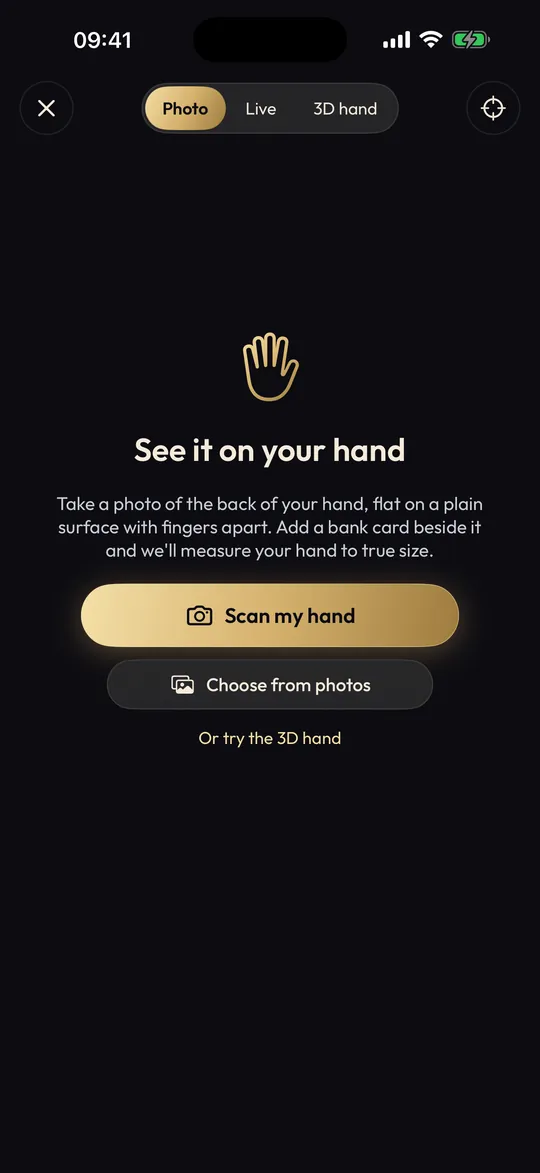
If you are designing a ring anyway, Ring Studio Pro can estimate your size from a hand scan: place a standard bank card beside your hand so the app knows the scale, and it reads the finger width. You can then try your design on live through the camera, or on a 3D hand, to see how the stone and band width look at that size.
- Build your ring in the 3D ring designer.
- Open try-on and scan your hand with a bank card flat beside it, in even light.
- Compare the estimate with one of the home methods above.
- Share the ring code with your jeweller and confirm the final size with their sizing rings.
When to get sized by a jeweller instead
A home measurement is fine for a fashion ring or a band that can be resized. Get a professional sizing for full eternity rings, tension-style or heavily set bands, and alternative metals such as tungsten, because these are hard or impossible to resize later. If the ring is a surprise, read how to find their ring size secretly, and if a ring has already arrived and does not fit, see what to do when a ring is too big or too small.
Frequently asked questions
Can I measure my ring size with string?
Yes, but it is the least accurate method because string stretches and twists. Use a thin strip of paper instead if you can, keep it snug but not tight, and check it slides over your knuckle.
Which finger should I measure for an engagement ring?
The ring finger of the hand you will wear it on. Dominant hands are often slightly larger, so measure the actual finger rather than the same finger on the other hand.
Should a ring be tight or loose?
It should slide over the knuckle with a little resistance and not spin freely or leave a deep mark at the base of the finger. If you cannot decide between two sizes, the larger is usually safer, especially for wider bands.
What time of day should I measure my ring size?
Late afternoon or evening at a comfortable room temperature. Fingers are usually smallest first thing in the morning and when cold, and larger in heat or after exercise.
How accurate is a phone app for ring size?
Apps that scan your hand give an estimate that can put you in the right range, but lighting, camera angle and the reference object all affect it. Confirm with a jeweller before ordering a ring that is hard to resize.