 Ring Studio
Around the world
Engagement Rings in Ireland: Sizes, Prices & Traditions
Engagement rings in Ireland are sized in letters like the UK, worn on the left hand, and hallmarked by the Assay Office at Dublin Castle. Ireland also has its own ring language in the Claddagh, which tells people your status by how you wear it.
On this page
- Sizes
- UK-style letters; EU circumference also common
- Engagement hand
- Left ring finger
- Assay office
- Dublin Castle (Company of Goldsmiths of Dublin)
- Distinctive custom
- The Claddagh: two hands, a heart and a crown
- Currency
- Euro; rough spend often €2,000 to €7,000 (estimate)
The Claddagh ring and what it says
The Claddagh comes from the fishing village of the same name just outside Galway city. Its design is two hands holding a heart topped with a crown, usually read as friendship, love and loyalty. Several origin stories circulate, the best known involving a Galway man named Richard Joyce, but treat any precise date with caution: the history is part record, part legend.
What matters for engagements is the wearing convention, which is widely understood in Ireland and among the diaspora:
| How it is worn | What it usually signals |
|---|---|
| Right hand, heart facing out (towards fingertip) | Single, or open to a relationship |
| Right hand, heart facing in (towards wrist) | In a relationship |
| Left hand, heart facing out | Engaged |
| Left hand, heart facing in | Married |
Families vary, and some people simply wear theirs however feels right. Claddaghs are also handed down, so a grandmother's ring can become a promise ring, then turn around on the wedding day.
Irish ring sizes and conversions
Ireland follows the British letter scale, so an Irish M is a UK M. Because Ireland is in the eurozone, online shops often add the EU size, which is simply the inside circumference in millimetres. American relatives buying a ring will need the US number.
| Irish / UK | EU (mm) | US |
|---|---|---|
| I | 48 | 4½ |
| J½ | 49.3 | 5 |
| K½ | 50.6 | 5½ |
| L½ | 51.9 | 6 |
| M½ | 53.1 | 6½ |
| N½ | 54.4 | 7 |
| P½ | 57.0 | 8 |
| R½ | 59.5 | 9 |
| T½ | 62.1 | 10 |
Irish winters matter here: fingers shrink in the cold and swell in a warm pub, so measure at a normal room temperature, ideally late in the day. Our guide to measuring ring size at home and the printable ring sizer help if you cannot get to a jeweller.
Dublin Castle hallmarks
Ireland has had hallmarking for centuries, and it remains compulsory. The Assay Office, run by the Company of Goldsmiths of Dublin from Dublin Castle, independently tests precious metal articles before they can be sold as gold, silver, platinum or palladium, subject to small weight exemptions. An Irish hallmark normally includes:
- a sponsor's mark identifying the maker or importer;
- a fineness mark such as 375, 585, 750 or 950;
- the Assay Office mark; for Irish-assayed gold this is traditionally the figure of Hibernia;
- often a date letter.
Imported rings can instead carry a Common Control Mark under the international Hallmarking Convention. If in doubt, the Assay Office's own website explains the current marks; our hallmarks guide covers how to read them.
Metals Irish couples choose
Yellow gold has a strong following here, partly because the Claddagh itself is so often yellow gold. For diamond engagement rings, 18ct white gold and platinum are the usual choices, with 14ct a sensible middle option and 9ct common in gift jewellery. Irish-made Claddaghs tend to come in 9ct, 14ct and 18ct, so a matching set is easy to put together. See yellow gold engagement rings for colour pairing, and karats explained for durability.
Proposal and wedding customs in Ireland
- Leap year proposals. Irish folklore links St Brigid and St Patrick to the idea that women can propose on 29 February. It still gets a mention every leap year, though few treat it seriously.
- Family rings. Resetting a parent's or grandparent's diamond is common. A jeweller can often reuse the gold too; see redesigning an old ring.
- Celtic designs. Knotwork bands and Ogham engraving (the early Irish alphabet) are popular for wedding rings, especially men's bands.
- Engraving. Couples often engrave the date or a short phrase in Irish, such as "mo ghrá" (my love). Our engraving ideas list has more.
Typical spend in euro (rough estimates)
We are not aware of a reliable Irish average, so take these only as broad, late 2026 ranges. They swing with diamond quality, gold and platinum prices and where you buy, and lab-grown diamonds now cost far less than they did a few years ago.
| Ring | Rough range (EUR) |
|---|---|
| Gold Claddagh, plain | €150 to €800 |
| Lab-grown diamond solitaire, about 1 ct | €900 to €3,000 |
| Natural diamond solitaire, about 0.5 to 1 ct | €1,500 to €10,000+ |
| Wedding band, 18ct or platinum | €350 to €1,800 |
Irish prices include VAT at the standard rate, so compare like with like if you are pricing against a UK or US retailer. Buying from outside the EU can bring import VAT and charges on delivery. The engagement ring cost guide explains what drives each figure.
Where to buy and your rights
Dublin's Grafton Street area and the jewellers around Galway's Latin Quarter are well known, but most towns have an independent jeweller who will make to order. Many Irish buyers also shop online, from Irish, UK and EU retailers. Under EU-derived consumer law, goods must match their description and be of acceptable quality, and distance sales usually carry a 14-day cancellation right, with custom-made items generally excluded. The Competition and Consumer Protection Commission (CCPC) publishes plain-English guidance; treat this as a summary, not legal advice.
Designing a Celtic-inspired ring in Ring Studio
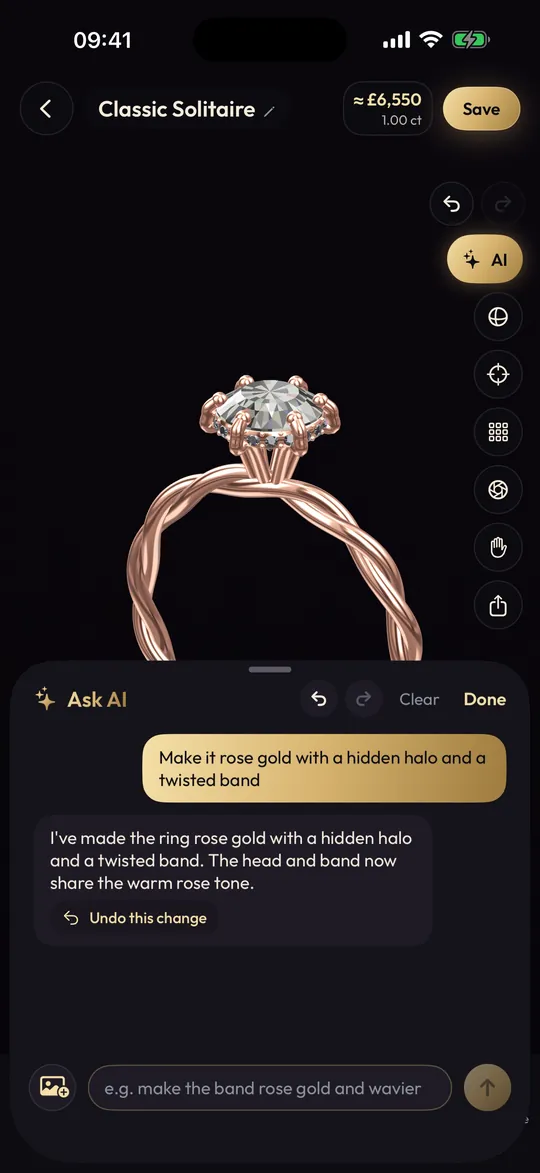
Ring Studio is a free 3D ring designer for iPhone, iPad and Android, in English. It doesn't have a Claddagh or Celtic knot template, so be realistic about that: a jeweller will carve those motifs. What the app is good for is the diamond ring that sits alongside one.
- Describe it to the AI, for example "yellow gold oval solitaire with a twisted band", and it builds the ring in 3D. Keep refining: "make the band thinner", "switch to platinum".
- Use the twisted or engraved (vintage) band for a heritage feel, and engrave inside the band, which is where an Irish phrase works best.
- Add hidden initials under the stone (Pro) for a private detail.
- Stack a wedding band with the engagement ring (Pro) to see how a plain band will sit beside it.
- Share the ring code with your jeweller, who rebuilds it in their own CAD and has it hallmarked in Dublin.
Before you commit
Ask for the hallmark or confirm the ring will be assayed, get any diamond's grading report, and settle the size in letters. If you plan to wear a Claddagh on the same finger later, tell the jeweller now so the engagement ring's band width and height leave room.
Frequently asked questions
How do you wear a Claddagh ring when engaged?
The common convention is the left hand with the crown towards the fingertip and the heart facing out. Once married, the ring is turned so the heart points towards the wrist.
What ring size system does Ireland use?
Irish jewellers use the same letter scale as the UK, from roughly H to Z for adults with half sizes. Many also quote the EU circumference in millimetres, especially online.
Is hallmarking compulsory in Ireland?
Yes. Gold, silver, platinum and palladium articles above small weight exemptions must be hallmarked before sale, and the Assay Office at Dublin Castle tests and marks them.
Can a Claddagh be used as an engagement ring?
Yes, many Irish couples use a gold Claddagh as an engagement or wedding ring, sometimes with a small diamond or gemstone set in the heart. Others pair a diamond engagement ring with a Claddagh band.
How much do people spend on an engagement ring in Ireland?
There is no single reliable average. As a rough estimate many couples spend somewhere between 2,000 and 7,000 euro, but prices vary widely with the stone, metal and retailer.