 Ring Studio
Lab Grown Diamond vs Natural Diamond
In the lab grown diamond vs natural diamond decision, the stones look identical and are equally hard; what separates them is origin, price and long-term value. Lab-grown buys you a much bigger or better stone for the money, while natural holds rarity and a little more resale value.
On this page
- Lab grown vs natural diamond at a glance
- Do lab grown and natural diamonds look different?
- Durability and everyday wear
- Price: why lab-grown costs so much less
- Resale and long-term value
- Certification and how to tell them apart
- Ethics and sourcing
- What does a lab grown vs natural diamond ring cost in practice?
- Choose lab-grown if... choose natural if...
- Compare them side by side in Ring Studio
- Look
- Identical to the eye and under a loupe
- Hardness
- Both 10 on the Mohs scale
- Price
- Lab-grown is usually a fraction of natural for the same grades
- Resale
- Low for both; lowest for lab-grown
- Short answer
- Lab-grown for size and value, natural for rarity and heritage
Lab grown vs natural diamond at a glance
| Lab-grown diamond | Natural diamond | |
|---|---|---|
| Look | Same brilliance and fire as natural | Same brilliance and fire as lab-grown |
| Durability | Mohs 10, tough, everyday-proof | Mohs 10, tough, everyday-proof |
| Maintenance | Regular cleaning; prong checks | Regular cleaning; prong checks |
| Price (1 ct, good grades) | Roughly £500 to £2,000 | Roughly £4,000 to £12,000+ |
| Apparent size per carat | Identical: a 1 ct round is about 6.5 mm either way | Identical |
| Resale | Very limited | Limited, but usually better |
| Best for | Maximising size, colour and clarity on a budget | Buyers who value rarity, geology and tradition |
Prices are rough estimates in GBP for a loose 1 ct round with good cut, colour and clarity, as of late 2026. They vary widely by retailer, grade and market, and lab-grown prices in particular have fallen sharply over the last few years.
Do lab grown and natural diamonds look different?
No. A lab-grown diamond is not an imitation; it is carbon crystallised in the same cubic structure, either under high pressure and high temperature (HPHT) or by chemical vapour deposition (CVD). It bends light in exactly the same way, so brilliance, fire and sparkle are governed by the same thing in both: the quality of the cut. A beautifully cut lab stone will outshine a poorly cut natural one every time, and vice versa.
Where you may see a difference is in what you can afford. Because lab-grown costs so much less, buyers often step up to a bigger carat weight, a whiter colour or a cleaner clarity grade. That is the real visual effect of choosing lab-grown: not a different-looking diamond, but a better-specified one for the same money. Our guide to the diamond 4Cs explains which grades actually show.
Durability and everyday wear
Both score 10 on the Mohs scale and have the same toughness. Neither will scratch from normal wear, and both can chip if struck hard on a thin edge or point. Origin makes no difference to how you should care for the ring; the setting matters far more. If you work with your hands, think about a protective bezel setting or lower profile regardless of which diamond you buy.
Price: why lab-grown costs so much less
A natural diamond's price reflects billions of years of geology, the cost of mining and a supply that cannot simply be increased. Lab-grown production has scaled quickly, and as capacity rose the prices fell, steeply and repeatedly. As of late 2026, a lab-grown stone commonly costs a small fraction of a natural stone with the same grading, and the gap widens at larger sizes.
That has two consequences. First, a 2 ct lab-grown centre stone is now realistic on a budget that would buy around half a carat of natural diamond. Second, the price you pay for lab-grown today may be noticeably higher than the same stone costs in a few years. See lab diamond prices and diamond price per carat for typical ranges by size.
Resale and long-term value
Be realistic about both. Natural diamonds rarely resell anywhere near what you paid at retail, but there is an established secondary market, and a well-graded natural stone usually commands a meaningful offer. Lab-grown diamonds have very little resale value at present, and many jewellers will not buy them back at all. If you see the ring as a lifelong piece rather than an asset, this matters less than it sounds.
Certification and how to tell them apart
Gemmologists separate the two with spectroscopy and growth-pattern imaging, not with a loupe. Both are graded by labs such as GIA and IGI, and reports state the origin clearly; many lab-grown stones are also laser-inscribed on the girdle. For a lab-grown stone, check the report for any post-growth treatment. Our page on diamond certificates covers what each report includes.
Ethics and sourcing
Lab-grown removes mining from the chain, which many couples prefer. It is not automatically low-impact, though: growing diamonds is energy-intensive, and the footprint depends heavily on how the electricity is generated. Natural diamonds can be traced through schemes and supplier documentation. If ethics drive your choice, ask the seller specific questions either way; our guide to conflict-free diamonds lists what to ask.
What does a lab grown vs natural diamond ring cost in practice?
Stone prices only tell half the story, because the setting costs the same whichever diamond you choose. A simple 18k gold or platinum solitaire mount might add several hundred to well over a thousand pounds, depending on the maker and metal. That fixed cost means the percentage saving on a finished lab-grown ring is smaller than the saving on the loose stone, especially for small diamonds.
As a rough illustration, as of late 2026, a 1 ct lab-grown solitaire in gold can often be found for under £2,500 in total, while a natural 1 ct ring of similar grades commonly runs from around £5,000 to well beyond £12,000. At 2 ct the gap becomes dramatic. These are estimates that vary by retailer and quality; our engagement ring cost guide and ring budget calculator help you plan a realistic figure.
Choose lab-grown if... choose natural if...
- Choose lab-grown if you want the biggest, whitest, cleanest stone your budget allows, you see the ring as sentimental rather than financial, or you prefer a stone with no mining in its history.
- Choose natural if rarity and the idea of a stone formed deep in the earth matter to you, you want the best chance of some resale value, or you are matching an heirloom or family tradition.
- Either works if you mainly care about how it looks on the hand: on that measure they are equal.
Compare them side by side in Ring Studio
The quickest way to feel the trade-off is to see what each budget buys. In Ring Studio, design your ring once, then switch the centre stone between natural and lab-grown diamond and watch the live price estimate change. Push the carat slider up on the lab-grown version until the estimate matches your natural-diamond figure, and you will see exactly how much bigger the stone gets.
- Pick a shape and setting, say a round in a six-prong solitaire.
- Set the stone to natural diamond at your target carat and note the estimate.
- Switch to lab-grown, then raise the carat until the estimate lines up.
- Try both on your own hand with the camera (Pro) to see whether the extra size suits your finger.
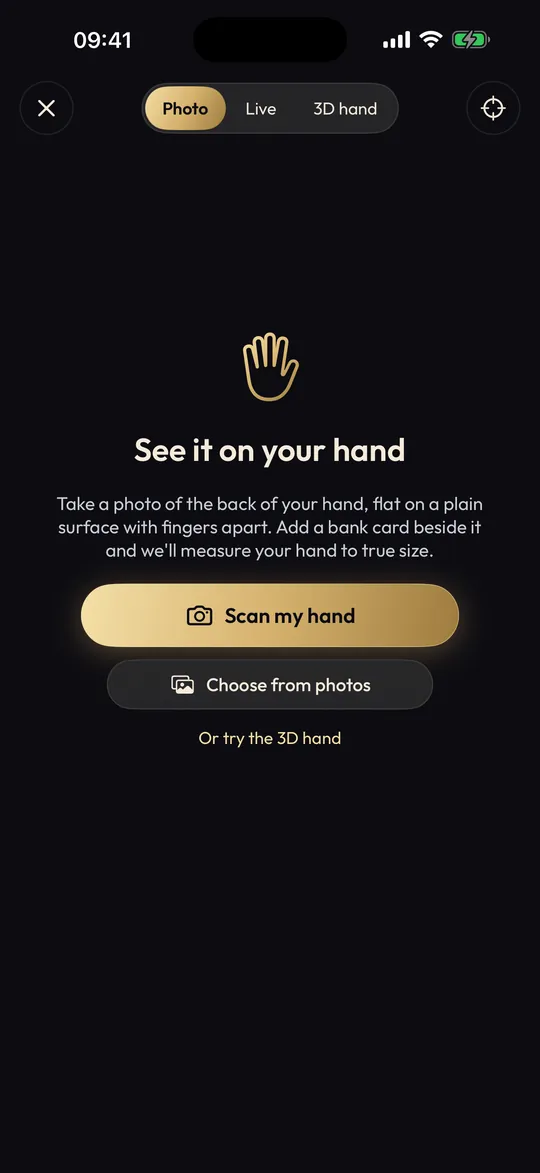
The estimate is a guide for comparing options, not a quote. Once you have chosen, share the ring code with your jeweller so they can source the actual stone.
Verdict
On looks and durability there is no winner: they are the same material. Lab-grown is the better value if you want size and quality for your money, and it is what most budget-conscious buyers now choose. Natural is the right pick if rarity, provenance or holding some value matters to you. Decide on what you care about, not on what you think others will notice, because nobody can tell by looking.
Frequently asked questions
Can you tell a lab grown diamond from a natural one by eye?
No. They are the same material with the same hardness, brilliance and fire, so even an experienced jeweller needs specialist equipment to separate them. Grading reports and laser inscriptions on the girdle state the origin.
Are lab grown diamonds real diamonds?
Yes. A lab grown diamond is crystallised carbon with the same chemical, physical and optical properties as a mined diamond. It is not a simulant like cubic zirconia or moissanite.
Do lab grown diamonds hold their value?
Generally not. Lab-grown prices have fallen sharply over recent years and resale offers are usually very low. Natural diamonds also resell well below retail, but tend to retain more of their price.
Will a lab grown diamond go cloudy or change colour?
A well-made lab grown diamond is as stable as a natural one and will not cloud or fade. Some lower-grade stones are treated after growth, so buy one with a grading report that discloses any treatment.
Is a lab grown diamond more ethical than a natural diamond?
It removes mining from the supply chain, but growing diamonds uses a lot of energy, so the footprint depends on the producer. Natural diamonds from well-documented sources can also be responsibly sourced; ask for provenance either way.