 Ring Studio
Six Prong Engagement Rings
A six prong engagement ring holds the centre stone with six evenly spaced claws, which makes it more secure than four prongs and gives a round stone a softer, rounder outline. The trade-off is a little more metal on show.
On this page
- Prongs
- Six, evenly spaced around the stone
- Security
- High: stone stays put if one prong fails
- Metal on show
- More than four prong; noticeable on small stones
- Best shapes
- Round; also oval, cushion, pear (with V-tip)
- Maintenance
- Check tips every 6-12 months; re-tip when worn
- In Ring Studio
- 6 prong setting, with round, claw, double or petite tips
Why choose a six prong engagement ring?
The six prong solitaire has been the reference engagement ring for well over a century. It was designed to lift a round diamond above the band and let light in from every side, and it still does that job well. Today people choose six prongs for three reasons: security, the way they round off a round brilliant, and a classic look that pairs easily with almost any wedding band.
How secure is a six prong setting?
Every prong in a setting carries part of the load. With four, each one matters a great deal: if a single prong bends back after a knock, the stone has three points of contact and can shift or fall. With six, losing one still leaves five evenly spread, which usually holds the stone firmly until you notice and get it fixed.
That redundancy is the main reason jewellers often suggest six prongs for larger stones, for people who work with their hands, and for anyone who wants extra peace of mind on an expensive diamond.
How much metal shows with six prongs?
Six prongs means six tips resting on the edge of the crown. On a 1 carat round, roughly 6.4 to 6.5 mm across, those tips occupy a small fraction of the visible outline and most people barely notice them. On a 0.3 to 0.5 carat stone, six full-size prongs can make the head look busy, almost as if the diamond is in a cage.
| Stone size (round) | Approx. diameter | Six prongs look |
|---|---|---|
| 0.3 ct | about 4.3 mm | Crowded unless tips are petite |
| 0.5 ct | about 5.1 mm | Fine with slim prongs |
| 1 ct | about 6.4 mm | Balanced, classic |
| 2 ct | about 8.1 mm | Prongs nearly disappear; recommended for security |
Use our carat size chart for other shapes. The metal colour matters too: white gold or platinum prongs blend into a colourless diamond, while yellow gold prongs are more visible and add warmth.
Does a six prong setting snag?
It can, but prong count is not the main factor. Snagging comes from tips that stand proud of the stone, sharp claw points, or heads set very high. A well-finished six prong head with low, smooth tips catches less than a sloppy four prong one. If snagging worries you, choose round or petite tips and a medium head height.
Which stone shapes suit six prongs?
- Round: the perfect partner. Six prongs follow a circle evenly and make the stone look rounder, whereas four prongs can make a round look subtly square. See round engagement rings.
- Oval: six prongs give two at each end and one on each side, protecting the ends well. Some feel it looks busier than four on an oval; try both.
- Cushion: six works, especially on rounder cushions, though four or eight (double) prongs on the corners are more common.
- Pear: often five or six prongs, including a V-prong to protect the point.
- Princess, emerald, asscher: generally not. Square and rectangular stones have four corners, and four corner prongs protect them better than six would.
Maintenance and re-tipping
Prong tips wear down slowly with daily contact. Platinum tends to push and move rather than wear away, while gold wears off more readily, but both need occasional attention. A jeweller can check every tip with a loupe in a few minutes. When tips are thin, they re-tip them by adding new metal and reshaping; this is routine and far cheaper than replacing a lost stone. Clean the ring regularly, since soap build-up hides tip wear. Our ring care guide covers the details, and platinum vs white gold explains how each metal behaves.
Six prong pros and cons
| Pros | Cons |
|---|---|
| More secure: one failed prong rarely means a lost stone | More metal visible, especially on small stones |
| Makes round stones look rounder | Slightly more cleaning around six tips |
| Classic, widely recognised look | Six tips to check and eventually re-tip |
| Spreads pressure evenly on the stone | Less of the stone's edge on show than four prong |
For a full head-to-head, read 4 prong vs 6 prong or our guide to four prong engagement rings.
Designing a six prong ring in Ring Studio
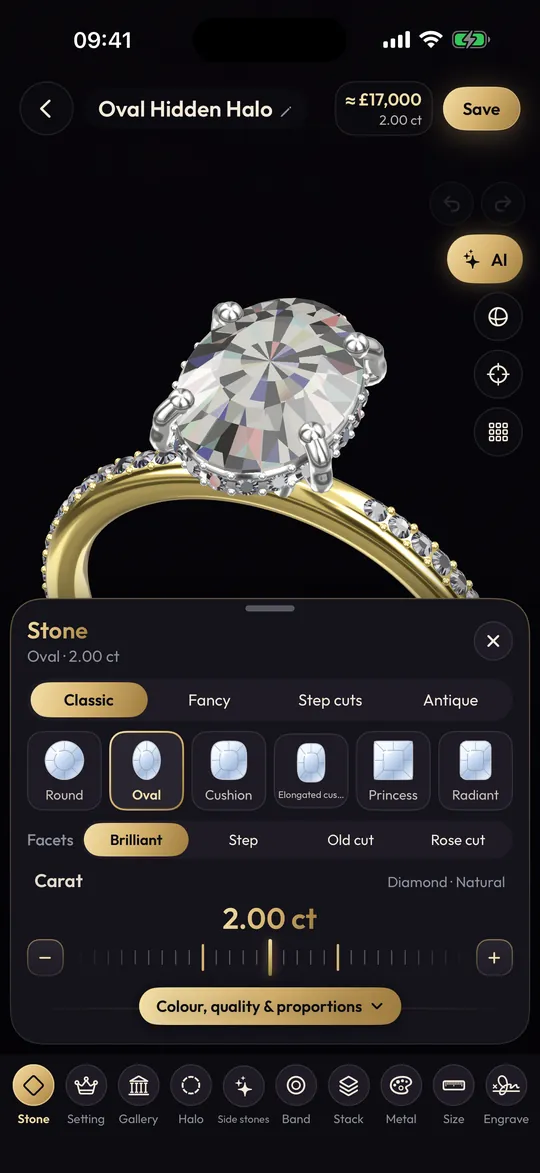
Six prong is one of the standard settings in Ring Studio, and it is the easiest way to see whether the extra prongs crowd your stone at the size you can afford.
- Choose a stone shape and drag the carat size to your target.
- Select 6 prong, then flip between 4 prong and 6 prong while looking straight down at the stone.
- Change the prong tips: petite for a lighter look on smaller stones, round for a soft classic finish, claw for a sharper outline, or double for a vintage feel.
- Pick a gallery: open lets in the most light, rail adds structure, tulip adds a curve.
- Add a band and metal, check the live price estimate, and share the ring code with your jeweller.
Who should pick six prongs?
Choose six prongs if you want a round diamond of around 0.7 carats or more, if security is a priority, or if you love the traditional solitaire silhouette. Consider four prongs if your stone is small, you want the most diamond on show, or your stone is square. If you want something between the two, claw prongs or double tips change the look without changing the count.
Frequently asked questions
Are six prongs more secure than four?
Yes. With six prongs, the stone stays held if one prong bends or breaks, which buys you time to get it repaired. With four, losing one prong often means the stone can work loose.
Do six prongs make a diamond look smaller?
Slightly more of the stone's edge is covered by metal, but on stones over about 0.7 carats the difference is hard to notice. On very small stones, six chunky prongs can crowd the diamond, so petite tips help.
What shape diamond is best for six prongs?
Round brilliants are the classic match, because six prongs follow a circle evenly and make the outline look rounder. Ovals and cushions can also be set with six, and pear shapes often use five or six with a V-prong at the point.
Do six prong rings snag on clothes?
More prongs means more tips that can catch, but snagging depends far more on tip shape and height than on prong count. Low, rounded or petite tips that sit snugly on the stone rarely catch.
Is the Tiffany setting a six prong setting?
The famous six prong solitaire design widely associated with Tiffany popularised the style in the late 1800s, and many people now use the brand name as shorthand for any high six prong solitaire. Any jeweller can make a six prong head.
Keep reading
 Round Engagement Rings: The Complete Buyer's GuideRound engagement ring guide: carat-to-mm sizes, cut grades that matter, best prong settings, band pairings and prices, p…Claw Prong Engagement RingsClaw prong engagement rings use tapered, pointed tips that show more stone and look crisp. Learn about snagging, securit…How to Clean and Care for Your Engagement RingHow to clean and care for your engagement ring: a safe weekly routine, what to avoid, care by stone and metal, prong che…