 Ring Studio
Ring size
Ring Width Guide: How Wide Should a Band Be?
Most engagement ring bands are about 1.6 to 2.5 mm wide, women's wedding bands about 2 to 4 mm and men's wedding bands about 4 to 8 mm. This ring width guide explains how width changes the look, the fit and the strength of a ring so you can pick the right band.
On this page
- Engagement ring band
- Typically 1.6 to 2.5 mm
- Women's wedding band
- Typically 2 to 4 mm
- Men's wedding band
- Typically 4 to 8 mm (5 to 6 mm is a common middle)
- Wide band fit
- Consider a quarter to half size up from about 6 mm
- Strength
- Depth (thickness) matters as much as width
Ring width chart in mm
These ranges are what you will typically find in jewellers' standard collections. Custom rings can be any width you like.
| Width | How it looks | Typical use |
|---|---|---|
| 1.0 to 1.5 mm | Very fine, almost a thread | Delicate stacking rings, very minimal engagement bands |
| 1.6 to 2.0 mm | Fine and dainty, makes a centre stone look larger | Solitaire engagement rings, thin pavé bands |
| 2.0 to 2.5 mm | Classic slim band | Most engagement rings, matching wedding bands |
| 3 to 4 mm | Noticeable but not heavy | Women's wedding bands, slimmer men's bands |
| 5 to 6 mm | Solid and classic | Men's wedding bands |
| 7 to 8 mm | Bold | Larger hands, statement men's bands |
| 9 mm and up | Very wide, more like a cigar band | Fashion rings, some statement wedding rings |
How wide should an engagement ring band be?
A thinner band makes the centre stone look bigger by contrast, which is why fine bands of about 1.6 to 2 mm have become so popular with solitaire and hidden halo designs. The trade-off is durability: a very thin band, particularly one set with pavé stones, can bend or wear thin after years of daily wear, and the small stones can loosen.
As a rough guide:
- Stones up to about 1 carat: 1.6 to 2.2 mm usually looks balanced.
- Larger or heavier centre stones: 2 to 2.5 mm, or a band that tapers, gives the head more support.
- Pavé bands: 1.8 mm and up gives the setter room for secure stones.
- Bold settings such as bezel or chunky vintage looks often suit 2.5 to 3.5 mm.
How wide should a wedding band be?
For a stacked set, most people match the wedding band to the engagement ring's width, or go slightly narrower so the engagement ring stays the focus. A wider wedding band worn alone can look great, but next to a fine engagement ring it can dominate the stack. If the engagement ring has a low-set stone or a halo, you may also need a curved or notched band to sit flush; see curved and contour wedding bands.
Men's bands are usually wider, with 5 to 6 mm a common middle ground. Larger hands and longer fingers carry 7 to 8 mm well; slimmer fingers often prefer 4 to 5 mm. The men's wedding band styles guide covers profiles and finishes.
How width changes your ring size
A wider band contacts more skin and has to pass the knuckle over a longer distance, so it feels tighter than a narrow band of the same size. The table below is a rule of thumb, not a guarantee: knuckle shape, band profile and the inside edge all play a part.
| Band width | Typical adjustment |
|---|---|
| Up to about 4 mm | Usually your normal size |
| About 5 to 6 mm | Same size, or a quarter size up |
| About 7 to 8 mm | Often a quarter to half size up |
| 9 mm and up | Often half a size up or more |
The best fix is to try a sizing ring of similar width. Find your base size with the ring size chart, and if the ring is wide, ask your jeweller to size you with a wide sizer.
Width versus depth
Width is what you see from above. Depth (also called thickness or height) is how much metal sits between the inside and outside surface. A 2 mm wide band that is 1.2 mm deep feels very different from one that is 1.8 mm deep: the deeper band is stiffer and lasts longer, but sits higher on the finger. Ask your jeweller for both numbers when comparing quotes. The ring anatomy guide shows where each measurement is taken.
Width and hand shape
- Short or slender fingers: narrow to medium bands keep the proportions light.
- Long fingers or larger hands: can carry wider bands without them looking heavy.
- Prominent knuckles: a slightly narrower band is easier to get on and off.
These are guidelines, not rules. The best engagement ring for your hand shape guide goes further.
Try band widths in Ring Studio
The quickest way to choose a width is to see it on a ring, and on a hand. In Ring Studio, band width is adjustable, and you can make the band straight or tapered towards the stone.
- Build your engagement ring in the 3D ring designer and pick a band: plain, pavé, knife edge, twisted, bypass and more.
- Adjust the band width and compare straight and tapered versions.
- With Pro, add a wedding band in the wedding band stack designer, above or below, with a straight, curved or chevron contour, and see the whole stack.
- Try it on your own hand through the camera or on a 3D hand (Pro), then share the ring code with your jeweller and agree exact width and depth in millimetres.
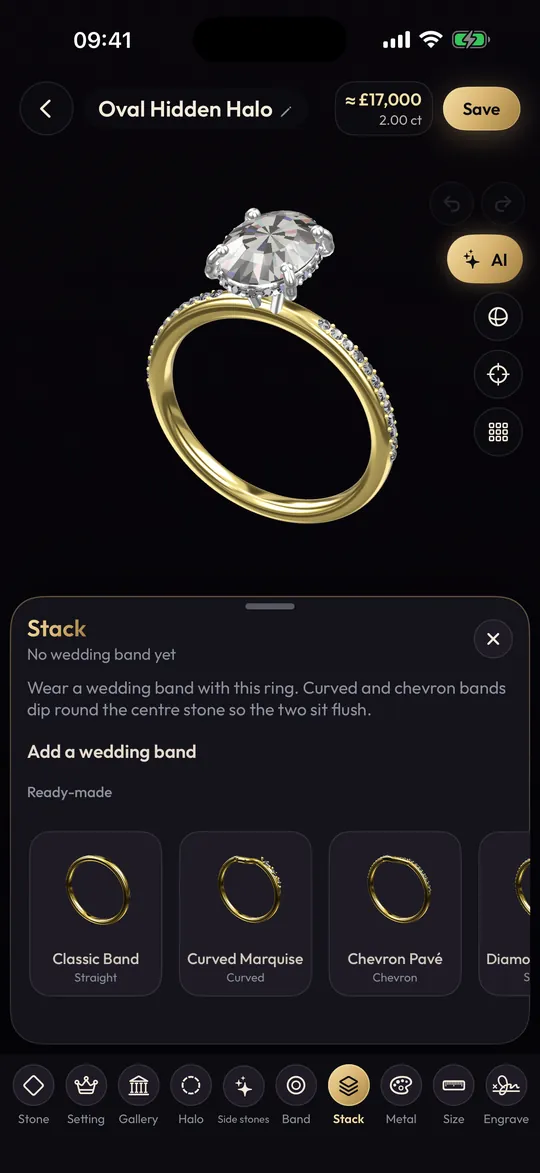
Ring Studio does not have a dedicated comfort-fit or court profile option for men's bands yet; describe the profile you want to your jeweller alongside the design.
Quick decisions
- Want the diamond to look biggest: about 1.6 to 2 mm, tapered.
- Want a durable everyday ring: 2 to 2.5 mm with good depth.
- Want a neat bridal stack: match widths, or go slightly narrower on the wedding band.
- Men's band, not sure: 5 to 6 mm is a safe starting point to try on.
Frequently asked questions
What is the most popular wedding band width?
There is no official figure, but jewellers commonly sell women's wedding bands around 2 to 3 mm and men's around 5 to 6 mm. Matching the engagement ring's band width is a popular choice for a neat stack.
Does a wider ring need a bigger size?
Often yes. Bands of about 6 mm or more cover more of the finger and feel tighter, so many people go up a quarter to half a size. Try a sizing ring of similar width before ordering.
Is a 2 mm band too thin?
Not for a light engagement ring, and very fine bands are popular. Bands under about 1.8 mm, especially pavé ones, are more prone to bending and wear, so a bit more depth (thickness) helps.
What is the difference between ring width and thickness?
Width is how far the band runs along your finger, seen from above. Thickness, or depth, is how much metal sits between the inside and outside of the band. Both affect strength and comfort.
What band width suits short fingers?
Narrow to medium bands, roughly 1.5 to 3 mm, tend to leave more visible finger and look balanced. Wide bands can make short fingers look shorter, though personal taste matters more than rules.