 Ring Studio
Parts of a Ring: Ring Anatomy Explained
The main parts of a ring are the centre stone, the head (the setting that holds it, made of prongs or a bezel), the gallery and bridge beneath it, the shoulders where the band meets the head, and the shank, the band that goes round the finger. Knowing these terms makes it far easier to explain to a jeweller exactly what you want.
On this page
- Top
- Centre stone, prongs or bezel, halo
- Middle
- Head, basket, gallery, bridge, under-bezel or hidden halo
- Sides
- Shoulders, side stones, cathedral arches
- Bottom
- Shank (band), inside surface, sizing area
- Why it matters
- Precise words make briefing a jeweller faster and clearer
- In Ring Studio
- Each part can be edited separately in 3D
The parts of a ring, from top to bottom
Jewellers describe rings from the top down, roughly in the order you would see them on a hand. The table below gives a quick overview; each part is explained in more detail beneath.
| Part | Where | What it does |
|---|---|---|
| Centre stone | Top | The main gem |
| Prongs (claws) | Around the stone | Grip the stone at its girdle |
| Bezel | Around the stone | A metal rim that holds the stone instead of prongs |
| Halo | Around the stone | A ring of small stones framing the centre |
| Head | Under and around the stone | The whole setting that holds the centre stone |
| Basket | Within the head | The cup formed by prongs and rails |
| Gallery | Below the stone, side view | The metalwork between stone and band |
| Under-bezel / hidden halo | Just below the girdle | A collar of metal, sometimes set with stones |
| Bridge | Under the head, side view | Connects the head to the shoulders |
| Shoulders | Either side of the head | Where the band rises to meet the head |
| Shank | Around the finger | The band itself |
Centre stone
The main gem. Its parts have names too: the table is the flat top facet, the crown is the angled upper section, the girdle is the narrow outer edge where prongs grip, the pavilion is the lower, cone-shaped section, and the culet is the point or small facet at the bottom. Our page on diamond cut grades explains how these proportions affect sparkle.
Prongs (claws) and tips
Prongs, called claws in the UK, are the metal wires that rise up and fold over the girdle to hold the stone. Settings usually have four, five, six or eight. The tip is the part that touches the stone, and its shape is a design choice: round, claw (pointed), double (paired) or petite, plus V-prongs that protect points on pear, marquise and princess stones. Tips wear over time and are rebuilt by re-tipping. See four prong and six prong rings.
Bezel
A bezel replaces prongs with a continuous rim of metal around the girdle. A full bezel surrounds the stone completely; a half bezel covers two sides. It is the most protective way to set a stone. See bezel set engagement rings.
Halo
A halo is a ring of small stones, usually pavé-set, surrounding the centre stone at roughly the height of its girdle. It makes the centre look larger and adds sparkle. A hidden halo sits below the girdle instead, invisible from above. See halo and hidden halo engagement rings.
Head
The head is the whole assembly that holds the centre stone: prongs or bezel plus the structure that joins them. Heads are often made as separate components and soldered onto the shank, which is why a jeweller can replace a worn head without remaking the whole ring. Head height affects how exposed the stone is and whether a wedding band can slip underneath.
Basket
The basket is the cup-like structure inside the head formed by the prongs and any horizontal rails that join them. The terms basket and rail gallery are often used together: a basket setting is a head whose prongs are joined by rails.
Gallery
The gallery is the metalwork beneath the stone, visible from the side. It may be open (just prongs), railed, curved into a tulip or flame shape, crossed like a trellis, or decorated with scrolls. It is one of the main ways two otherwise similar rings differ. See ring gallery styles for every type.
Under-bezel
An under-bezel is a collar of metal around the base of the head, below the stone's girdle. It strengthens the head, gives the prongs a common base and adds a clean line in profile. When small stones are set into it, it becomes a hidden halo.
Bridge
The bridge is the section beneath the head that connects it to the shoulders, best seen from the side. On many rings it is a simple curved arch; on others it carries detail such as accent stones, filigree or hidden initials. Some jewellers use bridge and gallery loosely for the same area; strictly, the gallery is part of the head and the bridge is the support beneath it.
Shoulders
The shoulders are the upper parts of the shank on either side of the head. They are prime design territory: pavé stones, side stones, tapered or knife edge profiles, and engraving all live here. In a cathedral setting, the shoulders sweep up into arches that support the head. In a split shank, each shoulder divides into two strands.
Shank
The shank is the band that circles the finger. It is described by:
- Width: measured across the top of the finger, in millimetres. See the ring width guide.
- Thickness (depth): from outer to inner surface; thin shanks bend more easily.
- Profile: the cross-section shape, such as court (comfort fit), flat, D-shape or knife edge.
- Shape: straight, tapered towards the head, twisted, bypass or split.
- Inside: where engraving goes, and where the hallmark is usually stamped in the UK. See ring hallmarks.
- Base (sizing area): the bottom of the shank, where a jeweller cuts and adds or removes metal to resize.
Side stones and accents
Stones set on the shoulders beside the centre stone, from a pair of trillions to tapered baguettes or rows of pavé. See side stone engagement rings.
Why the vocabulary matters
When you brief a jeweller, "a slightly lower head with a rail gallery, a tapered shank and pavé on the shoulders" says in one sentence what might otherwise take several photos and a lot of pointing. The terms also help you compare quotes, because you can check that two jewellers are describing the same ring. Our guide to working with a jeweller covers the rest of the process.
Exploring ring anatomy in Ring Studio
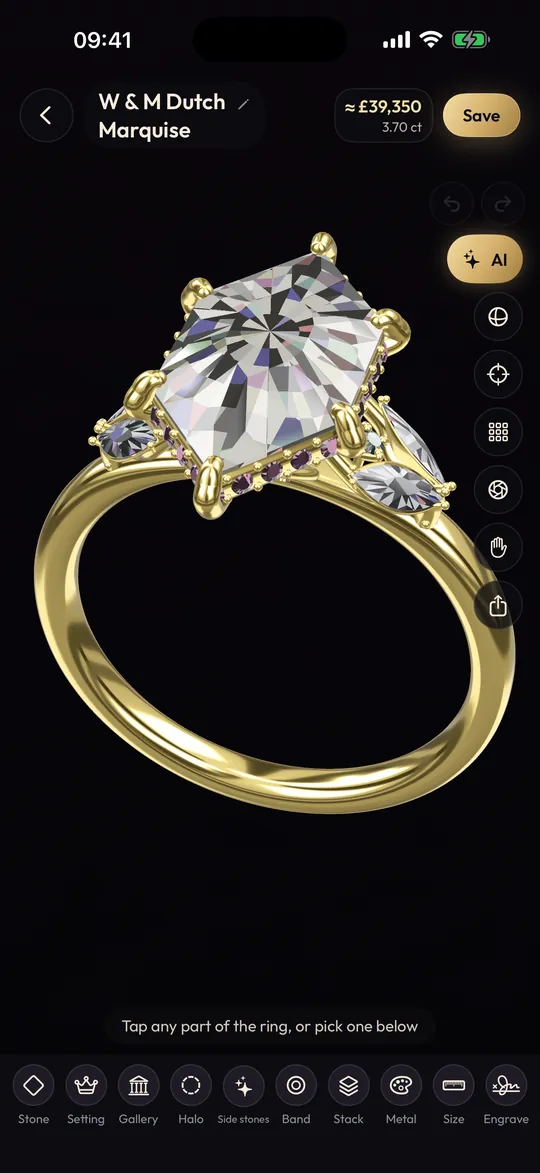
Ring Studio splits the ring into the same parts, so building one is a hands-on way to learn the anatomy.
- Centre stone: 28 shapes, natural or lab-grown diamond and coloured gems, carat size, north-south or east-west.
- Head and prongs: 4, 5, 6 or 8 prong, bezel, lotus or compass, with round, claw, double or petite tips.
- Halo: none, hidden halo or classic halo.
- Gallery: open, rail, tulip or flame.
- Shoulders: side stones (three stone, pears, marquise, leaf V, baguettes, kites) and hidden initials on top of the band.
- Shank: plain, pavé, eternity, knife edge, twisted, bypass, asymmetric or engraved; straight or tapered; adjustable width; engraving inside.
Rotate and zoom to see how each part connects, then share the ring code with a jeweller who can rebuild it in their own CAD.
Quick glossary
- Collet: another word for a bezel-style setting, common in the UK.
- Seat: the notch cut inside each prong where the girdle rests.
- Milgrain: a beaded edge on metal, typical of vintage rings.
- Pavé: small stones set closely, held by tiny beads of metal.
- Profile: the side view of a ring, or the cross-section of a band.
For many more terms, see the ring design glossary.
Frequently asked questions
What are the parts of a ring called?
The main parts are the centre stone, the head or setting, the prongs or claws, the gallery, the bridge, the shoulders and the shank. Rings may also have a halo, side stones, a hidden halo or under-bezel, and a basket.
What is the shank of a ring?
The shank is the band, the part of the ring that circles the finger. Its shape, width and thickness are described separately, and the bottom of the shank is where a ring is usually resized.
What is the bridge of a ring?
The bridge is the part of the ring that sits under the centre stone and connects the head to the shoulders, visible from the side. It often carries decorative details, hidden stones or engraving.
What is the head of a ring?
The head is the setting that holds the centre stone: the prongs or bezel together with the structure that joins them. Heads are often made separately and soldered onto the shank.
What is an under-bezel?
An under-bezel is a collar of metal beneath the centre stone, below the girdle, that supports the head. When it is set with small stones it becomes a hidden halo.