 Ring Studio
Ring Design Glossary
This ring design glossary explains more than 90 terms jewellers use, from basket, bezel and culet to milgrain, pavilion and tulip gallery, in plain English and alphabetical order. Keep it open when you read a quote, a grading report or a CAD render.
- Terms
- 90+, alphabetical
- Covers
- Ring parts, settings, cuts, metals, grading
- Most confused pair
- Carat (weight) vs karat (gold purity)
- See also
- Our illustrated guide to ring anatomy
Terms link to deeper guides where we have one. For a visual walk-through of the main parts, see parts of a ring explained.
A-B
| Term | Meaning |
|---|---|
| Art Deco | A 1920s-30s design movement: geometric shapes, step cuts, strong symmetry and contrast. See Art Deco engagement rings. |
| Asscher cut | A square step cut with deeply cropped corners and a "hall of mirrors" look, created in the early 20th century. |
| Asymmetric band | A band whose two sides differ, for example one shoulder set with stones and the other plain. |
| Baguette | A small rectangular step-cut stone, often used as side stones. |
| Basket | The structure of prongs and supporting wires that cradles the centre stone. |
| Bezel setting | A rim of metal surrounding the stone's edge, holding it securely. See bezel set rings. |
| Bow tie | A dark, bow-shaped shadow across the centre of some ovals, pears and marquises caused by facets that leak light. |
| Bridge | A bar of metal under the centre stone joining the two sides of the setting, sometimes decorated. |
| Brilliant cut | A faceting style with many triangular and kite-shaped facets designed for maximum sparkle, as in the round brilliant. |
| Bullet | A long, narrow stone shape with one pointed end, usually used as a side stone. |
| Bypass | A band whose two ends pass alongside each other rather than meeting, wrapping around the centre stone. See bypass rings. |
C
| Term | Meaning |
|---|---|
| CAD | Computer-aided design. Jewellers model rings in CAD before 3D printing and casting. |
| Carat (ct) | A unit of gemstone weight: 1 ct = 0.2 grams. Not a measure of size; see the carat size chart. |
| Casting | Pouring or forcing molten metal into a mould to form the ring. |
| Cathedral setting | A setting where arches of metal rise from the shoulders to support the head, like a cathedral vault. |
| Channel setting | Small stones set in a row between two parallel walls of metal, with no prongs between them. |
| Claw | Another word for a prong; also a pointed prong tip that tapers like a claw. |
| Clarity | A grade describing a diamond's inclusions and blemishes, from Flawless to Included. See diamond clarity. |
| Cluster | A group of small stones set together to resemble one larger stone or a flower. |
| Colour grade | For white diamonds, a letter grade from D (colourless) to Z (light yellow or brown). See diamond colour. |
| Comfort fit | A band with a rounded inner surface so it slides on and sits more comfortably. |
| Compass setting | Four prongs placed at north, south, east and west rather than at the corners. |
| Contour band | A wedding band shaped to curve around an engagement ring's setting so the two sit flush. See curved bands. |
| Crown | The upper part of a cut gemstone, above the girdle. |
| Culet | The tiny point or facet at the very bottom of a stone. Old cuts often have a visible open culet. |
| Cushion cut | A square or rectangular stone with rounded corners and curved sides, like a pillow. |
| Cut grade | A grade for how well a diamond's proportions and finish return light. See cut grades. |
D-F
| Term | Meaning |
|---|---|
| Double prong | Two thin prongs placed side by side at each holding point, for security and a distinctive look. |
| Dutch marquise | A marquise-like shape with flatter, more angular sides, often step-cut. |
| East-west | A stone set horizontally across the finger rather than lengthways. See east-west rings. |
| Emerald cut | A rectangular step cut with cut corners and long, parallel facets. |
| Epaulette | A five-sided side stone shape, resembling a military shoulder ornament. |
| Eternity band | A band set with stones all the way around (full) or across the top half (half eternity). |
| Facet | A flat polished surface cut on a gemstone. |
| Fancy shape | Any diamond shape other than round brilliant. |
| Filigree | Delicate openwork made from fine metal threads or pierced patterns, typical of Edwardian rings. |
| Fire | Flashes of spectral colour as white light is split by the stone. |
| Flame gallery | A decorative gallery style whose metalwork beneath the stone rises in flowing, flame-like curves. |
| Fluorescence | A glow, usually blue, some diamonds show under ultraviolet light. Noted on grading reports. |
| Flush setting | A stone sunk into a drilled hole so its table sits level with the metal surface. |
G-H
| Term | Meaning |
|---|---|
| Gallery | The part of the setting under the stone, seen from the side. See gallery styles. |
| GIA | Gemological Institute of America, a widely recognised gem grading lab. See GIA vs IGI. |
| Gimmel ring | A historic ring of two or three interlocking hoops that fit together into one. |
| Girdle | The narrow outer edge of a stone, where crown meets pavilion. Grading report numbers are often laser-inscribed here. |
| Half moon | A semicircular side stone, usually set in pairs either side of a centre stone. |
| Hallmark | An official mark stamped on precious metal showing its fineness and who made it. See hallmarks. |
| Halo | A ring of small stones surrounding the centre stone. See halo rings. |
| Head | The part of the ring that holds the centre stone: prongs, basket or bezel. |
| Hidden halo | A row of small stones set under the centre stone, visible only from the side. See hidden halo rings. |
| Hidden initials | Letters set in a discreet place, such as under the stone, visible mainly to the wearer. |
I-L
| Term | Meaning |
|---|---|
| IGI | International Gemological Institute, a grading lab widely used for both natural and lab-grown diamonds. |
| Inclusion | An internal characteristic in a gemstone, such as a crystal, feather or cloud. |
| Karat (k) | Gold purity in 24ths: 18k is 75% gold, 14k 58.3%, 9k 37.5%. See gold karats. |
| Kite | A four-sided stone shaped like a kite, with one long and one short point. |
| Knife edge | A band that rises to a narrow ridge on top, catching light along the edge. |
| Lab-grown diamond | A diamond grown in a laboratory, chemically and physically the same as a mined one. |
| Length-to-width ratio | How elongated a stone is: length divided by width. An oval of 1.40 is noticeably longer than one of 1.25. |
| Lost-wax casting | A casting method in which a wax or resin model is burned out of a mould and replaced with metal. |
| Lotus setting | A basket whose prongs and supports are shaped like the petals of a lotus flower. See lotus settings. |
| Loupe | A small magnifying glass, usually 10x, used by jewellers to inspect stones. |
| Lozenge | A diamond-shaped (rhombus) stone, often step-cut. |
M-O
| Term | Meaning |
|---|---|
| Marquise | A long stone with two pointed ends and curved sides. |
| Micro pavé | Pavé with very small stones, often under about 1 mm each. |
| Milgrain | A border of tiny beads of metal along an edge. |
| Mohs scale | A 1-10 scale of scratch hardness. Diamond is 10, sapphire and ruby 9, emerald 7.5-8. |
| Moissanite | Silicon carbide, a lab-made diamond alternative with a hardness of 9.25. See moissanite. |
| Mounting | The metal part of a ring without its stones. |
| Moval | A shape between an oval and a marquise: oval-like with gently pointed ends. |
| North-south | A stone set lengthways along the finger, the usual orientation. |
| Octagon | An eight-sided stone shape, often step-cut. |
| Old European cut | An antique round cut with a small table, high crown and open culet. |
| Old mine cut | An antique cushion-shaped brilliant with chunky facets and a high crown. |
| Open gallery | A gallery where the prongs rise without connecting rails, letting in more light. |
P-R
| Term | Meaning |
|---|---|
| Palladium | A white platinum-group metal, lighter than platinum. See palladium. |
| Patina | The soft satin surface platinum develops with wear. |
| Pavé | Small stones set close together across a surface, held by tiny beads of metal. See pavé rings. |
| Pavilion | The lower part of a cut gemstone, below the girdle. |
| Pear | A teardrop shape with one rounded end and one point. |
| Petite prong | A small, fine prong that shows as much of the stone as possible. |
| Platinum 950 | Platinum alloy that is 95% pure, the most common jewellery standard. |
| Point | One hundredth of a carat. A 0.50 ct stone is "50 points". |
| Princess cut | A square brilliant-cut stone with pointed corners. |
| Profile | The side view of a ring; also the cross-section shape of a band. |
| Prong | A metal tine that holds a stone. Rings commonly have 4, 5, 6 or 8. See 4 vs 6 prong. |
| Radiant cut | A rectangular or square stone with cut corners and brilliant faceting. |
| Rail gallery | A gallery in which a horizontal rail of metal connects the prongs beneath the stone. |
| Rhodium plating | A thin coating of rhodium that makes white gold bright white. See rhodium plating. |
| Rose cut | An antique cut with a flat base and a domed top covered in triangular facets. |
| Rose gold | Gold alloyed with copper for a pink tone. |
S
| Term | Meaning |
|---|---|
| Scintillation | The sparkle pattern of light and dark flashes as a stone moves. |
| Setting | The way a stone is held (prong, bezel, channel) or the whole mount itself. |
| Shank | The band of the ring that goes around the finger. |
| Shield | A stone shaped like a heraldic shield, often used as a centre stone or side stones. |
| Shoulders | The upper parts of the band either side of the setting. |
| Side stones | Stones flanking the centre stone. See side stone rings. |
| Solitaire | A ring with a single centre stone and no other stones. |
| Split shank | A band that divides into two strands as it approaches the setting. |
| Stacking | Wearing several rings together, typically an engagement ring with one or more bands. |
| Step cut | Faceting with long, parallel, step-like facets, as in emerald and asscher cuts. |
T
| Term | Meaning |
|---|---|
| Table | The large flat facet on top of a cut stone. |
| Tapered band | A band that narrows as it approaches the setting, making the stone look larger. |
| Tapered baguette | A baguette narrower at one end, used as side stones pointing towards the centre. |
| Tension setting | A setting where the band's pressure appears to hold the stone suspended between its ends. |
| Three stone | A centre stone with one side stone either side. See three stone rings. |
| Toi et moi | "You and me": a ring with two main stones side by side. |
| Trapezoid | A four-sided stone with two parallel sides, used as side stones. |
| Trellis | Prongs that cross over each other beneath the stone in an X pattern. |
| Trillion | A triangular stone, used as a centre stone or as side stones. |
| Tulip gallery | A gallery with petal-like curves under the stone, resembling a tulip from the side. |
| Twisted band | A band made of strands that twist around each other, like rope. |
| Two-tone | Two metal colours in one ring, often white prongs on a yellow gold band. See two-tone metals. |
U-Y
| Term | Meaning |
|---|---|
| Under-gallery | Decorative detail beneath the setting, between the gallery and the band. |
| V-prong | A V-shaped prong that protects a point on a pear, marquise, princess or heart. |
| Valuation | A written estimate of replacement cost, used for insurance. |
| Vintage | Strictly, an older piece; often used for new rings in older styles. |
| Wedding band | The ring given at the wedding ceremony, usually worn with the engagement ring. See wedding band styles. |
| White gold | Gold alloyed with white metals, usually rhodium plated. |
| Yellow gold | Gold alloyed with silver and copper to keep a warm yellow colour. |
See these terms in 3D with Ring Studio
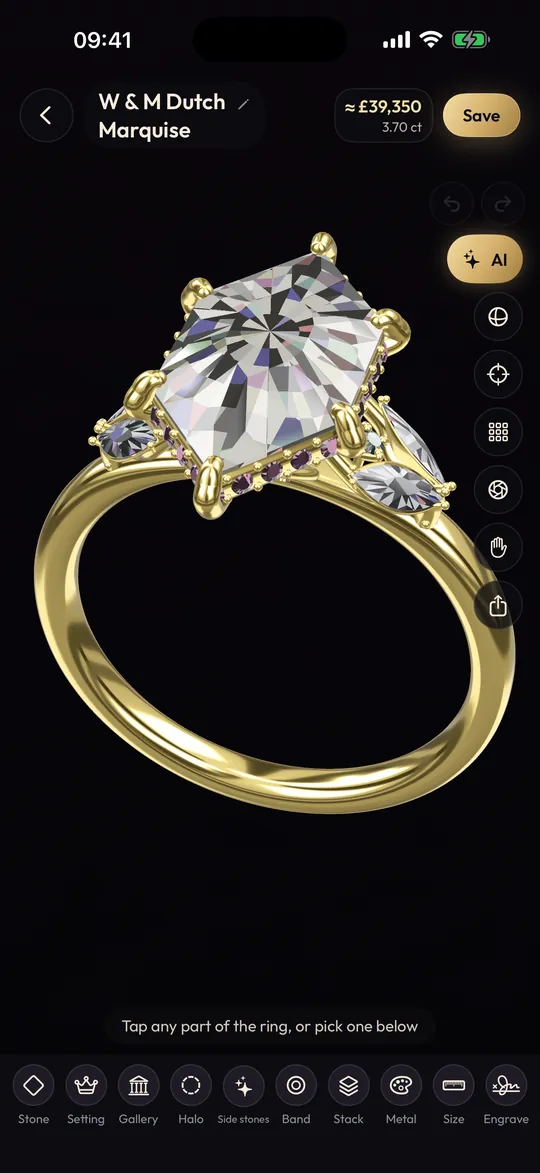
Words like "tulip gallery" or "hidden halo" make much more sense when you can rotate a ring and see them. Ring Studio, a 3D ring design app for iPhone, iPad and Android, uses many of the terms above as its own options:
- Settings: 4, 5, 6 and 8 prong, bezel, lotus and compass; prong tips round, claw, double or petite.
- Halos: none, hidden halo or classic halo.
- Galleries: open, rail, tulip and flame.
- Bands: plain, pavé, eternity, knife edge, twisted, bypass, asymmetric and engraved; straight or tapered.
- Shapes: 28, from round and oval to epaulette, lozenge, half moon and old mine.
Switch between options and watch the ring change, then share the design with a jeweller using the same vocabulary. Ring Studio doesn't have dedicated options for cathedral, tension, split shank, trellis or cluster designs yet; for those, talk to your jeweller.
Where to go next
If you're working on a custom ring, our guide to working with a jeweller shows how to put these terms into a clear brief, and the 4Cs guide explains the grading words on a diamond report.
Frequently asked questions
What are the main parts of an engagement ring?
The centre stone, the setting or head that holds it (prongs or a bezel), the gallery underneath, the shoulders where the band meets the setting, and the band or shank that goes around the finger.
What is the difference between carat and karat?
Carat measures a gemstone's weight (one carat is 0.2 grams). Karat measures gold purity out of 24 parts, so 18k gold is 75% pure gold.
What does gallery mean on a ring?
The gallery is the part of the setting under the stone, visible from the side. It can be open, joined by a rail, or shaped into decorative forms such as a tulip.
What is a shank on a ring?
The shank is the band of the ring that encircles the finger. Shanks can be straight, tapered, split, twisted or set with stones.
What does milgrain mean?
Milgrain is a row of tiny metal beads along the edge of a band or setting, typical of Edwardian and vintage-style rings.