 Ring Studio
Lotus Setting Engagement Rings
A lotus setting engagement ring holds the centre stone in a head shaped like an opening flower, with petal-shaped metal rising around the base of the stone. It reads as a solitaire from above and as a small sculpture from the side.
On this page
- What is a lotus setting engagement ring?
- How a lotus head differs from other heads
- Which stone shapes suit a lotus setting?
- Pros and cons of a lotus setting
- Is a lotus setting secure enough for everyday wear?
- Cleaning and caring for a lotus ring
- What does a lotus setting cost?
- Designing a lotus engagement ring in Ring Studio
- Lotus setting or something similar?
- What it is
- A head with petal-shaped metal cupping the base of the centre stone
- Seen best
- From the side (the profile), where the flower shape shows
- Best shapes
- Round, oval, cushion; pear and marquise with care
- Security
- Good: petals add structure, prongs or tips do the gripping
- Care
- Weekly soft-brush clean; petals trap soap and lotion
- In Ring Studio
- Lotus is one of the setting options (Pro)
What is a lotus setting engagement ring?
Most engagement ring heads are built from straight wires: four or six prongs, sometimes joined by a rail. A lotus setting swaps those straight lines for curves. Several petal-shaped sections of metal rise from the base of the head and open outwards around the lower half of the stone, the way the outer petals of a lotus flower open around its centre. The stone sits in the middle, and the tips that actually hold it rise from the petals or sit between them.
From directly above, a lotus ring looks much like a classic solitaire: you see the stone and a few small tips at its edge. The design reveals itself when the hand turns. In profile, the petals form a flower that the stone appears to bloom out of. That is the whole appeal: a quiet ring face-up, with a detail that rewards a closer look.
Jewellers sometimes call related designs a petal setting, a floral basket or a flower head. The terms overlap, and there is no single industry standard for how many petals a lotus head has or how high they rise, so it is worth agreeing the exact look with your jeweller using pictures or a 3D model.
How a lotus head differs from other heads
The gallery is the part of the head below the stone that you see from the side. Lotus overlaps with several gallery styles, but is not quite any of them.
| Head or gallery | What you see from the side | Character |
|---|---|---|
| Open prong | Straight prongs, nothing between them | Minimal, lets in the most light |
| Rail | Prongs joined by one or two horizontal bars | Tidy, structural, very common |
| Tulip | Prongs that curve outwards like a closed tulip | Soft, slightly vintage |
| Lotus | Separate petals opening around the stone | Floral and sculptural, the most decorative of the four |
| Bezel | A solid collar of metal around the girdle | Modern, protective, hides the pavilion |
The practical difference is coverage. Petals cover more of the stone's pavilion than an open head, less than a bezel. You get some of a bezel's protection for the lower stone while keeping the open, prong-held look at the top.
Which stone shapes suit a lotus setting?
Because the petals follow the outline of the stone, soft shapes are the natural fit.
- Round: the classic choice. The petals can be spaced evenly, typically five or six, so the flower is symmetrical from every angle. See our round engagement ring guide.
- Oval: elongates the flower and looks especially graceful on the finger. Petals at the ends help protect the narrower tips. More in the oval guide.
- Cushion: the rounded corners of a cushion sit naturally in curved petals, and the result has an antique flavour.
- Pear and marquise: workable, but the points are the weak spots, so a petal or a V-tip needs to cover each point. Without that, you lose the main security benefit of the shape-specific head.
- Emerald, asscher, princess: possible, but straight sides and sharp corners fight the organic petals. Most people who love step cuts prefer a rail or compass head instead.
Pros and cons of a lotus setting
| Pros | Cons |
|---|---|
| Distinctive profile without changing the classic top view | More nooks to collect soap, lotion and dust |
| Petals add rigidity to the head | Slightly more metal, so marginally higher cost |
| Covers more of the pavilion than an open head | Can block a little side light into the stone |
| Works as a canvas for hidden details below the stone | Fewer off-the-shelf options, often a custom job |
| Pairs well with plain or pavé bands | A tall head can make wedding band pairing harder |
Is a lotus setting secure enough for everyday wear?
Security in any head comes from two things: how firmly the tips grip the girdle and how rigid the structure beneath is. A lotus head scores well on the second, since the petals act like built-in braces. The first depends on the tips, which wear like any other prong. Have a jeweller check them every six to twelve months, and sooner if you feel a catch on clothing or hear a rattle when you tap the ring gently near your ear.
Height matters too. A lotus head that lifts the stone high is more exposed to knocks. If you work with your hands or play sport, ask for a lower head, and read our guide to rings for an active lifestyle.
Cleaning and caring for a lotus ring
The same curves that make the setting beautiful also trap grime. Soak the ring in warm water with a drop of washing-up liquid for a few minutes, then brush between the petals with a soft toothbrush, working from underneath where residue builds up. Rinse and pat dry. Our engagement ring care guide covers ultrasonic cleaners, which are fine for diamonds but not for every gemstone.
What does a lotus setting cost?
The head itself adds relatively little: a few extra grams of metal and more setting and finishing time. The stone, metal and band choice dominate the price. Because lotus heads are less common in ready-made ranges, many are made to order, which usually means a design fee or a higher making charge. For a sense of how those pieces add up, see how much a custom engagement ring costs.
Designing a lotus engagement ring in Ring Studio
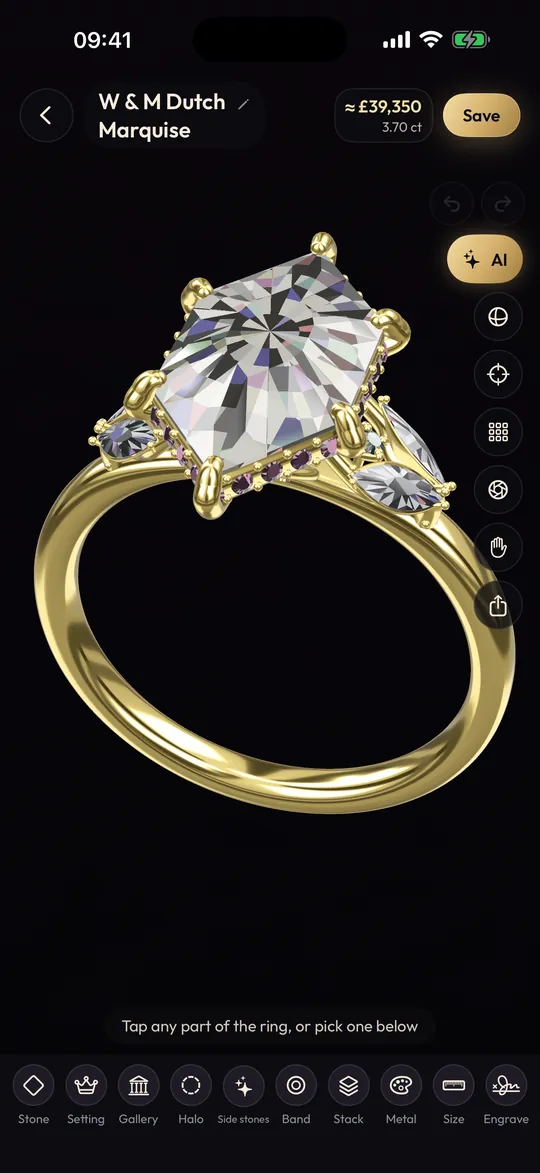
Lotus is one of the setting options in Ring Studio (part of Pro), so you can see the petal head on your chosen stone in real time 3D before you speak to a jeweller.
- Pick a stone shape from the tray: round, oval or cushion are good starting points. Set the carat size.
- Under settings, choose Lotus. Rotate the ring to look at the profile, which is where the setting does its work.
- Try it with no halo first. Then compare with a hidden halo, which adds a ring of sparkle under the petals.
- Choose the band: a plain or tapered band keeps attention on the flower; a pavé band adds glitter along the shoulders.
- Add hidden initials under the stone if you want a private detail in the gallery area.
- Check the live price estimate, then share the ring code or screenshots with your jeweller.
You can also describe it to the AI designer, for example "oval lab diamond in a rose gold lotus setting with a thin pavé band", and refine from there.
Lotus setting or something similar?
If you love the idea of a decorative profile but want something cleaner, a tulip gallery gives a softer curve with less metal. If you want maximum protection for a soft gemstone such as morganite or emerald, a bezel or a lotus head with a bezel collar may suit better. Our ring anatomy guide explains each part of the head so you can describe exactly what you want.
Frequently asked questions
What is a lotus setting on a ring?
A lotus setting is a head made of curved, petal-shaped metal sections that cup the lower part of the centre stone, so the side view looks like a flower opening. The stone is usually still secured by prongs that rise from or between the petals.
Is a lotus setting secure?
A well-made lotus head is at least as secure as a standard prong head, because the petals add structure around the pavilion of the stone. Security still depends on the prongs or tips that grip the girdle, so those need the same regular checks as any prong setting.
Does a lotus setting make the diamond look smaller?
From the top it barely changes the face-up size, because the petals sit mostly below the girdle. It can block a little light from entering the sides of the stone, which matters less with well-cut diamonds that take most of their light through the table and crown.
Which stone shapes suit a lotus setting?
Round, oval and cushion stones suit a lotus head best because the petals can follow a soft outline. Pear and marquise work with petals arranged to protect the points, while sharply angular cuts such as emerald and asscher can look at odds with the organic shape.
Is a lotus setting hard to clean?
The curved petals create small pockets where soap and skin oils collect, so it needs a soft brush and warm soapy water every week or two, and a professional clean now and then. It is no harder to care for than a basket or tulip gallery.