 Ring Studio
Bezel vs Prong Setting: Which Holds a Stone Better?
Bezel vs prong is a choice between protection and light: a bezel wraps the stone in a rim of metal for maximum security and a smooth, modern look, while prongs hold it with a few slim claws so more light reaches the stone and it looks bigger and brighter.
On this page
- Bezel vs prong comparison table
- Security: how each setting protects the stone
- Sparkle and apparent size
- Snagging and everyday comfort
- Shape matters
- Cleaning and maintenance
- Choose a bezel if... choose prongs if...
- Compare bezel and prong settings in Ring Studio
- A middle path
- Do bezels work with coloured stones?
- Most secure
- Bezel
- Most sparkle and apparent size
- Prongs
- Least snagging
- Bezel
- Easiest to clean
- Bezel on top; prongs let you reach under the stone more easily
- Best for pointed shapes
- Bezel, or prongs with V-tips at the points
Bezel vs prong comparison table
| Bezel | Prong (claw) | |
|---|---|---|
| How it holds the stone | A continuous metal rim around the girdle | Usually 4 or 6 slim claws bent over the edge |
| Security | Very high; edge fully protected | High if maintained; tips can wear or bend |
| Light and sparkle | Slightly reduced side light | Maximum light entry |
| Apparent size | Stone can look a touch smaller | Stone looks its full size or larger |
| Snagging | Smooth, very little | Tips can catch on fabric |
| Look | Modern, sleek, sometimes retro | Classic, the "traditional" engagement ring |
| Repairs | Rare, but resetting is more work | Re-tipping is common and straightforward |
| Cost | Similar; sometimes slightly more metal and labour | Similar |
Security: how each setting protects the stone
Diamonds are the hardest natural material, at 10 on the Mohs scale, but hardness is not toughness. A sharp knock on the girdle, especially at a point or corner, can chip even a diamond. A bezel setting covers that girdle completely, so the most vulnerable part of the stone is shielded. It is the setting jewellers most often suggest for nurses, climbers, gardeners and anyone who is rough on their hands.
Prongs leave most of the girdle exposed. They are very secure in normal wear, but each claw is a small piece of metal that thins over years of contact. A worn or bent prong is the classic reason stones go missing. Six prongs add redundancy compared with four; claw or double prongs add more grip still.
Sparkle and apparent size
Light enters a stone through its crown and sides and bounces back out. Prongs let light in from nearly every direction, and the slim claws cover very little of the stone, so it looks as large and bright as it can.
A bezel blocks some light from the sides and frames the stone with a band of metal. In a white metal like platinum or white gold, the rim can blend with the stone and the effect on apparent size is small. In yellow gold, the rim is a visible frame, which reads as intentional and bold. A partial (half) bezel, covering only two sides, is a compromise that keeps more light while still protecting the edges.
Snagging and everyday comfort
The smooth outline of a bezel is a big quality-of-life win: no catching on jumpers, tights or hair. High prong heads are more likely to snag, especially with claw tips. Lower-set prongs and rounded tips help a lot.
Shape matters
- Pear, marquise, princess, trillion: the points and corners are prone to chipping. A bezel protects them fully; with prongs, choose V-tips or a prong right at each point.
- Round and oval: look superb in either. Round solitaires in 4 or 6 prongs are the classic look.
- Emerald and asscher: their step-cut facets show off a clean bezel well, giving a strong Art Deco feel.
Cleaning and maintenance
A bezel's closed sides mean less dirt gets trapped on top, but grease can collect under the stone, and you cannot reach it as easily. Prong settings are open, so a soft brush and warm soapy water reach the pavilion directly. See our ring care guide for a safe routine. Prongs need checking more often; bezels mostly need checking only if the rim is knocked hard.
Choose a bezel if... choose prongs if...
Choose a bezel if you work with your hands, play sport, hate snagging, have a stone with fragile points, or love a sleek modern or minimalist look.
Choose prongs if you want the most sparkle and size from your stone, you want the traditional engagement ring look, or you like being able to see as much of the stone as possible from the side. Our 4 prong vs 6 prong comparison helps with the next decision.
Compare bezel and prong settings in Ring Studio
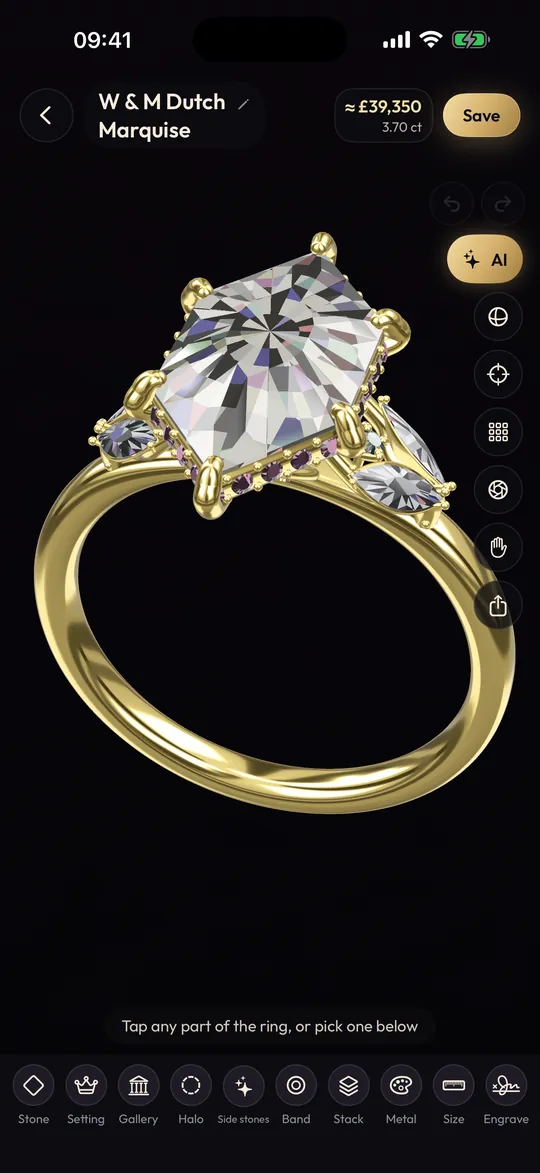
Ring Studio offers 4, 5, 6 and 8 prong heads, a bezel, and lotus and compass settings, plus prong tip styles (round, claw, double, petite). To compare:
- Choose your stone shape and carat.
- Set the head to bezel and rotate the ring to see how the rim frames the stone, especially in yellow versus white metal.
- Switch to 6 prong or 4 prong with round or claw tips, and compare the top and side views.
- Try it on your hand with the camera (Pro) to judge whether the bezel makes the stone look smaller to you.
A middle path
If you are torn, consider a half bezel, a bezel in white metal on a yellow-gold band, or claw prongs set low. Each gives some of the protection of a bezel with more of the light of a prong head. A jeweller can advise on what suits your stone's depth and shape.
Do bezels work with coloured stones?
Very well. A bezel protects softer gems, such as emeralds at 7.5-8 on the Mohs scale, far better than prongs, and a yellow gold rim can intensify warm colours. For tougher stones like sapphires, it is a style choice rather than a necessity.
Verdict
For security and an easy, snag-free life, choose a bezel. For maximum sparkle and the classic look, choose prongs and get them checked once a year. If your stone has fragile points or you are hard on your hands, the bezel's protection is worth the small trade in brightness.
Frequently asked questions
Is a bezel setting more secure than prongs?
Generally yes. A full bezel grips the stone all the way around its girdle and shields the edge from knocks, so there are no individual claws to bend or wear thin. Prongs are secure when well made and checked, but each one is a potential weak point.
Does a bezel setting make a diamond look smaller?
A little. The metal rim covers the very edge of the stone, and the outline of metal reads as part of the ring rather than the stone. A thin or white-metal bezel minimises this; a thick yellow-gold bezel makes it more noticeable, though some people like that framed look.
Do bezel settings reduce sparkle?
They block some light entering from the sides, so a bezel-set stone can look slightly less lively than the same stone in an open prong head. A well-cut stone still sparkles strongly in a bezel, and open galleries under the bezel help.
Can any shape be bezel set?
Almost any. Pointed shapes such as pear, marquise and princess actually benefit, because the bezel protects the fragile tips and corners. Very large or deep stones may need a taller bezel, which affects the ring's profile.
How often should prongs be checked?
Many jewellers suggest a quick check every six to twelve months, or sooner if you notice the stone moving or a prong catching on fabric. Re-tipping worn prongs is a routine repair.