 Ring Studio
Emerald Gemstone Engagement Rings
Emerald gemstone engagement rings are beautiful but demand more care than diamond or sapphire: emerald is 7.5 to 8 on the Mohs scale, almost always included, and usually oil or resin treated. Chosen and set well, an emerald can still be worn for decades.
On this page
- Can you wear an emerald engagement ring every day?
- Emerald gemstone vs emerald cut
- Colour, clarity and the jardin
- Oil, resin and why treatment levels matter
- Does origin matter?
- How much do emerald engagement rings cost?
- The best settings to protect an emerald
- Designing an emerald ring in Ring Studio
- Caring for an emerald ring
- Mineral
- Beryl, coloured green by chromium and/or vanadium
- Hardness
- 7.5 to 8 on the Mohs scale; toughness only fair to poor
- Clarity
- Inclusions are normal; eye-clean stones are rare
- Usual treatment
- Oil (often cedarwood) or resin filling of fissures
- Main sources
- Colombia, Zambia, Brazil, Afghanistan, Ethiopia, Zimbabwe
Can you wear an emerald engagement ring every day?
Yes, with eyes open. The hardness number alone is misleading. At 7.5 to 8, emerald resists most everyday scratching better than quartz-based dust, but nearly every emerald contains fine fractures and inclusions, which make it more likely to chip or crack from a sharp knock than a sapphire or diamond. Jewellers describe emerald as having fair to poor toughness.
That doesn't rule it out. It means you design around the weakness: protected edges, no exposed corners, and a little awareness when gardening, at the gym or carrying shopping. If your partner works with their hands every day, read our guide to engagement rings for an active lifestyle before committing.
Emerald gemstone vs emerald cut
These get mixed up constantly in searches. The emerald cut is a rectangular step-cut shape with cropped corners, used for diamonds and many other stones. The emerald gemstone is green beryl. The cut was named after the stone because lapidaries developed it to protect emerald's vulnerable corners and reduce cutting stress. So an emerald gemstone in an emerald cut is the classic pairing, but you'll also see emeralds in ovals, pears, cushions and rounds.
Colour, clarity and the jardin
For emerald, colour leads and clarity follows. The most valued stones are a pure green to slightly bluish green, medium to medium-dark in tone, with strong saturation. Yellowish greens and very light stones are less valuable; a stone that's too pale may legally be called green beryl rather than emerald, depending on the lab.
Clarity is judged differently from diamond. Inclusions, called the jardin, are expected. A good emerald can show visible inclusions as long as they don't cloud the stone, cluster near the surface or edges, or create obvious cracks. Be wary of an emerald that looks perfectly clean at a low price: it may be lab-grown, heavily filled, or an imitation.
| What you see | What it means |
|---|---|
| Fine mossy inclusions, bright colour | Normal and acceptable; often the best value |
| Eye-clean, rich green, natural | Rare and expensive; get a lab report |
| Fissure reaching the surface near a corner | Durability risk; avoid for daily wear |
| Cloudy, milky appearance | Lower transparency and value |
| Flashes of colour in cracks under magnification | Possible resin filler; ask about treatment |
Oil, resin and why treatment levels matter
Filling surface-reaching fissures with colourless oil or resin has been standard practice for centuries. It makes fractures less visible and the stone look cleaner. The question isn't whether an emerald is treated, but how much.
Independent gem labs typically describe clarity enhancement on a scale such as none, minor, moderate or significant (the exact wording varies by lab). Minor oil is common in good stones; significant enhancement lowers value and means the appearance depends heavily on the filler. Oil can slowly dry out or leak over years and may need re-oiling by a specialist. Hardened resins are more stable but harder to remove.
Very occasionally, coloured oil is used to add green, which is regarded as unacceptable without disclosure. For any significant purchase, ask for a lab report stating the type and degree of clarity enhancement.
Does origin matter?
Colombian emeralds are famous for a warm, pure green and often fetch the highest prices. Zambian emeralds tend toward a slightly cooler, bluish green with good clarity and are widely available. Brazil, Ethiopia, Afghanistan and Zimbabwe also produce fine material. Origin reports are optional and add cost; they matter most for high-value stones and resale. Look at the stone first.
How much do emerald engagement rings cost?
Rough estimates for the loose stone around 1 carat in British pounds, as of late 2026, varying widely by retailer and quality:
| Quality | Rough range (GBP) |
|---|---|
| Lab-grown emerald | Roughly £100 to £600 |
| Natural, moderate oil, commercial colour | Roughly £300 to £1,500 |
| Natural, minor oil, fine green | Roughly £1,500 to £6,000+ |
| Fine untreated or insignificant enhancement, with report | Well into five figures for larger stones |
Lab-grown emeralds have the same composition and hardness as natural ones and are usually cleaner, which makes them a sensible option if durability worries you. See our engagement ring cost guide for the setting side of the budget.
The best settings to protect an emerald
- Bezel: the most protective option, wrapping the whole girdle. Ideal for daily wear.
- Halo: shields the edges with small diamonds and adds white sparkle that contrasts with green.
- Prongs on the corners: if you choose prongs for an emerald cut, make sure they protect the cut corners rather than sitting mid-edge.
- Lower profile: a stone that sits closer to the finger takes fewer knocks.
Yellow gold is the traditional pairing for emeralds and makes green look warm and rich; platinum and white gold give a cooler, crisper look. A three stone design with white diamonds either side is another classic.
Designing an emerald ring in Ring Studio
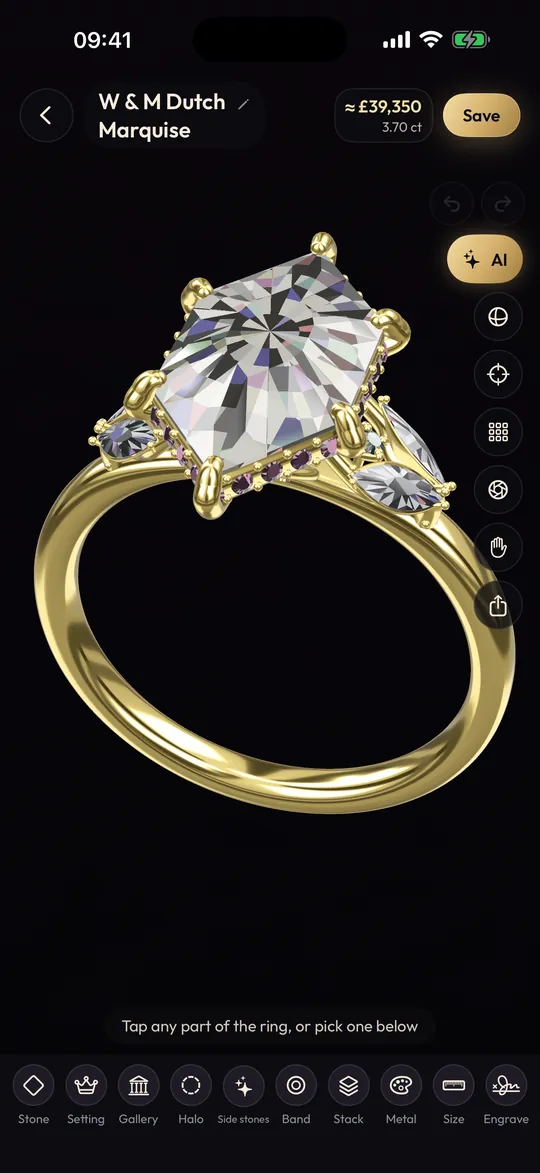
Ring Studio includes emerald as a stone option, so you can see exactly how much green your design shows and how protective the setting looks. Try this:
- Choose emerald as the stone, then the emerald cut shape (or oval, cushion or pear).
- Pick a bezel setting for maximum protection, or 4 prongs to compare the look.
- Add a hidden or classic halo and see how white stones frame the green.
- Compare yellow gold against platinum, then pick a plain or pavé band.
- Use the AI chat to make tweaks such as "lower the setting" or "make the band thinner".
The live price estimate updates as you go, as a comparison rather than a quote. Ring Studio doesn't make rings or set karats; share your ring code with a jeweller who can source a suitable emerald and build the piece.
Caring for an emerald ring
Take it off for heavy work, sport and cleaning with household chemicals. Clean with lukewarm water, mild soap and a soft brush; never use ultrasonic or steam cleaners, and avoid sudden temperature changes. Have a jeweller check the setting yearly and ask whether re-oiling is ever advisable. More general tips are in our engagement ring care guide, and if emerald is a birthstone choice for May, you're in good company.
Verdict
An emerald engagement ring is a choice made for colour and character. Buy a stone with minor enhancement and no surface-reaching fractures at the edges, protect it with a bezel or halo, and treat it a little more gently than a diamond. If you want red rather than green with more toughness, look at ruby.
Frequently asked questions
Are emeralds too soft for an engagement ring?
Emerald is 7.5 to 8 on the Mohs scale, so it is reasonably scratch resistant, but it is brittle because of its inclusions and fractures. A protective setting such as a bezel or halo and some care with knocks make it wearable every day.
Are all emeralds treated?
The great majority of emeralds have their surface-reaching fissures filled with oil or resin to improve clarity. Untreated or minor-oil emeralds exist but are rare and command significant premiums.
Can you put an emerald in an ultrasonic cleaner?
No. Ultrasonic and steam cleaners can drive out oil or damage fillers and may worsen fractures. Use lukewarm water, mild soap and a soft brush instead.
What is jardin in an emerald?
Jardin, French for garden, is the trade term for the mossy inclusions typical of emerald. Some inclusions are expected; what matters is whether they reduce transparency or weaken the stone.
Is an emerald cut the same as an emerald gemstone?
No. Emerald cut is a rectangular step-cut shape that can be used for any stone, including diamonds. An emerald gemstone is the green variety of beryl, and it is often cut in the emerald cut because the shape protects its corners.
Keep reading
 Emerald Cut Engagement Rings: Clarity, Sizes and StyleEmerald cut engagement ring guide: why clarity matters in step cuts, the best ratios, carat-to-mm sizes, settings, bands…Bezel Set Engagement RingsBezel set engagement ring guide: full vs half bezels, how a metal rim affects sparkle and size, best shapes, durability,…Halo Engagement RingsHalo engagement ring guide: how a halo adds face-up size, which shapes suit one, upkeep of small pavé stones, band pairi…Ruby Engagement RingsRuby engagement rings guide: what makes a fine red, heat vs glass-filled rubies, origins, hardness, best settings and pr…Birthstone Rings by MonthBirthstone rings by month: every modern and traditional birthstone, how hard each one is for daily wear, and ideas for e…Engagement Rings for an Active LifestyleEngagement rings for an active lifestyle: the toughest stones, low secure settings, sturdy bands and metals, plus ideas …