 Ring Studio
Ruby Engagement Rings
Ruby engagement rings combine a vivid red with corundum's hardness of 9 on the Mohs scale, making ruby one of the toughest coloured stones you can wear every day. The biggest pitfall is treatment: knowing the difference between a heated ruby and a glass-filled one protects your budget.
On this page
- Mineral
- Corundum coloured red by chromium
- Hardness
- 9 on the Mohs scale, good toughness
- Typical treatment
- Heating (often); lead-glass filling on low-grade material
- Main sources
- Mozambique, Myanmar, Thailand/Cambodia, Madagascar, Tanzania, Sri Lanka
- Birthstone
- July
What makes ruby suited to an engagement ring
Ruby and sapphire are the same mineral. Corundum turns red when chromium is present, and when the red dominates it is called ruby; lighter, pinker stones become pink sapphire. Because it shares sapphire's hardness and toughness, a ruby can sit in a solitaire and be worn daily in a way an opal or emerald can't. That durability plus the symbolism of red makes ruby a natural choice for anyone who wants an engagement ring that isn't a diamond.
Chromium also makes many rubies fluoresce red under ultraviolet light, including the UV in daylight, which is part of why the finest stones seem to glow.
What does a high-quality ruby look like?
Colour dominates value. The most prized rubies are a pure red to slightly purplish red, medium to medium-dark in tone, with vivid saturation. Too dark and the stone looks garnet-like; too light and it slides toward pink; too orange or brown and value drops.
Clarity expectations are lower than for diamonds. Fine rutile needles (silk) are normal and can soften the colour attractively. What you want to avoid are large fractures, especially those reaching the surface, and clouds that kill brightness.
Cut is often a compromise. Many rubies are cut deep to hold colour and weight, so check that a stone doesn't have a large "window" (a see-through, washed-out centre) when you look straight down.
Heat treatment vs glass filling
This is the single most important thing to understand before buying a ruby, because the price difference is huge and the stones can look similar in a photo.
| Type | What was done | Durability | Value |
|---|---|---|---|
| Unheated (no treatment) | Nothing beyond cutting | Excellent | Highest, especially with a report |
| Heated | Heat to improve colour and clarity | Excellent; stable | Standard market price |
| Heated with minor residues | Heat with flux; small fissures partly healed | Very good | Slightly below clean heated stones |
| Lead-glass filled (composite) | Fractured material filled with high-lead glass | Poor; filler can be damaged by heat, acids and some cleaners | Low; should be priced as such |
| Diffusion treated | Colour added near the surface or via beryllium | Colour may be lost if recut | Low to moderate |
| Lab-grown | Grown in a laboratory | Same as natural | Low compared with natural |
Glass-filled rubies are common in lower-priced jewellery, and in some markets they are described vaguely as "treated ruby". A jeweller's torch during a repair, or a pickling solution, can damage the glass. For an engagement ring, ask directly whether the stone is glass-filled, and get the answer in writing. Any ruby above a modest budget should have a report from an independent gem laboratory.
Ruby origins and the pigeon's blood label
Myanmar (Burma) rubies, particularly from the Mogok area, have the most storied reputation for vivid, glowing red. Myanmar ruby has been subject to import restrictions in some countries, including the United States and the UK, at various times; rules change, so check current regulations and ask the seller about provenance. Mozambique has become a major source of fine ruby in recent years. Thai and Cambodian rubies are often darker and iron-rich, with less fluorescence. Madagascar, Tanzania and Sri Lanka also produce rubies, with Sri Lankan stones sometimes leaning pinker.
"Pigeon's blood" is a trade term for a vivid, slightly bluish red with strong glow. Some labs print it on reports under their own criteria, while others don't use it, so treat it as a lab-specific descriptor rather than a universal grade.
How much does a ruby engagement ring cost?
As broad estimates for the loose stone around 1 carat in British pounds, as of late 2026:
- Lab-grown ruby: tens of pounds to a few hundred.
- Glass-filled ruby: typically low, often under a couple of hundred, and not recommended for an engagement ring.
- Natural, heated, commercial quality: roughly £400 to £2,000.
- Natural, heated, fine vivid red: roughly £2,000 to £8,000 or more.
- Unheated fine ruby with report: can reach five figures per carat and beyond in larger sizes.
Prices vary widely by retailer, quality, size and origin, and fine rubies over 2 carats are rare. The ring itself adds the metal and setting costs covered in our engagement ring cost guide.
Designs that make a ruby shine
Rubies suit both classic and characterful designs:
- Ruby and diamond halo: white diamonds intensify the red and add brightness that ruby, cut for colour, often lacks.
- Three stone: a ruby centre with diamond sides, or a diamond centre with ruby sides.
- Vintage-inspired: a cushion or oval ruby with an engraved band reads Edwardian or Victorian. See vintage engagement rings.
- Bezel: a sleek, protective modern look.
Yellow gold warms ruby and suits traditional styles; platinum and white gold make the red look cooler and crisper; rose gold creates a softer, tonal effect.
Design a ruby ring in Ring Studio
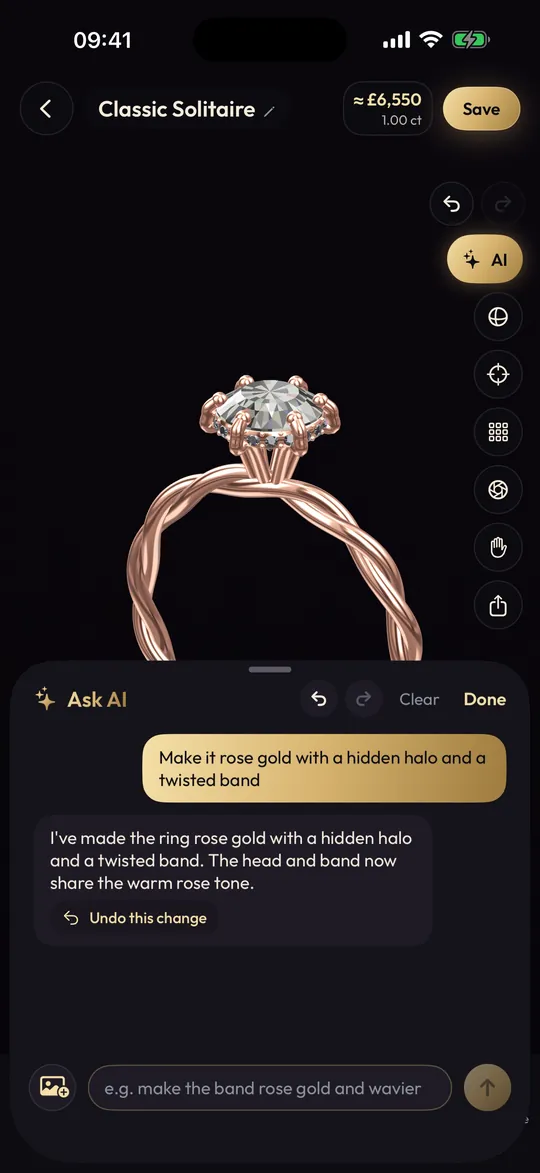
Ring Studio has ruby as a stone option, so you can test combinations before you shop for a stone:
- Choose ruby, then a shape such as oval, cushion or round.
- Set the carat size and orientation.
- Try three stone side stones or a classic halo for diamond contrast.
- Pick an engraved (vintage) band for an antique feel, or a plain knife edge for a modern one.
- Toggle yellow gold, rose gold, white gold and platinum to see how the red shifts.
Or let the AI start for you: type "vintage cushion ruby with a diamond halo in yellow gold" and refine by chatting. The live price estimate is a comparison tool, not a quote, and the app doesn't set karat or make rings. Share the ring code with your jeweller when you're ready.
Caring for a ruby
Heated and untreated rubies can be cleaned with warm soapy water, and ultrasonic cleaning is generally safe for them. For glass-filled or fracture-filled stones, stick to gentle soap and water and tell any jeweller about the treatment before repairs. Have prongs checked annually. Ruby is also the July birthstone, which makes it a meaningful choice for summer birthdays.
Verdict
A heated natural ruby with good colour is a durable, distinctive engagement ring stone at a fair price. Steer clear of glass-filled stones for something meant to last a lifetime, and get a lab report for anything significant. If you like the idea but want a softer tone, compare with sapphire in pink or other colours.
Frequently asked questions
Is ruby a good engagement ring stone?
Yes. Ruby is corundum, rated 9 on the Mohs scale with good toughness, so it withstands everyday wear far better than most coloured stones. Avoid heavily glass-filled rubies, which are much less durable.
What is a glass-filled ruby?
A glass-filled or composite ruby is low-grade, heavily fractured corundum whose cracks are filled with lead glass to make it look transparent. It is cheap, can be damaged by heat or household chemicals, and must be disclosed.
What does pigeon's blood ruby mean?
Pigeon's blood is a trade term for a vivid, slightly bluish red with strong fluorescence, traditionally linked to Myanmar. Some laboratories use it as a colour descriptor on reports under their own criteria; it is not a universal grade.
Are rubies more expensive than diamonds?
Commercial rubies are usually cheaper than diamonds of the same size, but fine unheated rubies with vivid colour can cost more per carat than many diamonds, especially above 2 carats.
How can I tell if a ruby is real?
A visual check is not reliable because lab-grown rubies are chemically identical and imitations such as garnet or glass can look convincing. A report from an independent gem laboratory confirms species, origin type and treatments.