 Ring Studio
Around the world
Engagement Rings in Italy: Sizes, Gold and the Fede Nuziale
Engagement rings in Italy sit within one of the world's great goldsmithing traditions: 18 carat gold is the norm, rings carry a star-shaped maker's mark, sizes are numbered as circumference minus 40, and the wedding band, the fede, comes in classic profiles with their own names.
On this page
- Italy's gold heritage and what it means for buyers
- Anello di fidanzamento: the Italian engagement ring
- The fede nuziale: francesina, mantovana and more
- Italian ring sizes
- Reading Italian gold marks
- What engagement rings and fedi cost in Italy
- From 3D design to laboratorio: using Ring Studio in Italy
- Quick tips for Italy
- Engagement ring
- Anello di fidanzamento, left ring finger
- Wedding band
- Fede nuziale, left ring finger
- Size system
- Circumference minus 40 (misura 14 = 54 mm)
- Usual gold
- 18k, stamped 750
- Maker's mark
- Star + number + province code
- Rough spend
- Often €800 to €4,000 for the ring (estimate)
Italy's gold heritage and what it means for buyers
Italy is one of Europe's largest producers of gold jewellery, with long-established manufacturing districts around Arezzo in Tuscany, Vicenza in the Veneto and Valenza in Piedmont, the last particularly known for fine gem-set pieces. For someone buying an engagement ring in Italy, this matters in a practical way: there is a deep pool of goldsmiths (orafi) and stone setters, and a custom ring made in a local laboratorio is a normal request rather than a luxury.
Two words you will see on shop signs: an oreficeria traditionally works with and sells gold, while a gioielleria is a jeweller's selling finer gem-set pieces. In practice many shops are both.
Anello di fidanzamento: the Italian engagement ring
The classic Italian engagement ring is a solitaire: one diamond, usually a round brilliant, in 18k white or yellow gold. Italian taste tends towards clean, well-finished metalwork rather than very large stones, and a slim band with a modest diamond is entirely conventional. A row of small diamonds set across a band, often called a veretta or riviera in Italian shops, is another popular choice, either as the engagement ring or as a later gift.
The engagement ring is worn on the left ring finger. After the wedding the fede joins it on the same finger, normally closest to the hand. Italian couples who marry in church usually have a ceremony that also has civil effect, so the rings are exchanged once, at the altar or in the town hall.
The fede nuziale: francesina, mantovana and more
Wedding bands in Italy are often called by their profile, and the names are worth knowing because shops use them without explanation.
| Name | Profile | Typical feel |
|---|---|---|
| Francesina | Slim band, domed outside | Delicate, traditional, sits neatly beside a solitaire |
| Mantovana | Wider, flatter outer face, rounded inside edges | Comfortable, more modern, popular for men |
| Fede con diamanti | Band set with small diamonds | Adds sparkle; similar to a half-eternity |
| Bicolore | Two gold colours combined | Mixes yellow and white gold |
Traditionally the fede is plain yellow gold and engraved inside with the partner's name and the wedding date. White gold and two-tone bands are now common too. See wedding band styles for profiles in English, and men's wedding band styles if you are choosing a groom's band.
Italian ring sizes
Italian sizes use the same convention as Spain and Switzerland: the inside circumference in millimetres minus 40. A misura 12 is 52 mm around; a misura 18 is 58 mm. Add 40 and you have the ISO size used in France or Germany.
| Italian size | Circumference | US | UK |
|---|---|---|---|
| 9 | 49 mm | 5 | J½ |
| 12 | 52 mm | 6 | L½ |
| 14 | 54 mm | 7 | N½ |
| 17 | 57 mm | 8 | P½ |
| 20 | 60 mm | 9 | R½ |
| 22 | 62 mm | 10 | T½ |
Equivalents are approximate. A wide mantovana fits more snugly than a slim francesina of the same size, so many jewellers suggest going up a half size for bands over about 5 mm; our ring width guide explains why. For every system side by side, see the ring size chart.
Reading Italian gold marks
Italian precious-metal jewellery carries two key marks. One is the fineness in parts per thousand: 750 for 18k gold, which is by far the most common standard for Italian fine jewellery, with 375 (9k) and 585 (14k) seen in some cheaper lines. The other is the identification mark: a five-pointed star, the maker's registration number and the abbreviation of the province, for example a number followed by AR for Arezzo or VI for Vicenza. It tells you which registered manufacturer is responsible for the piece.
This is a manufacturer's mark rather than an independent assay of the kind used in the UK, so buying from a reputable shop still matters. For context on how marks differ across Europe, see ring hallmarks explained; for why 18k looks warmer than 14k, see yellow gold engagement rings.
What engagement rings and fedi cost in Italy
The figures below are rough estimates of common price points, not survey results. Gold-heavy pieces such as plain fedi move with the gold price, which has been high as of late 2026, and lab-grown diamonds have become much cheaper over recent years.
- 18k solitaire with a small natural diamond: roughly €600 to €2,000.
- Natural diamond around half a carat: roughly €2,000 to €5,000.
- Lab-grown diamond around one carat: roughly €1,000 to €3,000.
- A pair of 18k fedi: often €600 to €2,500, depending mostly on weight and width.
Because plain bands are priced largely by gold weight, a heavy mantovana can cost noticeably more than a slim francesina. Ask for the weight in grams when comparing quotes. Our wedding ring cost guide covers this in more detail.
In general terms, EU consumer law gives a legal guarantee for faulty goods and a 14-day withdrawal right on most online purchases, usually excluding made-to-order items. Check official guidance for specifics; this is not legal advice.
From 3D design to laboratorio: using Ring Studio in Italy
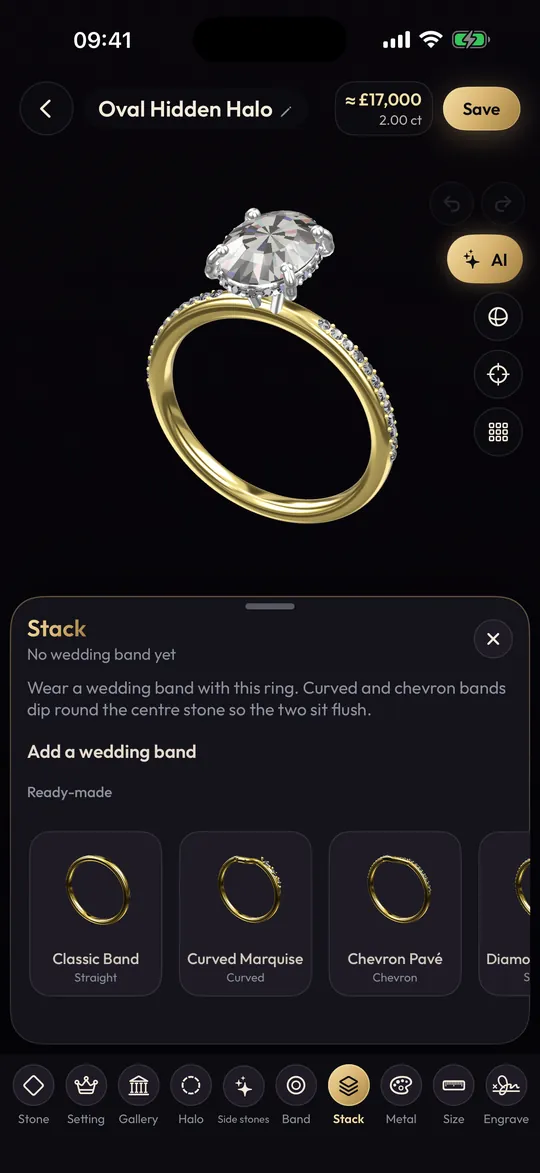
Ring Studio is a free-to-download app for iPhone, iPad and Android that lets you design a ring in real-time 3D. The interface is in English. It does not make rings: you show the design to an orafo, who builds it in their own CAD and casts it. Our guide to how custom rings are made explains that process.
Some ways to use it for an Italian ring:
- Design a slim solitaire with a round or oval stone and see it from every angle.
- Design a fede on its own, adjust its width, and stack it with the engagement ring to check proportions.
- Try a pavé or eternity band for a riviera-style look.
- Add an engraving inside the band and hidden initials under the stone.
- Share a ring code with your partner or jeweller.
Two honest limits: the app shows metal colour, not karat, so specify 750 to the jeweller; and it has no dedicated option for band profiles such as a mantovana's comfort-rounded inside, so describe the profile you want when you brief the orafo. The core designer is free; Pro adds the AI, try-on and band stacks.
Quick tips for Italy
- Ask whether a size is Italian (minus 40) or a plain circumference.
- Check for 750 and the star mark inside the band.
- Compare fede quotes by weight in grams, not just width.
- Ask for a certificate for diamonds of half a carat and above; see diamond certificates.
Frequently asked questions
Which hand is the engagement ring worn on in Italy?
The left ring finger, as is the fede nuziale (wedding band) after the wedding. Most people wear the fede closest to the hand with the engagement ring outside it.
What is the difference between a fede francesina and a mantovana?
A francesina is a slim, domed band, rounded on the outside. A mantovana is usually wider with a flatter outer face and a rounded inner edge for comfort. Both are classic Italian wedding band profiles.
How do Italian ring sizes work?
An Italian size is the inside circumference in millimetres minus 40. Italian size 14 means a 54 mm circumference, roughly a US 7 or UK N½.
What does the star mark on Italian gold mean?
Italian precious-metal items carry an identification mark: a five-pointed star, a registration number and the province code of the maker, usually alongside the fineness number such as 750 for 18k gold.
Is it cheaper to buy an engagement ring in Italy?
Not necessarily. Italy has many skilled goldsmiths and competitive workshop prices in some areas, but diamond and gold prices are set by international markets, so savings depend on the shop and the design rather than the country.