 Ring Studio
Diamond Certificates: GIA, IGI and Others
Diamond certificates, more accurately called grading reports, are independent records of a stone's identity and quality from a gemmological laboratory such as GIA, IGI or HRD. They let you compare stones fairly and confirm you are getting what you pay for, but only if you know which lab issued the report and how to check it.
On this page
- What does a diamond certificate actually tell you?
- The main diamond grading labs compared
- Why do grades differ between labs?
- Certificates for lab-grown diamonds
- How to verify a diamond certificate step by step
- Coloured diamonds and gemstones
- Planning your ring around a certified stone in Ring Studio
- Do you really need a certificate?
- What it is
- An independent grading report from a gemmological lab, not a valuation
- Main labs you will see
- GIA, IGI, HRD Antwerp, plus others such as GCAL; older stones may have AGS or EGL reports
- What it records
- Carat, colour, clarity, cut (for round brilliants and some labs' fancy shapes), measurements, proportions, fluorescence, treatments, natural vs lab-grown
- How to verify
- Look up the report number on the lab's own website; match the laser inscription
- When it matters most
- Centre stones; less so for small accent stones
What does a diamond certificate actually tell you?
A grading report is a snapshot of one stone, made by gemmologists who did not sell it to you. A typical report for a natural or lab-grown diamond includes:
- Identity: that the stone is diamond, whether it is natural or laboratory-grown, and any detected treatments.
- The 4Cs: carat weight, colour grade, clarity grade and, for round brilliants (and some fancy shapes at some labs), a cut grade. Our 4Cs guide explains each one.
- Measurements and proportions: length, width and depth in mm, table and depth percentages, girdle thickness and culet.
- Polish, symmetry and fluorescence.
- A plot: a diagram showing the position and type of inclusions, on many full reports.
- A report number, often also laser-inscribed on the girdle.
What a report does not tell you is the price, whether the stone is beautiful in the setting you want, or anything about where it was mined (unless it is a specific origin programme). It also does not replace a valuation for insurance; see engagement ring insurance for how valuations work.
The main diamond grading labs compared
All the labs below are real and widely seen in the market. They differ in history, focus and how buyers and the trade perceive their consistency. The descriptions are general; check each lab's own website for its current report types.
| Lab | Background | Where you will see it | Worth knowing |
|---|---|---|---|
| GIA (Gemological Institute of America) | Non-profit; created the 4Cs grading system and the D-to-Z colour scale used widely today | The most referenced report for natural diamonds worldwide | Generally regarded as the benchmark for colour and clarity consistency. Has changed how it reports lab-grown diamonds in recent years, so check the current report type. |
| IGI (International Gemological Institute) | Large international lab with offices in Antwerp, India, the US and elsewhere | Very common on lab-grown diamonds and on many jewellery-store natural diamonds | Widely used and well established. Some traders feel its colour and clarity grades can be slightly more generous than GIA's, so compare like with like. |
| HRD Antwerp | Belgian lab linked to the Antwerp diamond trade | Common in Europe | Respected in the European market; less often seen in the US. |
| AGS (American Gem Society) Laboratories | Known for its 0-to-10 numeric scale and detailed light-performance cut grading | Found on many existing stones, especially ideal-cut rounds | Its grading operations were folded into GIA around 2022, so new AGS reports are no longer the norm; existing AGS reports remain a useful record. |
| GCAL | US lab | Some US retailers | Includes images and measurement data on its reports. |
| EGL (various labs using the name) | Several independently operated labs have used the EGL name | Older stones and some retailers | Grading consistency has varied between EGL labs, and some major trading platforms stopped accepting some EGL reports. Treat an EGL grade with caution and consider a re-grade for an expensive stone. |
For a head-to-head on the two you will meet most often, read GIA vs IGI.
An "in-house certificate" from the shop selling the diamond is not independent. It can be useful paperwork, but it is not a substitute for a report from a recognised lab when you are spending serious money on a centre stone.
Why do grades differ between labs?
Colour and clarity grading involves trained human judgement against reference standards, and every lab has its own procedures. A stone graded G colour at one lab could be called H at another. One grade sounds small, but it can change the price noticeably. That is why experienced buyers compare stones graded by the same lab, or apply a mental discount to grades from labs they consider more lenient. It is not that one lab is "right" and another "wrong"; it is that the grade is only as useful as its consistency.
Cut grades vary too. GIA gives an overall cut grade for standard round brilliants, while assessment of fancy shapes like oval and pear relies more on proportions, polish and symmetry and on looking at the stone. Our guide to diamond cut grades covers what the numbers mean.
Certificates for lab-grown diamonds
Lab-grown diamonds are real diamond and can be graded in much the same way. IGI grades a large share of the lab-grown stones on sale, and GIA and other labs also issue reports for them. A proper report should state clearly that the stone is laboratory-grown, and many also note the growth method (CVD or HPHT) and any post-growth treatment. Lab-grown stones are often laser-inscribed with "LG" or "lab-grown" alongside the report number.
Because lab-grown prices have fallen sharply, paying extra for a particular lab's report makes less sense than with natural stones of similar size. But a report remains useful as proof of what you bought. See lab-grown diamonds and lab-grown vs natural for more.
How to verify a diamond certificate step by step
- Find the report number on the paper or PDF report.
- Go to the issuing lab's own website (type the address yourself, rather than following a link the seller sends) and use its report check tool.
- Compare every detail: carat to two decimal places, measurements in mm, shape, colour, clarity and any comments.
- Check the laser inscription. Ask the jeweller to show you the girdle under a loupe or microscope and confirm the number matches.
- Check the stone fits the measurements. A jeweller can gauge a mounted stone; a stone that measures differently from the report is a red flag.
This matters most when buying online or second-hand, or when redesigning an inherited ring whose paperwork is decades old.
Coloured diamonds and gemstones
Coloured diamonds such as yellow diamonds get a separate coloured-diamond report that grades hue, tone and saturation and states whether the colour is natural or treated. For a black diamond, a report is the main way to confirm natural colour. Sapphires, rubies and emeralds are usually covered by gemstone reports from specialist labs that describe identity, treatments such as heat or oil, and sometimes an opinion on geographic origin. Origin opinions are expert assessments, not guarantees.
Planning your ring around a certified stone in Ring Studio
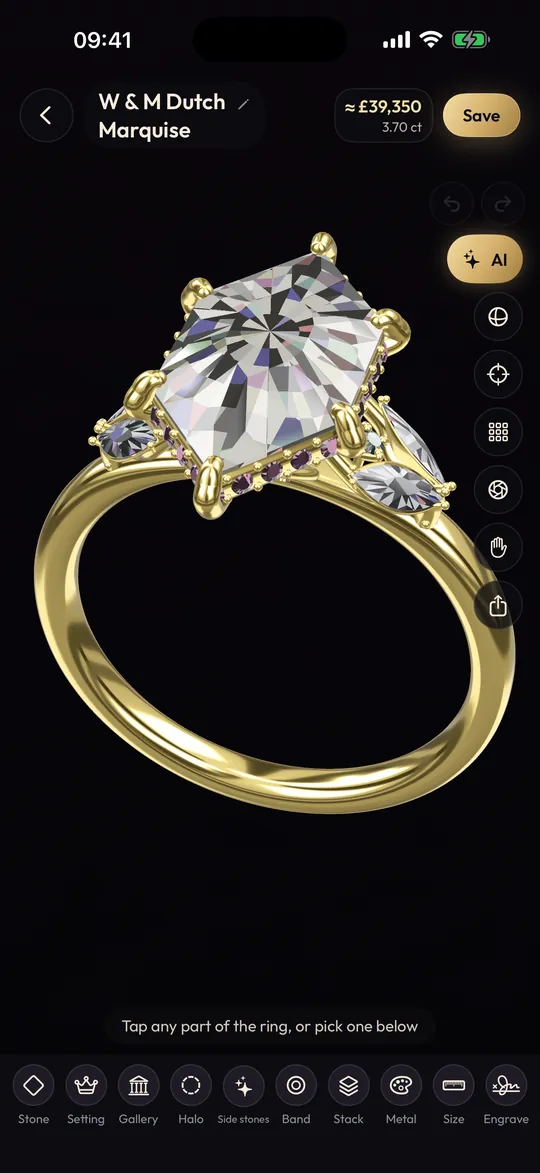
A grading report gives you the exact measurements of the stone you are considering, which makes it easy to plan the setting. In Ring Studio you can pick the matching shape, set the carat weight, and see how the stone sits in a 4, 6 or 8 prong setting, a bezel or a halo. The live price estimate is a comparison tool, not a quote, but it helps you see how changing carat and metal affects your budget. When you are happy, share the ring code with your jeweller alongside the report number so they know exactly what you want built around that stone.
Do you really need a certificate?
Verdict
For any centre diamond you are paying meaningful money for, get a report from a recognised independent lab, verify it on the lab's own website and check the inscription. Compare stones graded by the same lab, and do not pay a big premium for paperwork on small accent stones.
Frequently asked questions
Is a diamond certificate the same as a valuation?
No. A grading report describes the stone's characteristics such as carat, colour, clarity and cut, and whether it is natural or lab-grown. A valuation or appraisal estimates a monetary value, usually for insurance, and is a separate document.
Which diamond certificate is best, GIA or IGI?
Both are large, established laboratories. GIA is the most widely referenced for natural diamonds, while IGI grades a large share of lab-grown diamonds. Some in the trade view GIA colour and clarity grading as stricter, so compare stones graded by the same lab where possible.
How do I check if a diamond certificate is real?
Enter the report number on the issuing laboratory's own website and check that the details match the paper or PDF. If the stone is laser-inscribed, ask the jeweller to show you the inscription under magnification and confirm it matches the report number.
Do lab-grown diamonds come with certificates?
Many do, most often from IGI, and other labs including GIA also issue reports for laboratory-grown diamonds. The report should state clearly that the stone is laboratory-grown and may note the growth method.
Should I buy a diamond without a certificate?
For small accent stones that is normal. For a centre stone of meaningful value, a report from a recognised independent lab is strongly advisable, because grades assigned by the seller alone are hard to verify.
Does a certificate expire?
A report does not expire, but it describes the stone at the time of grading. Chips, damage or re-cutting after the report was issued will not be reflected, so check the stone itself matches.