 Ring Studio
Lab-Grown Diamonds
Lab-grown diamonds are real diamonds made in a factory rather than mined. They have the same crystal structure, hardness and sparkle as natural diamonds, cost a fraction of the price, and can only be told apart with specialist equipment.
On this page
- What it is
- Real diamond (pure carbon), grown above ground
- Growth methods
- HPHT and CVD
- Hardness
- 10 on the Mohs scale, same as mined
- Grading
- Same 4Cs scales; certificates from IGI, GIA and others
- Price
- A fraction of a comparable natural diamond, and still falling
Are lab-grown diamonds real?
Yes. This is the most common question, and the answer is not marketing spin. A diamond is defined by what it is, not where it formed: carbon atoms locked in a cubic crystal lattice. Lab-grown diamonds have that structure, so they share the same chemical composition, hardness, refractive index and dispersion as a natural diamond. In the US, the Federal Trade Commission's jewellery guidance removed "natural" from its definition of a diamond back in 2018, while requiring sellers to disclose clearly that a stone is lab-grown.
What a lab diamond is not is a simulant. Cubic zirconia and moissanite look like diamond but are different materials with different properties.
How lab-grown diamonds are made: HPHT and CVD
HPHT (high pressure, high temperature)
HPHT recreates the conditions deep in the earth. A small diamond seed is placed in a press with a carbon source and a metal solvent. The press applies enormous pressure and heat of well over a thousand degrees Celsius, the carbon dissolves and crystallises onto the seed, and a rough diamond grows over days to weeks. HPHT diamonds can show tiny metallic inclusions from the solvent.
CVD (chemical vapour deposition)
CVD builds a diamond atom by atom. Thin diamond seed plates sit in a vacuum chamber filled with a carbon-rich gas such as methane, plus hydrogen. Microwaves or another energy source turn the gas into plasma, and carbon settles onto the seeds layer by layer. Many CVD diamonds are given a post-growth heat treatment to improve colour, which is disclosed on reputable grading reports.
| HPHT | CVD | |
|---|---|---|
| Process | Press with heat and pressure | Vacuum chamber with carbon gas plasma |
| Crystal shape | Cuboctahedral | Flat, tabular |
| Typical inclusions | Metallic flux | Dark carbon specks, growth striations |
| Post-growth treatment | Less common | Common for colour |
| Quality ceiling | Excellent | Excellent |
Neither method is better across the board. Judge the individual stone by its grading report, not by how it was grown.
How lab-grown diamonds are graded
Lab diamonds use the same 4Cs: cut, colour, clarity and carat. IGI grades a large share of lab-grown diamonds sold today, and GIA also grades them. Reports normally state that the stone is laboratory-grown, list any treatments and note the growth method, and the girdle is usually laser-inscribed. See diamond certificates and GIA vs IGI for how the labs differ.
Because lab diamonds are cheaper, it is easy to buy very high colour and clarity. You rarely need D colour or VVS clarity to get a stone that looks perfect. An excellent cut matters far more to sparkle than a top clarity grade.
How much do lab-grown diamonds cost?
Lab-grown diamond prices have fallen sharply over recent years as production has expanded, and they continue to drift down. As of late 2026, a well-cut lab-grown diamond typically costs a small fraction of a natural diamond with the same 4Cs, often less than a fifth and sometimes far less, depending on size, quality and retailer. Our lab diamond price guide gives ranges by carat. Treat any price as an estimate.
The flip side is resale. A lab diamond is unlikely to be worth much second-hand, and today's price may look high in a few years. If that matters to you, read lab-grown vs natural diamonds.
Pros and cons of lab-grown diamonds
| Pros | Cons |
|---|---|
| Real diamond with identical durability and sparkle | Low resale value |
| Much more size or quality for the money | Prices still falling |
| No new mining for the stone itself | Energy use varies by producer; claims need checking |
| Easy to find large, high-grade stones | Some buyers value natural rarity |
Lab-grown diamonds avoid mining, but they are energy-intensive to produce, and environmental impact depends on where the power comes from. Look for producer-level evidence rather than broad "eco" labels; the ethical diamonds page has more context.
Lab-grown diamonds vs moissanite
Both are popular budget-friendly alternatives to a mined diamond, but they are very different. A lab diamond is diamond; moissanite is silicon carbide, slightly softer (9.25 on the Mohs scale) with stronger rainbow fire. See moissanite vs lab-grown diamond.
Designing a lab-grown diamond ring in Ring Studio
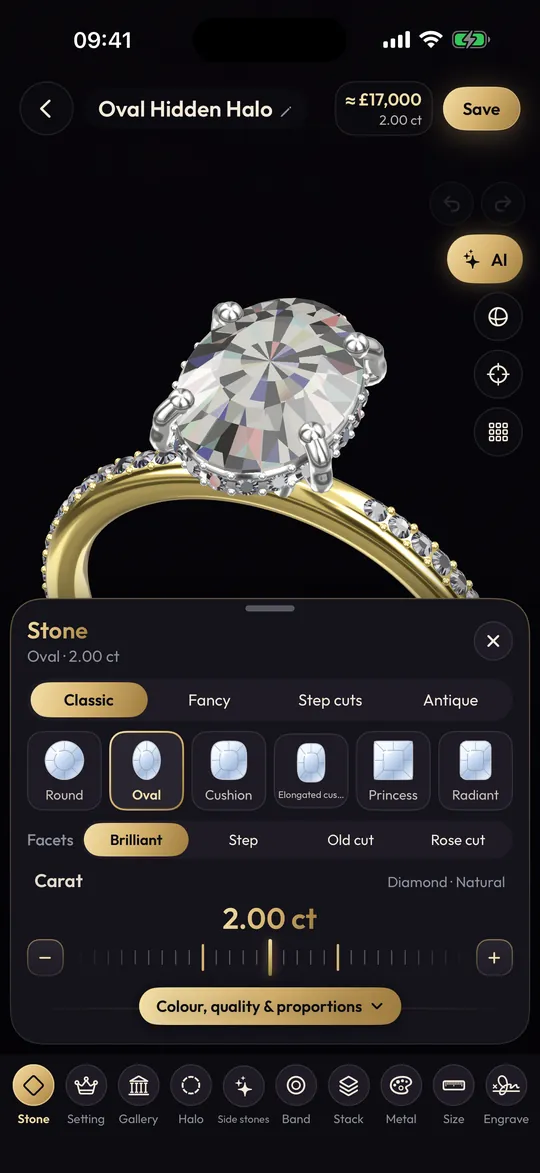
Ring Studio has a lab-grown diamond option alongside natural diamond, and the live price estimate reflects the choice, so you can see how much further your budget goes.
- Pick a shape and set the stone to lab-grown diamond.
- Increase the carat size and watch the estimate and the stone's size on the ring change together.
- Switch to natural diamond at the same carat to compare the estimate.
- Try it on your hand with the camera (Pro) to see whether a larger lab stone suits your finger.
- Share the ring code with your jeweller to source a graded lab diamond to match.
The estimate is for comparison, not a quote. For help picking a size, use the carat size visualiser.
Who should choose a lab-grown diamond?
A lab-grown diamond suits you if you want a real diamond, care more about size and quality than rarity, and see the ring as something to wear rather than an asset. If the story of a stone formed over billions of years matters to you, or you want something that holds value better, a natural diamond may be worth the premium.
Frequently asked questions
Are lab-grown diamonds real diamonds?
Yes. A lab-grown diamond is pure crystallised carbon with the same atomic structure, hardness of 10 on the Mohs scale and optical properties as a mined diamond. It is not a simulant like cubic zirconia or moissanite.
Can a jeweller tell if a diamond is lab-grown?
Not with the eye or a normal loupe. Labs identify growth origin with specialist instruments that detect growth patterns, trace elements and fluorescence features. Graded lab diamonds are usually laser-inscribed on the girdle as laboratory-grown.
Do lab-grown diamonds hold their value?
Generally no. Prices for new lab-grown diamonds have fallen sharply over recent years, and resale value is low. Buy one because you love it and want more size or quality for your budget, not as an investment.
What is the difference between HPHT and CVD diamonds?
HPHT recreates the heat and pressure of the earth's mantle in a press; CVD grows diamond layer by layer from carbon-rich gas in a vacuum chamber. Both produce real diamond, and both can produce top-quality stones.
Do lab-grown diamonds get cloudy or change colour?
No. A lab-grown diamond is as chemically stable as a natural one and will not cloud or fade with normal wear. Any post-growth treatment should be listed on its grading report, so ask for one.