 Ring Studio
Ethical and Conflict-Free Diamonds
Conflict-free diamonds are, in the narrow official sense, diamonds not used to fund rebel movements against governments, which is what the Kimberley Process certifies. Ethical diamonds is a wider idea that also covers workers' rights, communities and the environment, and that part you have to check for yourself.
On this page
- What does conflict-free actually mean?
- How the Kimberley Process works, and where it falls short
- The System of Warranties
- Ethical diamond options compared
- Beyond the stone: the rest of the ring
- Questions to ask your jeweller
- Designing an ethical ring in Ring Studio
- The bottom line on conflict-free diamonds
- Conflict diamond (official meaning)
- Rough diamonds used by rebel movements to finance wars against legitimate governments
- Kimberley Process
- International rough diamond certification scheme, in effect since 2003
- What it does not cover
- Abuses by governments or security forces, labour conditions, community impacts, environmental harm, polished stones' later journey
- Lower-impact routes
- Recycled or vintage diamonds, traceable mined diamonds, lab-grown diamonds
- Best single step
- Ask your jeweller specific questions about origin and documentation
What does conflict-free actually mean?
The term "conflict diamonds" (or "blood diamonds") became widely known in the late 1990s, when diamonds mined in rebel-held areas helped finance brutal civil wars in parts of West and Central Africa, including Sierra Leone and Angola. The international response focused on that specific problem: stopping rebel groups from selling rough diamonds onto the world market.
So when a jeweller says a diamond is "conflict-free", they usually mean it came through the Kimberley Process and is covered by industry warranties stating it was not used to fund rebel movements. That is genuinely important, but it is a much narrower promise than most buyers assume.
How the Kimberley Process works, and where it falls short
The Kimberley Process Certification Scheme came into effect in 2003. Participating countries agree to trade rough diamonds only with other participants, to ship rough diamonds in sealed containers with a government-issued certificate, and to maintain national controls on mining and export. Industry and civil society groups take part alongside governments.
| What it does | What it does not do |
|---|---|
| Certifies shipments of rough diamonds between participating countries | Track polished diamonds or individual stones through cutting and retail |
| Aims to exclude diamonds that fund rebel movements | Cover violence or abuses by governments, armies or private security |
| Requires national import and export controls | Set standards for wages, child labour or working conditions |
| Allows suspension of non-compliant countries | Address environmental damage or community displacement |
Critics, including some civil society groups that once participated, have argued that the definition should be widened to cover human rights abuses more broadly. Proposals to change the definition have been discussed for years, but because decisions are made by consensus, change has been slow. As of late 2026, the core definition remains focused on rebel financing.
The System of Warranties
Because the Kimberley Process stops at rough diamonds, the diamond trade added a voluntary System of Warranties, run through the World Diamond Council. Sellers include a statement on invoices that the diamonds were purchased from legitimate sources not involved in funding conflict, in compliance with UN resolutions, and the warranty passes down the chain to the retailer. Newer versions of the warranty guidelines reference broader principles on human and labour rights and anti-money laundering. It is a useful signal, but it relies on self-declaration rather than independent tracking of each stone.
Ethical diamond options compared
| Option | Main ethical strength | Trade-offs |
|---|---|---|
| Recycled or vintage diamonds | No new mining; reuses existing stones | Original origin usually unknown; older cuts may need re-polishing |
| Traceable mined diamonds | Documented mine of origin; some programmes track the stone from mine to market | Usually costs more; traceability claims vary in rigour |
| Diamonds from specific origins (for example Canadian origin programmes) | Strong regulatory frameworks for labour and environment at the mine | Price premium; origin is one factor, not the whole story |
| Diamonds supporting producing countries | Some buyers prefer supporting well-governed producing countries such as Botswana and Namibia, where diamond revenue is a major part of the economy | Requires trust in the supply chain and the retailer's information |
| Lab-grown diamonds | No mining; chemically and physically diamond | Energy-intensive; footprint depends on the power source. Lower resale value |
There is no universally "right" choice. Someone worried about mining impacts may prefer lab-grown diamonds or recycled stones; someone who wants to support mining communities may prefer traceable natural diamonds from well-governed sources. Our lab-grown vs natural comparison sets out the wider differences.
Beyond the stone: the rest of the ring
An ethical diamond in an unknown setting is only half the job. The metal usually makes up a large share of the ring's weight, and gold and platinum mining carry their own environmental and social concerns. Many jewellers now offer recycled gold and platinum at little or no extra cost, and some offer certified responsibly mined metal.
Small accent diamonds deserve a thought too. A halo or pavé band can hold dozens of tiny stones, and these are rarely traceable individually. If full traceability matters to you, a solitaire or bezel design with a single well-documented centre stone is easier to source responsibly than a ring covered in melee. Coloured gemstones such as sapphire and emerald are mined in many small-scale operations worldwide, and are not covered by the Kimberley Process at all, so the same questions about origin apply.
Questions to ask your jeweller
- Where was this diamond mined, or where was it grown, and how do you know?
- Can you show the supply chain documentation or System of Warranties statement on your invoice?
- Is the stone part of a traceability or origin programme? What does that programme actually verify?
- For lab-grown stones: who grew it, and do they disclose their energy sources?
- Where does the metal come from? Is recycled gold or platinum available?
A jeweller who answers specifically and admits what they do not know is more trustworthy than one who uses "conflict-free" as a catch-all. A grading report confirms what the stone is and whether it is natural or lab-grown; see diamond certificates. It does not, on its own, prove ethical sourcing.
The most sustainable diamond may be one you already have. Resetting an inherited or old stone avoids new mining and production entirely. Our guide to redesigning an old ring walks through the process.
Designing an ethical ring in Ring Studio
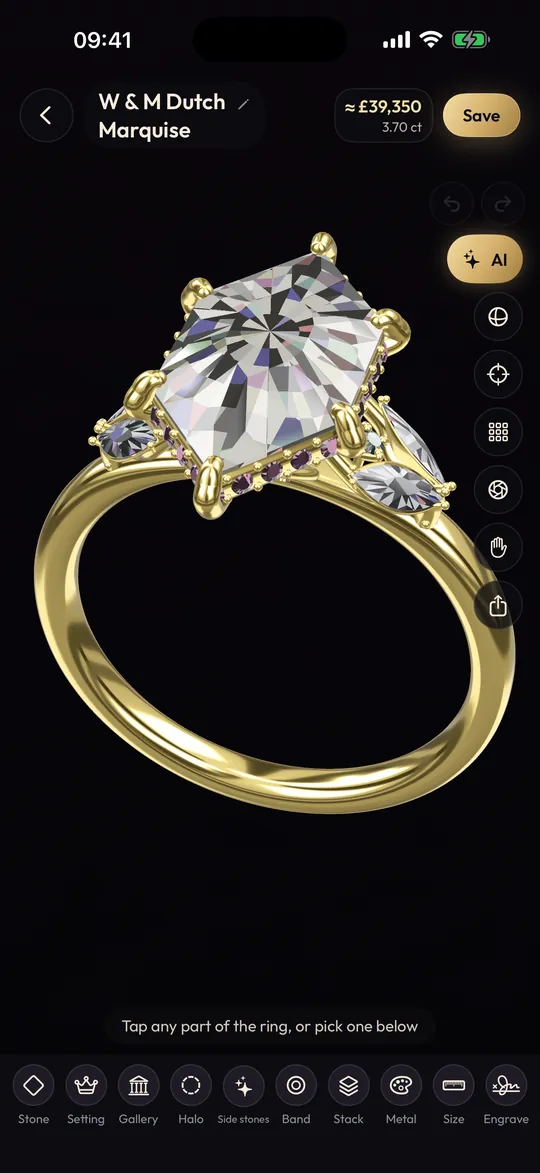
Ring Studio is a design and visualisation tool, so it does not source or sell stones. What it can do is help you plan a ring around whichever ethical route you choose, and give your jeweller a precise brief.
- Resetting a family stone: choose the matching shape (old mine, old European and rose cut are available with Pro) and set the carat size to match, then try new settings, halos and bands around it.
- Lab-grown or natural: the app includes both natural and lab-grown diamonds, and the live price estimate shows how the choice changes the cost for comparison.
- Recycled metal: design in yellow, white or rose gold or platinum, then ask your jeweller to make it in recycled metal.
Share the ring code with an ethical jeweller and they can open the exact design in Ring Studio before recreating it in their own CAD software.
The bottom line on conflict-free diamonds
Verdict
"Conflict-free" is a starting point, not a guarantee of an ethical diamond. Treat Kimberley Process compliance as the minimum, ask specific questions about origin, and consider recycled, traceable or lab-grown options depending on which ethical issues matter most to you.
Frequently asked questions
Are all diamonds today conflict-free?
Most rough diamonds traded internationally pass through the Kimberley Process, which aims to exclude rough diamonds that fund rebel movements. However, its definition is narrow and does not address human rights abuses by governments or security forces, labour conditions or environmental harm, so 'Kimberley compliant' does not guarantee a diamond is ethical in the broader sense.
What is the Kimberley Process?
It is an international certification scheme launched in 2003 that brings together governments, the diamond industry and civil society observers. Participating countries must certify that shipments of rough diamonds are free from conflict diamonds as the scheme defines them.
Are lab-grown diamonds more ethical?
They avoid mining-related conflict and community impacts, but they use significant energy, and their footprint depends heavily on how that energy is generated. Look for producers that disclose their energy sources if environmental impact matters to you.
What is the most ethical diamond?
There is no single answer. Recycled or vintage diamonds avoid new mining entirely, traceable mined diamonds with documented origin offer transparency, and lab-grown diamonds avoid mining. Which is best depends on whether you prioritise mining impacts, energy use, or supporting mining communities.
How do I know if my diamond is ethically sourced?
Ask the jeweller for the stone's origin and how they know it, what supply chain documentation they hold, and whether the stone is part of a traceability programme. A jeweller who can answer specifically is a better sign than a generic 'conflict-free' label.