 Ring Studio
Engagement Ring Buying Guide
This engagement ring buying guide covers the practical side of the purchase: what a fair price looks like, how to compare jewellers, which documents you should walk away with, and the protections that matter if something goes wrong. Use it alongside our style guide once you know roughly what you want.
On this page
- Before you start: the four things to know
- How much should you spend on an engagement ring?
- Where to buy an engagement ring
- How to compare quotes fairly
- Diamond certificates: which ones to trust
- Hallmarks and metal quality
- Returns, warranties and resizing terms
- Paying and protecting the purchase
- Natural or lab-grown: a buying decision, not just a style one
- Questions to ask before you pay
- Buying for someone else's style
- Timeline: when to start buying
- Design it first, then buy with confidence
- Inspecting the ring when you collect it
- Common buying mistakes
- Must-have documents
- Itemised receipt, lab grading report, insurance valuation, terms
- Recognised diamond labs
- GIA and IGI are the most widely used
- UK legal marking
- Hallmark on gold over 1 g and platinum over 0.5 g
- Allow
- 2-4 weeks ready-made, 6-10 weeks custom, plus resizing time
Before you start: the four things to know
Walking into a jeweller (or onto a website) with no plan is how people overspend. Know these four things first:
- Your ceiling. A number you can pay without debt. Our guide to setting an engagement ring budget helps.
- The shape and metal. Even a rough direction (an oval in yellow gold, say) narrows the search enormously. If you have not decided, start with how to choose an engagement ring.
- The ring size. Or at least a close estimate. See the ring size chart.
- The date you need it. Work backwards from the proposal and add two weeks of slack.
How much should you spend on an engagement ring?
There is no correct amount. Spend what feels sensible for your finances; a well-chosen ring at a modest budget will be loved just as much. What helps is knowing what money buys at different levels. The ranges below are rough estimates in pounds sterling for a solitaire in 18k gold as of late 2026. They vary considerably by retailer, stone quality, region and the gold and platinum price, and lab-grown diamond prices have fallen sharply over recent years and may keep moving.
| Budget | Lab-grown diamond | Natural diamond |
|---|---|---|
| Up to £1,000 | Roughly 0.7-1.5 ct, good quality | Roughly 0.2-0.35 ct |
| £1,000-£3,000 | Roughly 1.5-2.5 ct | Roughly 0.4-0.7 ct |
| £3,000-£6,000 | Large stones, or upgraded setting and platinum | Roughly 0.7-1.1 ct |
| £6,000+ | Rarely needed for the stone alone | 1 ct and above, higher grades |
For specific sizes, see 1 carat diamond ring prices, lab-grown diamond prices and diamond price per carat. If budget is tight, ways to save money on an engagement ring lists the levers that make the biggest difference without visible compromise.
Where to buy an engagement ring
| Where | Strengths | Watch out for |
|---|---|---|
| High-street chain | Convenient, try on in person, easy returns | Brand mark-up, limited stone choice |
| Independent jeweller | Custom work, personal service, bench skills on site | Quality varies; check reviews and examples |
| Online retailer | Huge stone inventory, competitive pricing, 360° videos | Can't try on, returns logistics, sizing guesswork |
| Luxury house | Recognisable design and packaging | Pay substantially for the name |
| Antique or pre-owned dealer | Character, older cuts, sometimes good value | Wear, repairs, and older stones without reports |
Not sure whether to buy ready-made or commission one? Our custom vs off-the-shelf comparison sets out cost, time and risk, and custom engagement ring cost explains how jewellers price bespoke work.
How to compare quotes fairly
Two rings that look similar on a screen can be very different products. When you compare, make sure each quote states the same things:
- Stone: shape, carat weight, colour, clarity, cut grade (for rounds), fluorescence, and the grading lab and report number.
- Natural or lab-grown: this should be stated clearly; reputable lab reports say it on the document and laser-inscribe the girdle.
- Metal: exact alloy (platinum 950, 18k, 14k, 9k) and approximate finished weight. A heavier, sturdier mount costs more and lasts longer.
- Side stones: total carat weight and quality range of any pavé or halo diamonds.
- Labour and extras: setting, engraving, rhodium plating, first resize, VAT.
A quote that only says "1ct diamond, white gold" is not comparable with anything. Ask for the full specification in writing before you decide.
Diamond certificates: which ones to trust
A grading report is the diamond's ID. It records measurements, the 4Cs, and often a plotted diagram of inclusions. The two labs most commonly seen on engagement ring diamonds are GIA (the Gemological Institute of America) and IGI (the International Gemological Institute); both grade natural and lab-grown stones. Our GIA vs IGI comparison and diamond certificates guide explain the differences.
Check that the report number is laser-inscribed on the girdle and matches the paperwork. You can verify GIA reports on the GIA Report Check service. In-house "certificates" from the seller are not independent and should not be treated as equivalent.
If you want to understand the grades on the report, our guides to cut grades, colour and clarity cover each one.
Hallmarks and metal quality
In the UK, the Hallmarking Act requires precious metal items over certain weights to be hallmarked by an independent Assay Office before they are sold as gold, platinum, palladium or silver (the exemption thresholds are 1 g for gold and palladium and 0.5 g for platinum). A hallmark shows the sponsor (maker), the fineness (such as 750 for 18k gold or 950 for platinum) and the assay office. Other countries have their own systems, some voluntary. Read ring hallmarks explained and check the UK Assay Office for official detail.
White gold is usually rhodium plated to look bright white and will need re-plating periodically; ask whether the first re-plate is included. Our page on rhodium plating explains why.
Returns, warranties and resizing terms
Read the terms before you pay, not after. In particular:
- Return window. Online purchases in the UK usually carry a statutory cancellation period for distance sales, but bespoke or engraved items are often excluded. Shops set their own in-store policies.
- Resizing. Is the first resize free? Within how many sizes? Some designs (full eternity, tension, some pavé) can't be resized much. See ring resizing cost.
- Warranty. What is covered: manufacturing faults, lost side stones, prong re-tipping? Does it require periodic inspections?
- Upgrade programmes. Some retailers credit the price against a future upgrade; useful if you expect to trade up.
Paying and protecting the purchase
Paying by credit card can give extra protection in some countries; in the UK, Section 75 of the Consumer Credit Act generally covers single purchases between £100 and £30,000 on a credit card. This is general information, not financial advice, so check the current rules with your card provider. Avoid bank transfers to sellers you don't know.
Insure the ring from the day you collect it. A valuation from a qualified valuer, typically listed at full replacement cost, supports the policy. Our engagement ring insurance guide covers specified-item cover on home insurance versus standalone jewellery policies.
Natural or lab-grown: a buying decision, not just a style one
For many buyers this is the biggest single choice, because it changes what the budget buys more than anything else. A few buying points to weigh:
- Upfront price. Lab-grown diamonds cost far less than natural stones of the same size and grade, and their prices have fallen sharply over recent years.
- Resale. Neither is a reliable investment. Natural diamonds tend to have more of a resale market; lab-grown diamonds currently have very little.
- Disclosure. Make sure the receipt, report and girdle inscription all state which it is.
- Insurance. Replacement value follows the stone type, so a lab-grown ring usually costs less to insure.
Our full comparison of lab-grown vs natural diamonds covers appearance, ethics and value. If you're considering an alternative, see moissanite vs lab-grown diamond.
Questions to ask before you pay
- Is this exact stone the one on the report, and can I see a video of it?
- Is the diamond natural or lab-grown, and is that stated on the invoice?
- What is the metal, its purity and approximate weight?
- Are side stones included in the price, and what grade are they?
- What does the warranty cover, and for how long?
- Is the first resize free, and can this design be resized?
- What is the return window, and does engraving affect it?
- Is a valuation for insurance included?
- When will it be ready, and is delivery insured?
A good jeweller will answer every one of these without hesitation. Vague answers are a reason to keep looking.
Buying for someone else's style
If the ring is a surprise, the risk of a mismatch is the hardest one to insure against. Take time over the wearer's taste first; our guide to how to choose an engagement ring shows how to read the jewellery they already wear, and the ring style quiz can help put a direction into words. Ask whether the seller offers an exchange if the style isn't right, separate from returns.
Timeline: when to start buying
| Weeks before proposal | What to do |
|---|---|
| 12-16 | Set budget, gather style clues, find ring size |
| 10-12 | Shortlist jewellers, design and compare options |
| 8-10 | Choose the stone, approve the design or CAD render |
| 3-6 | Ring is made or sourced; arrange insurance |
| 1-2 | Collect, inspect, check paperwork and engraving |
Design it first, then buy with confidence
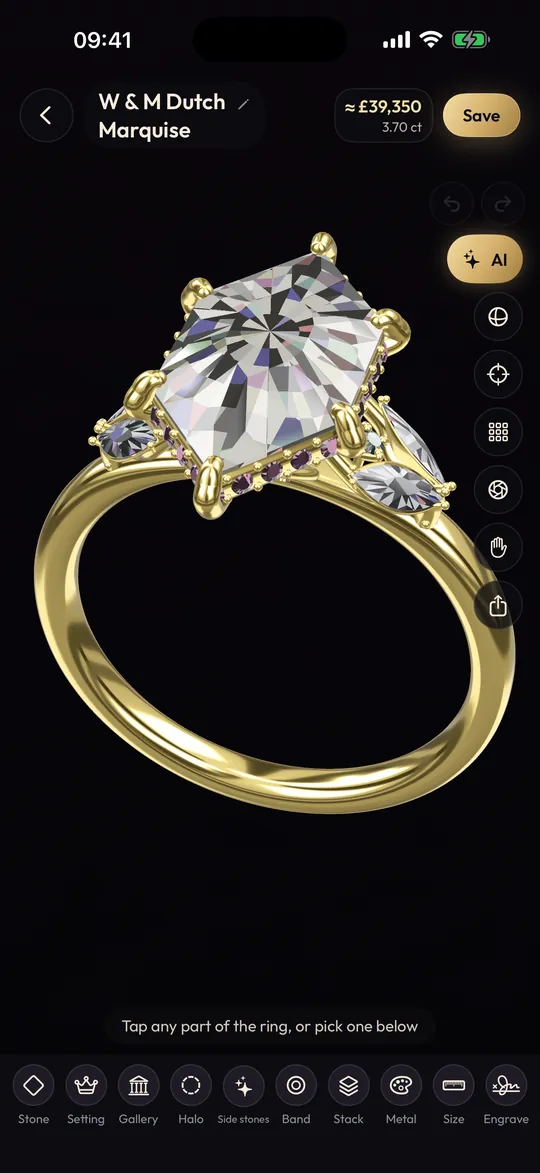
The biggest source of regret is buying a ring you have only seen in one photo. Ring Studio, a free 3D ring designer for iPhone, iPad and Android, lets you build the design you have in mind before you speak to anyone:
- Choose the shape, stone, carat, setting, halo, band and metal and rotate the ring in real-time 3D.
- Watch the live price estimate move as you change stone, carat and metal, so you can see which choices drive cost. It's a comparison tool, not a quote.
- With Pro, scan your hand to estimate ring size and try the ring on your own hand through the camera.
- Share a ring code with a jeweller so they open your exact design, then ask them to quote for it.
Ring Studio doesn't make or sell rings; it gives you a precise brief so every quote is for the same thing. You can read more about the ring price estimator and custom ring designer.
Inspecting the ring when you collect it
Before you leave the shop or sign for the parcel, check:
- The stone matches the report: shape, approximate size, and the girdle inscription under a loupe.
- Prongs are even, smooth and not catching on a jumper or tissue.
- The ring sits level on the finger and doesn't spin to one side.
- Engraving is spelled correctly.
- Hallmark is present (UK) and the receipt states the metal and stone details.
- You have the valuation, the report, the receipt and the warranty card together.
Common buying mistakes
The mistakes we see most are buying carat over cut, skipping the lab report, forgetting the wedding band fit, guessing the ring size wildly, and leaving it so late that there is no time for adjustments. Our full list of engagement ring mistakes to avoid goes into each. If you are buying online, read buying an engagement ring online safely before you check out.
And once it's on their finger, a little maintenance goes a long way: see how to clean and care for your engagement ring.
Frequently asked questions
What should I get when I buy an engagement ring?
A detailed receipt listing metal, stone type, weight and grades; an independent grading report for any significant diamond; a valuation for insurance; and written terms for returns, resizing and warranty.
Is it cheaper to buy an engagement ring online or in a shop?
Online retailers often have lower overheads and wider stone choice, but independent jewellers can be competitive, especially for custom work. Compare like-for-like quotes with the same stone grades and metal.
Can you negotiate the price of an engagement ring?
Often, especially with independent jewellers and on higher-value pieces. Ask about the price of a slightly different stone, a different metal, or included extras like engraving and the first resize.
Do I need a diamond certificate?
For any diamond over roughly 0.3 carats, a report from a recognised lab such as GIA or IGI is strongly recommended. It lets you compare stones fairly and supports insurance and resale.
When should I insure an engagement ring?
From the day you collect it, including before the proposal. Some home insurance covers it only within limits, so check whether you need to list it as a specified item or take a dedicated policy.
What is the difference between a valuation and a certificate?
A grading report describes the diamond's quality. A valuation is an estimated replacement cost of the whole ring for insurance, and is usually higher than the price paid.