 Ring Studio
Ring designer
Engagement Ring Price Estimator
Ring Studio works as an engagement ring cost calculator that runs while you design: the price estimate updates as you change the stone, carat and metal, so you can see which choices move the cost and which barely touch it. It's an estimate for comparison, not a quote.
On this page
- Updates with
- Stone type, carat and metal
- Use it for
- Comparing options side by side
- Don't use it as
- A quote; jewellers price the actual stone and work
- Biggest lever
- Natural vs lab-grown, then carat
A calculator that sits inside the design
Most engagement ring cost calculators ask for numbers in a form: budget, carat, metal. That tells you a figure but not what the ring looks like. Ring Studio does it the other way round. You design the ring, and the estimate updates live as you go. Slide the carat from 1.0 to 1.5 and you see both the bigger stone and the bigger number. Swap natural diamond for lab-grown and watch the estimate drop while the ring looks the same.
If you'd rather start from a budget, our ring budget calculator works that way round, and how to set an engagement ring budget helps decide the number.
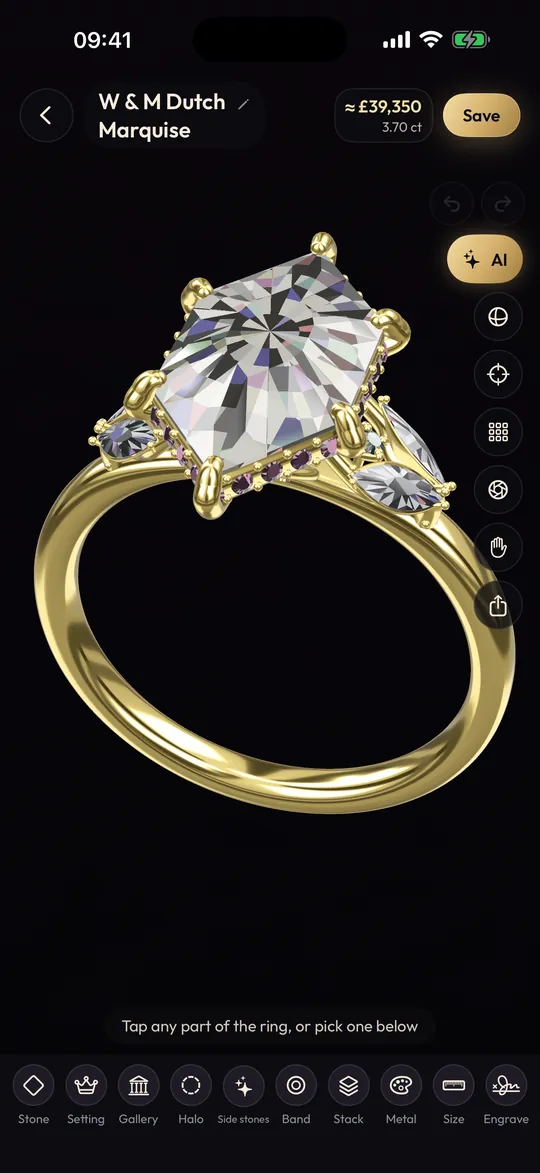
What moves the estimate, and by how much
| Change | Typical effect on price | Why |
|---|---|---|
| Natural to lab-grown diamond | Large drop | Lab-grown prices have fallen sharply in recent years |
| Increase carat | Large rise, faster than the weight | Price per carat climbs as stones get bigger |
| Diamond to sapphire, morganite etc. | Varies widely | Coloured stone prices depend heavily on quality and origin |
| Gold to platinum | Moderate rise | Platinum rings are denser and usually 95% pure |
| Yellow to white or rose gold | Small | Same gold content; white gold often adds rhodium plating |
Effects are general and vary by market. For per-carat detail, see diamond price per carat; for lab stones, lab-grown diamond prices.
How to use the price estimator in Ring Studio
- Design the ring you'd love, without thinking about price yet.
- Note the estimate. This is your "dream" reference.
- Change one thing at a time. Switch to lab-grown, drop the carat by a step, change platinum to gold. Note each estimate.
- Find the trade-offs you don't mind. Many people discover that dropping from 1.5 to 1.2 carat barely changes the look but saves a lot, or that lab-grown lets them have the size they wanted.
- Save two or three versions at different price points to discuss with a partner or jeweller.
What the estimate can't tell you
The estimate is built from the design choices in the app. It doesn't know:
- The stone's grade. Two 1 carat diamonds can differ hugely in price based on colour, clarity and cut. The 4Cs guide explains why.
- Metal karat. The app doesn't set karat, and 18k costs more than 14k or 9k.
- The jeweller's labour and margin, which vary from a small workshop to a high-street brand.
- Today's metal prices. Gold and platinum prices move constantly.
- Taxes, certificates, hallmarking and engraving, which vary by country and jeweller.
Use the estimate to compare designs, not to decide how much money to bring. For a budget, get itemised quotes from two or three jewellers against the same design.
Example: three versions of the same ring
Here's how a typical comparison plays out in the app, described in relative terms because real figures depend on market and quality.
| Version | Design | Estimate, relatively |
|---|---|---|
| A: the dream | 1.5 ct natural oval diamond, platinum, pavé band | Highest |
| B: same look, lab-grown | 1.5 ct lab-grown oval, platinum, pavé band | Far lower; the stone is the big saving |
| C: natural, trimmed | 1.2 ct natural oval, yellow gold, plain band | Between the two |
Seeing A and B side by side in 3D makes the point well: they look the same on screen and on the hand. Whether the natural stone is worth the difference is a personal choice; our natural diamonds and lab-grown diamonds guides set out the arguments fairly.
Rough ranges to sense-check against
As of late 2026, a simple 1 carat lab-grown diamond solitaire in gold can often be found from somewhere around £800-£2,000 in the UK, while a comparable natural diamond solitaire commonly runs from roughly £3,000 to well over £8,000 depending on quality. These are broad estimates; prices vary by retailer, stone quality and market, and lab-grown prices in particular keep moving. Detailed breakdowns are in 1 carat diamond ring prices and how much an engagement ring costs.
Ways to bring the number down
- Choose a shape that looks larger per carat, such as oval, pear or marquise.
- Buy just under a "magic" weight: 0.9 ct instead of 1.0.
- Pick gold over platinum.
- Use a halo or hidden halo to add presence without a bigger centre.
- Consider lab-grown; see lab-grown vs natural.
More in ways to save money on an engagement ring. This isn't financial advice; it's a way to see the trade-offs clearly.
Frequently asked questions
How accurate is an engagement ring cost calculator?
Good enough to compare options, not to budget to the pound. Real prices depend on the exact stone's grading, the jeweller's labour and margin, the metal price on the day and where you buy.
What affects engagement ring cost the most?
The centre stone, by a wide margin: whether it's natural or lab-grown, its carat weight, and its colour, clarity and cut. Metal and setting matter less, though platinum and pavé add noticeably.
Why does price jump at 1 carat?
Natural diamond prices per carat tend to rise sharply at popular weights like 1.00 ct because demand clusters there. A stone just under, such as 0.90 ct, can look almost identical and cost noticeably less.
Are lab-grown diamonds cheaper?
Yes, considerably. Lab-grown diamond prices have fallen sharply over recent years, so a lab stone usually costs a fraction of a natural diamond of similar size and quality.
Does the estimate include the setting?
Ring Studio's estimate responds to the stone, carat and metal. Treat it as a guide to the ring as a whole, then get itemised quotes from jewellers.