 Ring Studio
Gemstones
The Diamond 4Cs Explained
The diamond 4Cs are cut, colour, clarity and carat weight, the grading system GIA introduced in the mid-20th century and now used worldwide. Cut drives sparkle most; colour and clarity are where most buyers can save without seeing a difference.
On this page
- Cut
- How well the diamond is proportioned and finished; most important for sparkle
- Colour
- D (colourless) to Z (light yellow or brown)
- Clarity
- FL (flawless) to I3 (obvious inclusions)
- Carat
- Weight: 1 ct = 0.2 g
- Best value lever
- Great cut, then compromise on colour and clarity
What are the 4Cs?
Before the mid-20th century, each dealer described diamonds in their own terms. GIA developed the 4Cs and the D to Z colour scale to give buyers and sellers one shared language, and it is now the global standard. Every major lab, including IGI, grades on similar scales. Here is the quick version, then each C in turn.
| C | Measures | Scale | Visible impact | Where to save |
|---|---|---|---|---|
| Cut | Proportions, symmetry, polish | Excellent to Poor (GIA, round) | Very high | Do not; buy the best you can |
| Colour | Absence of yellow or brown | D to Z | Moderate | Drop to G to J depending on metal |
| Clarity | Inclusions and blemishes | FL to I3 | Low once eye-clean | VS2 to SI1 eye-clean |
| Carat | Weight | Carats (0.2 g each) | High | Buy just under round numbers |
Cut: the C that makes a diamond sparkle
Cut does not mean shape. It is about how well the facets are angled and finished so light entering the top bounces around inside and comes back out to your eye. A well-cut diamond shows brightness (white light), fire (flashes of colour) and scintillation (the sparkle as it moves). A diamond cut too deep or too shallow leaks light and looks dull or dark in places.
GIA gives a cut grade from Excellent to Poor for round brilliants. For fancy shapes such as ovals and pears there is no GIA cut grade, so you judge by proportions, polish and symmetry, and by looking. Our diamond cut grades page has the detail.
Colour: how white is white enough?
Most diamonds have a trace of yellow or brown. The D to Z scale grades how much, from D (colourless) to Z (light yellow). The differences between adjacent grades are tiny and graded face-down under controlled light, so most people cannot see a one-grade difference once a stone is set.
- D to F: colourless, the iciest and priciest.
- G to J: near colourless, the sweet spot for most rings.
- K and below: visible warmth, which some people love in yellow gold.
The setting metal changes how colour reads. See the diamond colour chart for which grade suits which metal.
Clarity: inclusions you can and cannot see
Clarity grades the tiny internal features (inclusions) and surface marks (blemishes) almost every diamond has. The GIA scale runs FL, IF, VVS1, VVS2, VS1, VS2, SI1, SI2, I1, I2, I3. Grading is done at 10x magnification, so most stones from VS2 upwards look perfectly clean to the naked eye. The key phrase is "eye-clean". Step-cut shapes like emerald and asscher show inclusions more readily, so they need higher clarity. The diamond clarity chart explains each grade.
Carat: weight, not size
One carat is 0.2 grams. Carat is the C people notice first, but it does not tell you how big a stone looks face-up. A shallow oval of 1 ct looks larger than a deep cushion of the same weight, and a well-cut 0.9 ct round can look almost identical to a 1.0 ct. Prices jump at "magic weights" such as 0.5, 1.0, 1.5 and 2.0 ct, so buying just under can save money. The carat size chart converts carat into millimetres for each shape.
How the 4Cs work together on price
Price rises with every C, but not evenly. Carat has the steepest effect, because large rough is rare. Top colour and clarity grades carry premiums that you will rarely see once the ring is on a hand. The smart approach for most buyers:
- Choose the shape and rough size you want.
- Insist on an excellent cut (or excellent proportions for fancy shapes).
- Pick the lowest colour that looks white in your chosen metal.
- Pick the lowest clarity that is eye-clean.
- Spend what is left on carat.
See diamond price per carat for ranges, and remember that lab-grown diamonds graded on the same 4Cs cost a fraction of natural ones.
Beyond the 4Cs
- Certificate: the 4Cs are only as reliable as the lab that graded them. See diamond certificates.
- Fluorescence: a blue glow under UV. Usually harmless and occasionally helpful in lower colours; strong fluorescence can rarely make a stone look hazy.
- Polish and symmetry: finishing grades, ideally Excellent or Very Good.
- Length-to-width ratio: for fancy shapes, decides whether an oval looks slim or chunky.
Using the 4Cs when designing in Ring Studio
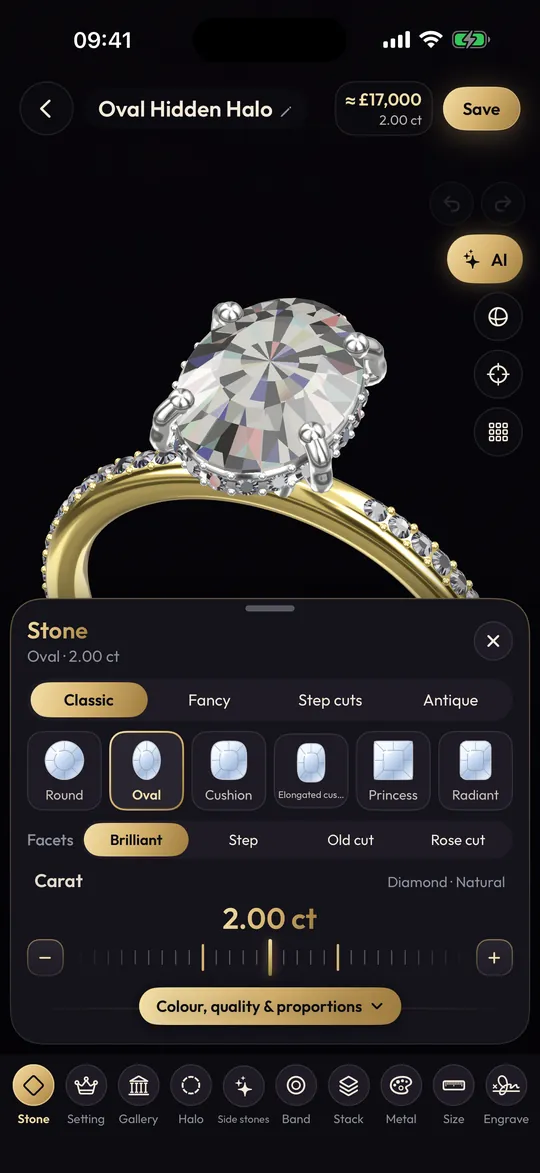
In Ring Studio you choose the shape, carat size and stone type (natural or lab-grown diamond, or a coloured stone). The app shows the stone as a well-cut, clean stone; it does not grade colour or clarity. That makes it ideal for settling shape and carat, the two Cs you see most, before you shop for the other two.
- Pick a shape from 28 cuts and slide the carat size up and down on the ring.
- Try it on your own hand with the camera (Pro) to find the carat that feels right.
- Watch the live price estimate change between natural and lab-grown.
- Share the ring code with your jeweller along with your target colour and clarity.
Quick 4Cs cheat sheet
| Priority | Round diamond | Oval, pear, marquise | Emerald, asscher |
|---|---|---|---|
| Cut | GIA Excellent | Strong proportions, minimal bow-tie | Even steps, good symmetry |
| Colour (white metal) | G to H | G to H (colour pools at the points) | F to H |
| Colour (yellow or rose) | I to J | H to J | H to I |
| Clarity | VS2 to SI1 eye-clean | VS2 to SI1 eye-clean | VS1 to VS2 |
Use these as starting points, not rules. Your eyes, and a good jeweller, are the final judge. For the full purchase process, see the engagement ring buying guide.
Frequently asked questions
Which of the 4Cs is most important?
Cut. It decides how well the diamond returns light, so a well-cut stone with modest colour and clarity often looks better than a poorly cut stone with top grades. Prioritise an Excellent or Ideal cut for round diamonds.
What is a good 4Cs combination for value?
For a round diamond, a popular value combination is Excellent cut, G to H colour and VS2 to SI1 clarity, checked to be eye-clean. Adjust colour down for yellow or rose gold settings.
Is carat the size of a diamond?
Carat is weight, not size. One carat is 0.2 grams. Two diamonds of the same weight can look different sizes depending on their shape and how deep they are cut.
Do the 4Cs apply to lab-grown diamonds?
Yes. Lab-grown diamonds are graded on the same cut, colour, clarity and carat scales. The report will also state that the stone is laboratory-grown.
Are there more than 4Cs?
Retailers sometimes add a fifth C for certificate or conflict-free. Other factors such as fluorescence, polish, symmetry and proportions also appear on grading reports and affect how a stone looks.