 Ring Studio
Comparisons
Moissanite vs Diamond
Moissanite vs diamond comes down to sparkle style and budget: moissanite costs a fraction of a diamond and flashes more rainbow colour, while diamond is harder and has a cooler, white brilliance that most people still read as "diamond".
On this page
Moissanite vs diamond comparison table
| Moissanite | Diamond | |
|---|---|---|
| Look | Very bright, strong rainbow fire | Crisp white brilliance with balanced fire |
| Hardness (Mohs) | 9.25 | 10 |
| Refractive index | About 2.65 to 2.69 | 2.42 |
| Dispersion (fire) | About 0.104 | 0.044 |
| Maintenance | Clean regularly; very low upkeep | Clean regularly; very low upkeep |
| Price (6.5 mm round) | Roughly £150 to £600 for the stone | Lab-grown roughly £500 to £2,000; natural roughly £4,000+ |
| Apparent size | 6.5 mm round weighs about 0.88 ct | 6.5 mm round weighs about 1 ct |
| Best for | Maximum size and sparkle on a small budget | The classic white look and top hardness |
Prices are rough GBP estimates for a loose stone as of late 2026 and vary a great deal by retailer, quality and market. Lab-grown diamond prices have fallen sharply over recent years, which has narrowed the gap with moissanite.
How the sparkle differs
This is the difference you will actually notice. Moissanite has a higher refractive index than diamond, so it returns a lot of light, and more than double diamond's dispersion, so it splits that light into strong spectral colour. In sunlight a moissanite throws flashes of red, green and violet; some people love this "disco ball" quality and some find it too much.
Diamond's sparkle is cooler and crisper: bright white flashes with fire that shows but does not dominate. Size exaggerates the contrast. At 6 mm and below, moissanite and diamond are hard to tell apart for most observers. Past about 8 mm, moissanite's rainbow effect becomes more obvious.
Moissanite is also doubly refractive. Cutters orient it to hide this, but looking through the side of a large stone you may see slightly doubled facet edges. Diamond is singly refractive and never shows this.
Colour
Early moissanite had a yellow or green tint. Modern colourless moissanite is much better, and the top grades face up close to a near-colourless diamond. Under some lighting, larger moissanites can still show a faint warm or grey cast. If you are sensitive to colour, look at the stone in daylight before buying.
Durability
Diamond is 10 on the Mohs scale and moissanite is 9.25, so both are harder than any other common engagement ring stone. In practice moissanite holds a polish for decades of daily wear. Diamond keeps very sharp facet edges a little better over a lifetime, and neither is immune to chipping from a hard knock on a point or thin girdle.
Price and apparent size
Moissanite is far cheaper than natural diamond and usually well below lab-grown diamond too, although that gap has shrunk as lab-grown prices have dropped. Because moissanite is about 10% less dense, a 6.5 mm round, the size of a 1 ct diamond, weighs roughly 0.88 ct. That is why moissanite is often sold by millimetre or "diamond equivalent weight". Compare by millimetres, not carats, using our carat size chart. For full ring budgets, see moissanite ring prices and the 1 carat diamond ring price guide.
Value and perception
Neither moissanite nor lab-grown diamond holds meaningful resale value; natural diamond holds some. Perception is personal. Some couples like that moissanite is openly its own gem; others want a diamond because of what it means to them or their family. There is no wrong answer, but it is worth talking about before the ring is bought.
Does moissanite look different in certain shapes and settings?
Yes, and it is worth knowing before you choose. Brilliant shapes such as round, oval and cushion play to moissanite's strengths, and at modest sizes they are very hard to tell from diamond. Step cuts like the emerald cut and Asscher are more revealing: their large, open facets show moissanite's double refraction and colourful flashes more clearly, so many buyers who want a step cut choose a lab-grown diamond instead.
Setting changes the picture too. Surrounded by small diamonds in a halo or pavé band, a moissanite centre's extra fire can make the contrast with the white side stones more visible. A plain solitaire or bezel avoids that comparison entirely. Some people use moissanite for the centre and moissanite melee throughout, so everything sparkles the same way.
Choose moissanite if... choose diamond if...
- Choose moissanite if you want a large stone on a modest budget, you love vivid colourful sparkle, or you would rather spend the money on something else.
- Choose diamond if you want the hardest stone and the classic white sparkle, you are buying a large centre stone where moissanite's fire would show, or a diamond matters to you or your partner. A lab-grown diamond is the middle ground on price.
Compare them side by side in Ring Studio
Ring Studio does not have a separate moissanite option. Because a colourless moissanite and a colourless diamond look the same on a phone screen, you can design the full moissanite look with the diamond option: the size, shape, setting and band are identical. What you cannot rely on is the price estimate, which is calculated for diamonds.
- Choose your shape in the stone tray and set the carat to match the millimetre size you are considering (1 ct round is about 6.5 mm).
- Build the setting, for example a hidden halo or a simple solitaire, and pick your metal.
- Save a copy, then use the price estimate to compare natural against lab-grown diamond for the same design.
- Try it on your own hand with the camera (Pro) to judge whether a bigger moissanite or a smaller diamond suits you better.
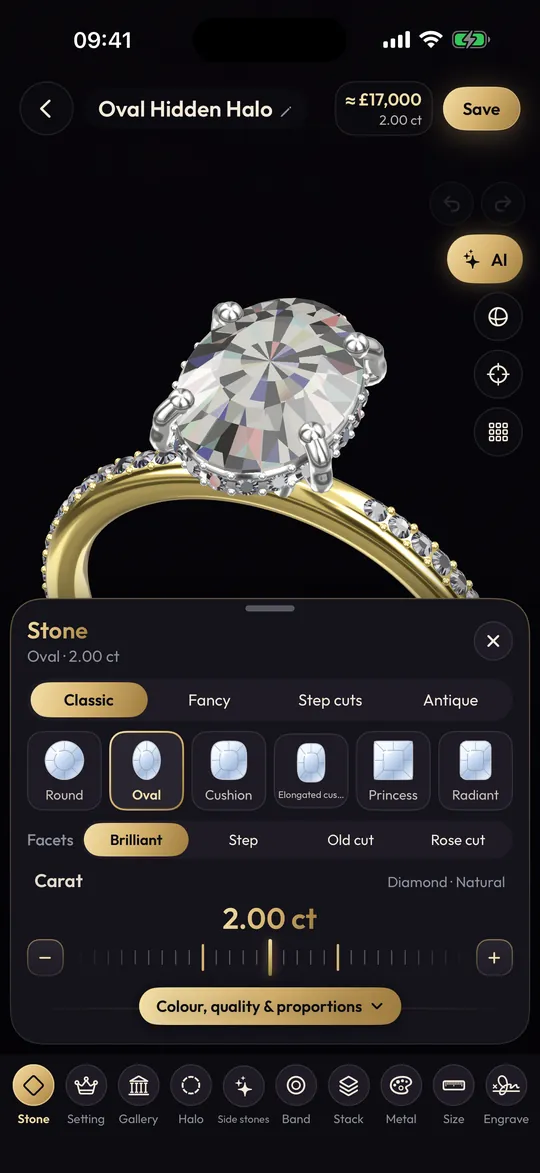
Share the ring code with a jeweller who works with moissanite, and they can quote the actual stone. You can start in the free ring designer.
Verdict
Moissanite is the best value for sheer size and brightness, and at everyday sizes most people will never know. Diamond wins on hardness, on that crisp white look, and on meaning for many couples. If you like the idea of moissanite but worry about the rainbow effect, view one in sunlight first, or compare it with a lab-grown diamond, which now costs less than many expect.
Frequently asked questions
Can people tell moissanite from diamond?
Most people cannot at a normal distance. Up close, especially in sunlight or in larger sizes, moissanite's strong rainbow flashes can give it away to a trained eye, and a tester can separate them instantly.
Is moissanite a fake diamond?
Moissanite is not a diamond; it is silicon carbide, a different gemstone with its own properties. It is a genuine gem in its own right, usually lab-created, and is sold honestly as moissanite by reputable jewellers.
Does moissanite get cloudy?
No. Moissanite does not cloud or change colour over time. It can look dull when coated in oil and soap, exactly like a diamond, and a clean restores it.
Why is moissanite sold in millimetres instead of carats?
Moissanite is less dense than diamond, so a stone of the same size weighs less. Sellers often quote millimetres or a diamond-equivalent weight so you know how big it will look.
Is moissanite hard enough for an engagement ring?
Yes. At 9.25 on the Mohs scale it is harder than sapphire and resists scratching well in daily wear. Only diamond, at 10, is harder.