 Ring Studio
Ring size
Ring Size by Diameter and Circumference
To find a ring size by diameter, measure straight across the inside of a ring that fits, edge to edge, in millimetres; to find it by circumference, measure around the finger. A 17.3 mm inside diameter, or about 54.4 mm around, is a US 7, UK N½ and EU 54.
On this page
- Diameter
- Straight line across the inside of the ring, in mm
- Circumference
- Distance around the inside, in mm (diameter × π)
- US formula
- Diameter ≈ 11.63 + 0.8128 × US size
- Sensitivity
- About 0.4 mm of diameter = half a US size
- Best tool
- Calipers on a ring that already fits, or a jeweller's mandrel
Ring size by diameter chart (mm)
Find the inside diameter you measured in the left column. Circumference is the diameter multiplied by pi. US sizes are rounded to the nearest quarter, and UK letters to the nearest half letter. Where a measurement sits right on the boundary between two sizes, both are shown. The figures are approximate, and sizing scales differ slightly between manufacturers, so confirm with a professional sizing before ordering a ring that cannot easily be resized.
| Inside diameter (mm) | Circumference (mm) | US (approx.) | UK (approx.) | EU / ISO |
|---|---|---|---|---|
| 14.0 | 44.0 | 3 | F | 44 |
| 14.5 | 45.6 | 3½ | G | 46 |
| 15.0 | 47.1 | 4¼ | H to H½ | 47 |
| 15.5 | 48.7 | 4¾ | I½ | 49 |
| 16.0 | 50.3 | 5½ | K | 50 |
| 16.5 | 51.8 | 6 | L to L½ | 52 |
| 17.0 | 53.4 | 6½ | M½ | 53 |
| 17.5 | 55.0 | 7¼ | N½ to O | 55 |
| 18.0 | 56.5 | 7¾ | P | 57 |
| 18.5 | 58.1 | 8½ | Q½ | 58 |
| 19.0 | 59.7 | 9 | R½ | 60 |
| 19.5 | 61.3 | 9¾ | T | 61 |
| 20.0 | 62.8 | 10¼ | U | 63 |
| 20.5 | 64.4 | 11 | V½ | 64 |
| 21.0 | 66.0 | 11½ | W½ | 66 |
| 21.5 | 67.5 | 12¼ | Y | 68 |
| 22.0 | 69.1 | 12¾ | Z | 69 |
| 22.5 | 70.7 | 13¼ | Z+1 | 71 |
If your number falls between two rows, use the ring size converter to get a precise conversion, or see the full ring size chart for Japanese and Indian sizes as well.
Diameter vs circumference: which should you use?
They describe the same ring, so either works. The choice depends on what you are measuring.
- Measuring an existing ring? Use diameter. A ring is rigid and round, so measuring straight across the inside is easy and repeatable.
- Measuring a finger? Use circumference. Wrap a strip of paper or string around the base of the finger and measure its length. Fingers are not perfect circles, so a "diameter" of a finger is meaningless.
Circumference is also what the European system uses directly: an EU 54 ring is 54 mm around the inside. That is why EU sizes are easy to sanity-check and why the US to EU conversion is essentially a circumference lookup.
How to measure the inside diameter of a ring
The most reliable home method is to measure a ring that already fits the right finger comfortably. Choose a ring with a similar band width to the one you are buying, because a wide band and a thin band of the same size can feel quite different.
- Pick the right ring. It should be round, not bent, and worn on the same finger (or one you know is the same size).
- Measure the inside edge to inside edge. Lay the ring flat and measure across the widest point of the opening. Do not include the metal.
- Measure twice, at 90 degrees. Rings can go slightly oval with wear. If the two readings differ, average them.
- Use calipers if you can. Inexpensive digital calipers read to 0.1 mm. A ruler is readable to about 0.5 mm, which is more than half a US size.
- Look up the size. Find the diameter in the chart above.
Watch out for rings with sizing beads, a comfort-fit (domed) interior or a ring guard. They all make the opening read smaller than the actual size the ring was made in. If the ring has any of these, a jeweller's mandrel will give a truer reading.
Measuring circumference around the finger
Wrap a thin strip of non-stretch paper around the base of the finger, mark where it overlaps, then lay it flat against a millimetre ruler. Make sure the strip can slide over the knuckle, because the ring has to. Measure later in the day, when fingers are at their typical size, and avoid measuring when your hands are very cold. Our full guide to measuring ring size at home walks through the string, paper and printable methods, and the printable ring sizer includes a calibration line so you can check your printer has not scaled it.
Why half a millimetre matters
On the US scale each whole size adds about 0.81 mm to the inside diameter, so a half size is roughly 0.4 mm. That is about the thickness of two sheets of paper. A measurement error that small can be the difference between a ring that slips off in cold water and one that will not pass the knuckle. That is why we describe every home method as an estimate and recommend a jeweller's sizing ring for the final call, especially for designs that are difficult to resize such as full eternity bands. See what to do if a ring is too big or too small.
Using your measurement in Ring Studio
Once you know the size in millimetres, you can focus on the ring itself. Ring Studio is a 3D ring design app for iPhone, iPad and Android that helps you settle the design before you visit a jeweller.
- Design the ring in the 3D ring designer: stone shape, setting, halo, band style and metal.
- Adjust the band width and see how it looks; remember wider bands usually call for a slightly larger size.
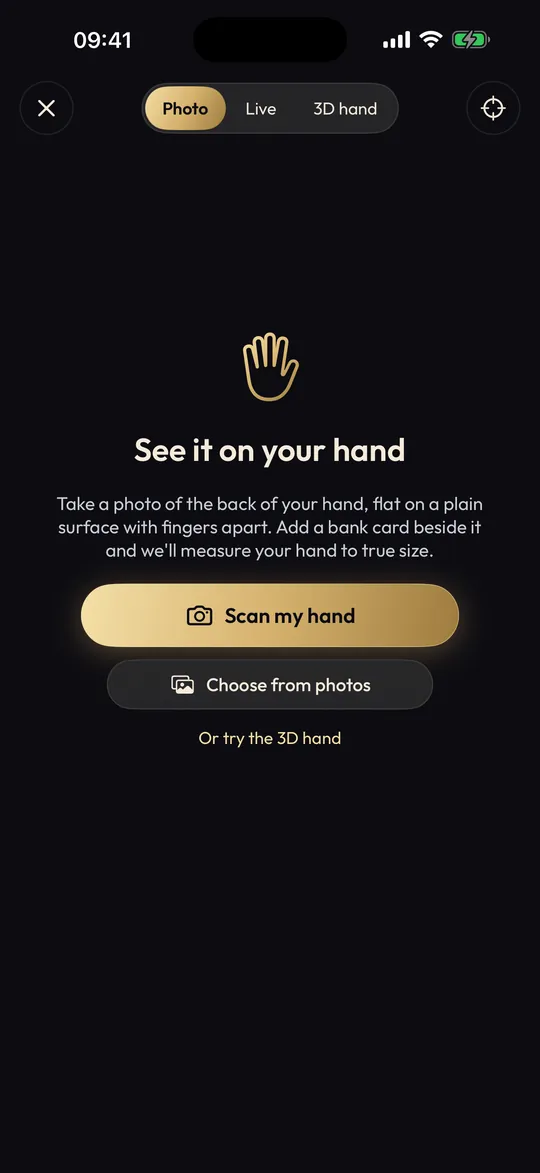
- With Ring Studio Pro, scan your hand with a bank card beside it for scale. The app estimates your ring size from the scan and lets you try the ring on with the camera. It is a useful cross-check on your tape-measure result, not a replacement for a jeweller's sizing.
- Share the ring code with your jeweller along with your measured diameter or circumference.
Measuring a borrowed ring for a surprise
Diameter is the go-to method for a secret purchase: borrow a ring your partner wears on the right finger, measure it in a minute, and put it back. If you cannot get it out of the house, press it into a bar of soap or trace the inside edge on paper and measure the impression. Our guide to finding a ring size secretly covers this and other low-risk tricks, plus what to do if you are not sure.
Frequently asked questions
What ring size is 18 mm diameter?
An 18 mm inside diameter is about 56.5 mm in circumference, which is roughly a US 7¾, UK P and EU 57.
What ring size is 16 mm diameter?
A 16 mm inside diameter is about 50.3 mm around, which is roughly a US 5½, UK K and EU 50.
How do I convert ring diameter to circumference?
Multiply the inside diameter by pi (about 3.1416). A 17 mm diameter gives a circumference of about 53.4 mm. Divide circumference by pi to go the other way.
Do I measure the inside or outside diameter of a ring?
Always the inside diameter, from inner edge to inner edge across the widest point. The outside measurement includes the metal and will make the size look much larger than it is.
How accurate is measuring a ring with a ruler?
A ruler marked in millimetres can only be read to about half a millimetre, and 0.4 mm of diameter is roughly half a US size. Digital calipers, a ring sizing cone or a jeweller's mandrel are more reliable.