 Ring Studio
Around the world
Engagement Rings in Germany: Sizes, Hands and Customs
Engagement rings in Germany follow a few habits you will not find in the UK or US: sizes quoted as a circumference in millimetres, an engagement ring worn on the left that often gives way to a wedding band on the right, and a long tradition of both partners wearing engagement bands.
On this page
- Ringgröße: how German ring sizes work
- Left hand, then right: the German ring swap
- Verlobungsringe for two: matching engagement bands
- 333, 585 and 750: reading German gold stamps
- What an engagement ring costs in Germany
- Where people buy: Juwelier, Goldschmied or online
- Your rights when buying in Germany
- Designing a German-style ring in Ring Studio
- A short checklist for German buyers
- Size system
- Inner circumference in mm (Ringgröße 54 = 54 mm); sometimes diameter
- Engagement ring
- Usually left ring finger
- Wedding band
- Traditionally right ring finger
- Common gold
- 585 (14k) and 750 (18k); 333 (8k) at budget level
- Hallmarking
- Fineness stamped by the maker; no compulsory independent assay
- Rough spend
- Often €800 to €4,000 for an engagement ring (estimate)
Ringgröße: how German ring sizes work
Germany uses the simplest sizing system in Europe: the number is the inside circumference of the ring in millimetres. A Ringgröße 52 measures 52 mm around the inside, and each whole size is one millimetre. This is the same logic as the international ISO standard, so a German size converts directly to most of continental Europe.
The catch is that some jewellers, and many ring-sizing gauges sold online, work in inner diameter instead. A diameter of 17 mm is a circumference of about 53.4 mm, which is a very different number. If a shop says "17", it is almost certainly a diameter; if it says "54", it is a circumference.
| German size (circumference) | Inner diameter | US | UK |
|---|---|---|---|
| 49 | 15.6 mm | 5 | J½ |
| 52 | 16.5 mm | 6 | L½ |
| 54 | 17.2 mm | 7 | N½ |
| 57 | 18.1 mm | 8 | P½ |
| 60 | 19.1 mm | 9 | R½ |
| 62 | 19.7 mm | 10 | T½ |
| 65 | 20.7 mm | 11 | V½ |
Conversions are approximate because US and UK sizes do not land exactly on whole millimetres. For anything in between, use the ring size converter or see the fuller US to EU ring size table. If you are measuring at home, a strip of paper and a ruler gives you circumference directly; our guide to measuring ring size at home covers the pitfalls, such as cold fingers and wide bands.
Left hand, then right: the German ring swap
The question of which hand an engagement ring goes on has a two-part answer in Germany. During the engagement, the ring is usually worn on the left ring finger. At the wedding, the Ehering (wedding band) is traditionally placed on the right ring finger, a custom shared with Austria, Poland, Norway and parts of Eastern Europe.
What happens to the engagement ring after that varies by couple. Some move it to the right hand so it sits above or below the wedding band; others leave it on the left so each hand carries one ring. There is no rule, and younger couples, couples with international ties and people who work with their right hand sometimes simply wear everything on the left. If you plan to stack both rings on the right, it is worth designing them together so the band sits flush, which is exactly what a curved or contour wedding band is for.
Verlobungsringe for two: matching engagement bands
An older German custom, still alive today, is for both partners to wear a ring from the engagement. Traditionally these were matching plain gold bands worn on the left, which then moved to the right hand at the wedding and became the wedding rings. That is why German jewellers often talk about Trauringe and Eheringe as a pair, and why wedding rings are commonly priced and sold as a set of two.
Today the more international pattern, a diamond engagement ring for one partner followed by two wedding bands, is widespread, and many couples mix the two: a solitaire for one partner, a plain band for the other. Another distinctly German option is a goldsmith workshop where couples forge their own wedding rings in a day under supervision. Several goldsmiths around the country offer this, and it suits people who care more about the story than about a diamond.
333, 585 and 750: reading German gold stamps
German jewellery is stamped with a three-digit fineness number in parts per thousand rather than a karat figure. The gold karat guide explains the chemistry; the short version for German shoppers:
| Stamp | Karat | Pure gold | Where you see it |
|---|---|---|---|
| 333 | 8k | 33.3% | Budget rings and fashion jewellery |
| 585 | 14k | 58.5% | The everyday standard for engagement and wedding rings |
| 750 | 18k | 75% | Higher-end rings, richer yellow colour |
| 950 | Platinum | 95% platinum | Premium white metal |
Germany does not require pieces to be sent to an independent assay office. The fineness stamp is applied by the manufacturer or retailer, who is legally responsible for it being accurate. That makes the reputation of the shop matter more than it would in the UK, where independent hallmarking is compulsory. Our hallmarks guide compares systems across countries. For white gold, ask whether the ring is rhodium-plated, since 585 white gold usually is and will need re-plating every so often.
What an engagement ring costs in Germany
We are not aware of a reliable, regularly updated figure for average spend in Germany, so treat the ranges below as rough estimates of what jewellers commonly sell. They vary with gold prices, stone quality and the shop, and lab-grown diamond prices have fallen sharply in recent years.
| Type of ring | Rough range (EUR, estimate) |
|---|---|
| 585 gold band with a small natural diamond (around 0.1 to 0.2 ct) | €500 to €1,500 |
| Natural diamond solitaire around 0.5 ct | €1,500 to €4,000 |
| Lab-grown diamond solitaire around 1 ct | €900 to €2,500 |
| Natural diamond solitaire around 1 ct | €4,000 to €12,000 and up |
| Pair of plain wedding bands (Trauringe), 585 gold | €700 to €2,500 per pair |
German buyers tend to be careful with money and less attached to the "spend a set number of salaries" idea; the three months' salary rule is mostly an American import. Our engagement ring cost guide breaks down what drives price, and the lab-grown vs natural diamond comparison is worth reading before you choose.
Where people buy: Juwelier, Goldschmied or online
- Juwelier (jeweller's shop): department-store counters and chains in city centres, plus long-established family jewellers. Good for trying on and for wedding band pairs.
- Goldschmied (goldsmith): independent workshops that make rings on site. This is where custom and redesign work happens, and many will work from a design you bring in.
- Online: German and international sites sell both natural and lab-grown stones. Check the certificate, the return terms and where the ring ships from.
Your rights when buying in Germany
In very general terms, EU rules give you a legal guarantee against faulty goods for at least two years, and a 14-day right to withdraw from most online purchases. That withdrawal right normally does not apply to items made to your personal specification, so a custom ring ordered online is usually not returnable just because you changed your mind. Get the design agreed in writing first. This is general information rather than legal advice; the Verbraucherzentrale (consumer advice centre) is a good official starting point.
Designing a German-style ring in Ring Studio
Ring Studio is a 3D ring designer for iPhone, iPad and Android, free to download, with the app itself in English. It does not sell rings; you design and visualise, then take the result to a Goldschmied. A few ways to use it for German traditions:
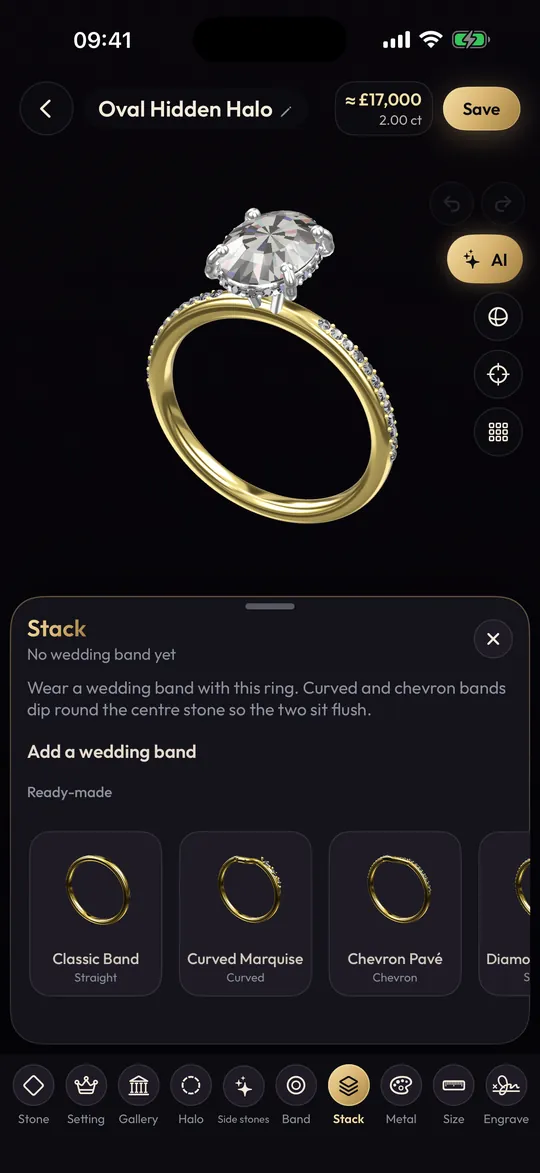
- Plan the right-hand stack. Design the engagement ring, then add a wedding band and stack it above or below. A curved or chevron contour lets the band sit flush against a solitaire or halo.
- Match the partner's band. Design a plain band on its own in the same metal, adjusting the width, and add an engraving inside such as a date or names.
- Describe it in words. Type something like "slim yellow gold solitaire, oval diamond, six prongs" and the AI builds it in 3D, then refine by chatting.
- Check the size. Scan your hand with a bank card beside it for scale to estimate your size, and try the ring on your hand with the camera.
- Share a ring code with your partner or goldsmith so they open the exact design.
The app shows yellow, white and rose gold, platinum and two-tone, but not specific karats, so tell your jeweller whether you want 585 or 750. The core designer is free; Ring Studio Pro unlocks the AI, try-on and advanced options such as band stacks. See the wedding band stack designer for more on pairing.
A short checklist for German buyers
- Confirm whether the size you have is a circumference or a diameter.
- Decide early which hand each ring will live on; it affects how they need to fit together.
- Ask for the fineness in writing (585 or 750) and whether white gold is rhodium-plated.
- For diamonds of half a carat and above, ask for a grading certificate; see diamond certificates explained.
- Get custom work quoted and agreed in writing before production starts.
Frequently asked questions
Which hand is the engagement ring worn on in Germany?
Most people wear the engagement ring on the left ring finger. At the wedding the wedding band (Ehering) usually goes on the right ring finger, and the engagement ring either moves to the right to sit with it or stays on the left.
How are ring sizes measured in Germany?
German jewellers normally give the inside circumference in millimetres, so a size 54 is a ring with a 54 mm inner circumference, roughly a US 7 or UK N½. Some shops quote the inner diameter instead, so check which number you are being given.
What does 585 mean on a German ring?
585 means the metal is 58.5% pure gold, the same as 14 karat. 750 is 18 karat and 333 is 8 karat, a lower fineness that is legal and common in German budget jewellery.
Do German couples both wear engagement rings?
Traditionally many did: couples exchanged matching plain bands at the engagement and these became their wedding rings by moving to the right hand. Today a solitaire for one partner is at least as common, but matching engagement bands are still offered by most jewellers.
How much does an engagement ring cost in Germany?
There is no reliable single figure. As a rough estimate, many rings sold in Germany fall between about 800 and 4,000 euros, with lab-grown diamonds bringing larger stones into the lower end of that range.