 Ring Studio
Settings & styles
Solitaire Engagement Rings
A solitaire engagement ring is a single centre stone on a band with no other stones competing for attention. It is the simplest ring to wear, clean and resize, and every pound goes into the stone and the metal.
On this page
- What makes a ring a solitaire
- Solitaire setting styles compared
- Which stone shapes suit a solitaire?
- How to make a solitaire look bigger
- Durability and everyday care
- Pairing a wedding band with a solitaire
- How much does a solitaire engagement ring cost?
- Designing a solitaire in Ring Studio
- Solitaire vs other styles
- What it is
- One centre stone, no accent stones
- Best shapes
- Any; round, oval and emerald are the classics
- Durability
- High; fewest stones to lose
- Maintenance
- Lowest of any style
- Band pairing
- Easiest; most straight bands sit flush
- Cost impact
- Lowest setting cost; budget goes to the stone
What makes a ring a solitaire
The word means "single stone". A solitaire engagement ring has one centre stone and nothing else set into the head or the band. That restraint is the whole point: the eye goes straight to the stone, so its cut, colour and proportions matter more than in any other style.
Three parts define a solitaire, and changing any one of them changes the ring's character far more than you might expect:
- The head: how the stone is held. Prongs (four, six or eight) or a full bezel.
- The gallery: the metal under the stone, seen from the side. It can be open, a simple rail, a tulip shape or a decorative flame. See our guide to gallery styles.
- The band: width, profile and whether it tapers towards the stone.
Solitaire setting styles compared
| Head | Look | Security | Best for |
|---|---|---|---|
| 4 prong | Most stone visible; squares off a round | Good | Round, princess, cushion, asscher |
| 6 prong | Round and protected; slightly busier | Very good | Round, oval, larger stones |
| Double or claw prongs | More decorative tips | Very good | Ovals, cushions, vintage looks |
| Bezel | Sleek metal rim | Excellent | Active lifestyles, pointed shapes |
| Compass (prongs at N, E, S, W) | Rotated, geometric | Good | Square shapes turned on point, rounds |
If you are stuck between the two most common heads, our 4 prong vs 6 prong comparison goes into the trade-offs in detail. For pointed stones such as pear and marquise, make sure the tip has a V-prong or a bezel; an exposed point chips easily.
Which stone shapes suit a solitaire?
All of them, which is part of the appeal. But some shapes need the help of a halo or side stones less than others:
- Round brilliant: maximum sparkle and the most forgiving of slightly lower colour. The default solitaire for good reason. See round engagement rings.
- Oval: looks larger than a round of the same carat weight and lengthens the finger. See oval engagement rings.
- Emerald and asscher: step cuts with a quieter, hall-of-mirrors flash. On a plain band they look architectural. They show inclusions more readily, so clarity matters.
- Cushion, radiant and princess: bright, square or rectangular alternatives that sit well in four prongs.
- Pear and marquise: dramatic and finger-lengthening; protect the points.
How to make a solitaire look bigger
A solitaire has no halo to borrow size from, so the tricks are all about proportion:
- Keep the band slim. A 1.8 to 2 mm band makes the same stone look noticeably larger than a 3 mm band. Our ring width guide explains why.
- Taper the shoulders so the metal narrows as it meets the head.
- Choose an elongated shape. Ovals, pears and marquises spread their weight across more surface area than a round.
- Use thin prongs or petite tips so less metal covers the girdle.
- Prioritise cut. A well-cut stone returns more light and simply looks bigger than a deep, poorly cut one of higher weight.
To see real dimensions by carat, use the diamond carat size chart.
Durability and everyday care
With one stone and no pavé, a solitaire has the fewest points of failure. The main things to watch are prong wear (have them checked once a year, more often with daily gym or garden use) and a high setting catching on jumpers. A low-profile setting or bezel solves the snagging issue. Cleaning is simple: warm water, a drop of washing-up liquid and a soft toothbrush under the stone, where oil and soap collect and dull the sparkle. Our ring care guide covers more.
Pairing a wedding band with a solitaire
Solitaires are the most flexible style for stacking. A straight plain or pavé band usually slides under the gallery and sits flush, and you can match or deliberately contrast the metal. If the head sits very low, or you have chosen a bezel that flares wide, a gently curved band avoids a gap. Many people add a slim eternity band later for an anniversary.
How much does a solitaire engagement ring cost?
The setting itself is usually the cheapest part of the ring because there are no accent diamonds to buy or set. As a rough guide, as of late 2026 a plain gold solitaire mount from a UK independent jeweller often costs a few hundred pounds, with platinum higher. The centre stone drives almost everything else, and lab-grown diamond prices have fallen sharply in recent years, so a lab stone can buy you a much larger solitaire. These are estimates; prices vary by retailer, quality and metal market. See 1 carat diamond ring prices for stone-level detail.
Designing a solitaire in Ring Studio
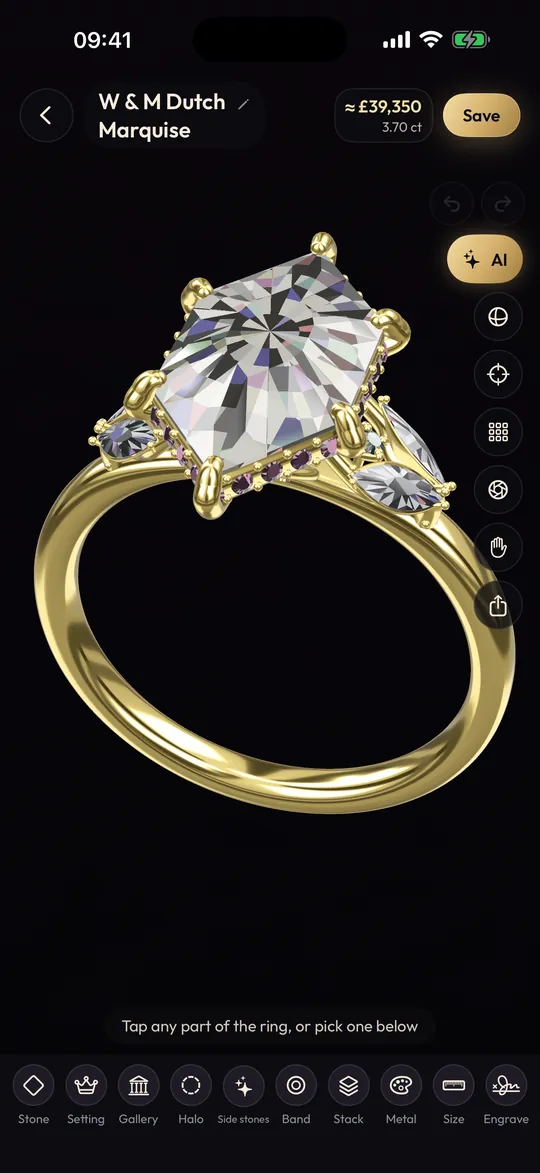
A solitaire is the fastest thing to build in Ring Studio, which makes it a good way to test how small changes feel:
- Pick a stone shape and set the carat size. Watch the live price estimate move as you go up in weight.
- Choose the head: 4, 5, 6 or 8 prong, or a bezel, then the prong tips (round, claw, double or petite).
- Set the halo to none and pick a gallery. A rail or tulip gallery gives a plain solitaire a nice side profile.
- Choose a plain band, make it straight or tapered, and adjust the width until the stone looks the size you want.
- Pick yellow, white or rose gold or platinum, rotate the ring in 3D and save it.
If you would rather describe it, the AI designer will build "a 1.5 carat oval solitaire on a thin platinum band" in seconds. With Pro you can also try it on your own hand through the camera, then share the ring code with your jeweller.
Solitaire vs other styles
If a solitaire feels too plain, the usual next steps are a hidden halo (sparkle from the side only), a pavé band, or side stones. Our halo vs solitaire and solitaire vs three stone comparisons weigh up the options, and the minimalist rings guide goes further in the other direction.
Frequently asked questions
What is a solitaire engagement ring?
It is a ring with one centre stone and no accent stones on the band or around the head. The stone can be held by prongs or a bezel, and the band is usually plain metal.
Does a solitaire make the diamond look smaller?
Next to a halo of the same carat weight it reads smaller, because nothing adds to its outline. A thin band of around 1.8 to 2 mm and slim prongs do the most to make a solitaire look larger.
Is a 1 carat solitaire a good size?
A 1 carat round brilliant measures roughly 6.4 to 6.5 mm across, which looks substantial on most fingers. Elongated shapes such as oval, pear and marquise of the same weight look larger face-up.
Which setting is best for a solitaire?
Four prongs show the most stone and give a squarer look on a round; six prongs are more secure and keep a round looking round. A bezel is the most protective choice for active wearers.
Can you wear a wedding band with a solitaire?
Yes, and it is the easiest style to pair. Most solitaires sit high enough for a straight band to slide underneath, although a very low setting may need a slightly curved band.
Keep reading
 Stone shapesRound Engagement Rings: The Complete Buyer's GuideRound engagement ring guide: carat-to-mm sizes, cut grades that matter, best prong settings, band pairings and prices, p…Settings & stylesMinimalist Engagement RingsMinimalist engagement ring guide: thin bands, low settings, bezels and small stones, how to make a simple ring look inte…GemstonesDiamond Carat Size Chart (mm)Diamond carat size chart in mm: approximate sizes for round diamonds from 0.25 to 5 carats, plus oval, cushion, princess…