 Ring Studio
Ring Gallery Styles: Open, Rail, Tulip and More
Ring gallery styles describe the part of the setting below the stone that you see from the side: open, rail, tulip, flame, basket, trellis, scroll and hidden halo are the main types. The gallery shapes the ring's profile, how much light reaches the stone, how rigid the head is and how easily it cleans.
On this page
- What is a ring gallery?
- Ring gallery styles compared
- Open gallery
- Rail gallery (basket)
- Tulip gallery
- Flame gallery
- Trellis gallery
- Scroll, filigree and decorative galleries
- Hidden halo gallery
- Cathedral and the gallery
- How the gallery affects wedding band fit
- Hidden details in the gallery
- Trying gallery styles in Ring Studio
- Choosing a gallery: quick guide
- Gallery
- Metalwork beneath the centre stone, seen from the side
- Main styles
- Open, rail (basket), tulip, flame, trellis, scroll, hidden halo, bezel
- Affects
- Profile, rigidity, light into the stone, cleaning, band fit
- Hidden details
- Hidden halos, initials, accent stones
- In Ring Studio
- Open, rail, tulip and flame (flame is Pro), plus hidden halo and hidden initials
What is a ring gallery?
Look at an engagement ring from the side and you see three zones: the stone at the top, the band at the bottom, and the metalwork connecting them. That middle zone is the gallery. It holds the lower parts of the prongs, any rails or decorative elements between them, and sometimes a hidden halo of small stones. Because most people see a ring face-up, the gallery is a quiet design element, but it is visible in every side glance and every photo of a hand, and it affects how the ring wears.
The term overlaps with head, basket and setting. The ring anatomy guide defines each part precisely.
Ring gallery styles compared
| Gallery | Side view | Rigidity | Light and cleaning | Character |
|---|---|---|---|---|
| Open | Prongs only, nothing between | Depends on prong gauge | Most open; easiest to clean | Minimal, classic |
| Rail (basket) | Prongs joined by one or two bars | High | Open; rails gather some grime | Tidy, structured |
| Tulip | Prongs curving out from a narrow base | Good | Open; curves collect a little soap | Soft, floral, slightly vintage |
| Flame | Swept, flowing curves like rising flames | Good | Open; more nooks to clean | Decorative, dynamic |
| Trellis | Prongs crossing in an X | High | Open; crossing points need brushing | Architectural |
| Scroll or filigree | Ornamental metal patterns | High | More enclosed; harder to clean | Vintage, Edwardian |
| Hidden halo | A ring of small stones under the girdle | High | Sparkle from the side; tiny stones to check | Glamorous but subtle |
| Bezel / cup | Solid metal surrounding the stone | Highest | Least light from the sides | Modern, protective |
Open gallery
The prongs rise from the base of the head to the stone with nothing between them. This is the cleanest profile and lets light and air reach the stone's pavilion. It is easy to clean and suits minimalist rings. The trade-off is that each prong stands alone, so the head depends on the prongs' thickness for strength. Choose an open gallery for a very simple, light look, especially on a solitaire.
Rail gallery (basket)
A rail gallery adds one or two horizontal bars that connect the prongs below the stone. Joined prongs brace each other, so the head is stiffer and the prongs less likely to bend out of line after a knock. From the side, the rails form a neat band under the stone. A head with rails is often called a basket setting. If you want a classic look with a little extra security, this is the default choice.
Tulip gallery
In a tulip gallery the prongs start close together at the base and curve outwards as they rise, like a tulip about to open. The curve gives a soft, organic profile and often lets the head sit a little lower. It is popular for oval, round and cushion stones and pairs well with vintage and romantic designs. A close relative is the lotus setting, which uses fuller petal shapes.
Flame gallery
A flame gallery uses swept, flowing curves in the side profile, evoking flickering flames rising towards the stone. It is the most decorative of the common prong galleries and gives the ring movement when viewed from the side. It suits people who want the profile to be a real feature without adding stones.
Trellis gallery
The prongs lean and cross each other beneath the stone, creating an X or woven lattice in profile. Crossed prongs support each other, making the head rigid. See trellis engagement rings for a full guide.
Scroll, filigree and decorative galleries
Vintage and vintage-inspired rings often fill the gallery with scrolls, filigree or pierced patterns. They look beautiful and are strong, but they enclose more of the stone and need more careful cleaning. They are often paired with milgrain edges and engraved bands; see vintage engagement rings.
Hidden halo gallery
A hidden halo is a ring of small stones set around the base of the centre stone, below the girdle, so it is invisible from above and sparkles from the side. It is a gallery detail as much as a halo. See hidden halo engagement rings.
Cathedral and the gallery
A cathedral setting is not strictly a gallery style; it describes metal arches that rise from the shoulders of the band up to the head. But the arches change the side view dramatically and can combine with any of the galleries above. See cathedral engagement rings.
How the gallery affects wedding band fit
The lower the gallery, the more likely a straight wedding band will meet the head before it meets the shank. Tulip and hidden halo galleries tend to sit lower; rail and open galleries can be made taller. If you want a straight band to sit flush, ask for enough clearance under the gallery, or plan on a curved band.
Hidden details in the gallery
Because only the wearer looks closely at the gallery, it is a favourite spot for private touches: a birthstone set in the side, a tiny diamond, or initials worked into the metal. See hidden initials rings.
Trying gallery styles in Ring Studio
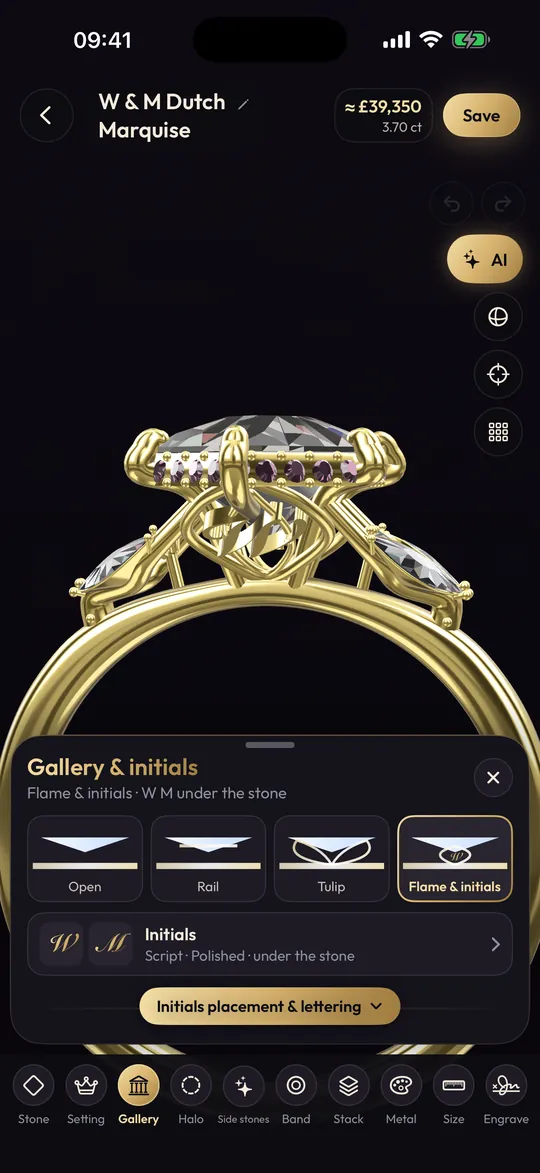
Ring Studio includes four gallery styles: open, rail, tulip and flame (flame is part of Pro). You can switch between them on the same stone and setting, and rotate the ring to compare profiles.
- Choose a stone and a prong setting (4, 5, 6 or 8 prong).
- Open the gallery options and cycle through open, rail, tulip and flame, viewing from the side.
- Add a hidden halo to see how it combines with each gallery.
- With Pro, add hidden initials under the stone, hand-drawn or typed in one of eight lettering styles.
- Stack a wedding band to check clearance under the gallery.
Trellis, scroll and filigree galleries are not in the app yet; choose the nearest gallery and describe the detail to your jeweller.
Choosing a gallery: quick guide
- Want it clean and minimal: open.
- Want extra strength with a classic look: rail.
- Want a soft, romantic profile: tulip or lotus.
- Want the side view to be a feature: flame, trellis or scroll.
- Want hidden sparkle: hidden halo.
- Want maximum protection: bezel.
For definitions of every part of a ring, see our ring anatomy guide and the ring design glossary.
Frequently asked questions
What is the gallery of a ring?
The gallery is the metalwork beneath the centre stone, between the stone and the band, visible when you look at the ring from the side. It includes the prongs' lower sections and any rails, curves, decoration or hidden halo below the stone.
What is a rail gallery?
A rail gallery joins the prongs with one or more horizontal bars of metal beneath the stone. The rails stiffen the head and give a tidy, structured profile, which is why rail galleries are among the most common.
What is a tulip gallery?
A tulip gallery shapes the prongs so they curve outwards from a narrow base, like the petals of a tulip. It gives a soft, flowing side view and often sits a little lower than a straight-prong head.
Does the gallery affect how a diamond sparkles?
Only a little. A well-cut diamond takes in most of its light through the top, so an open gallery adds only a small amount of extra light. Very solid galleries can make the pavilion look slightly darker from the side.
Can you put something hidden in the gallery?
Yes. Galleries are a popular place for hidden details such as a hidden halo of small stones, a birthstone, or initials, because they are visible to the wearer but not obvious to others.