 Ring Studio
Engagement Rings in New Zealand: Sizes, Prices & Traditions
Engagement rings in New Zealand are sized in UK-style letters, worn on the left hand, and protected by the Consumer Guarantees Act. With a small market, many Kiwis buy from a local jeweller who makes to order, often after sketching or designing the ring themselves.
On this page
- Sizes
- Letters (A to Z, half sizes), same as the UK and Australia
- Hand
- Left ring finger
- Hallmarking
- No compulsory assay; maker's stamps
- Key law
- Consumer Guarantees Act 1993
- Rough spend
- Often NZ$2,500 to NZ$9,000 (estimate)
Why so many Kiwis go bespoke
New Zealand is a small market, and the big international chains have a lighter footprint here than in Australia or the UK. What it does have is a strong community of independent jewellers and workshops in Auckland, Wellington, Christchurch, Dunedin and smaller towns. Many make rings in-house, so bringing a design to them is normal rather than unusual.
That suits the way a lot of couples approach rings here: practical, personal and not overly formal. It is common to choose the ring together, to reuse a family stone, or to ask for recycled metal. If that sounds like you, our guide to working with a jeweller on a custom ring explains the CAD, wax and casting stages, and recycled gold covers what to ask about sourcing.
NZ ring size letters, with conversions
NZ jewellers use letters. Overseas websites mostly use US numbers or EU millimetres, which is where mix-ups happen, especially when ordering from Australia (letters, fine) versus the US (numbers).
| NZ / AU / UK | US | EU / ISO (mm) |
|---|---|---|
| J½ | 5 | 49.3 |
| K½ | 5½ | 50.6 |
| L½ | 6 | 51.9 |
| M½ | 6½ | 53.1 |
| N½ | 7 | 54.4 |
| Q½ | 8½ | 58.3 |
| S½ | 9½ | 60.8 |
| U½ | 10½ | 63.4 |
If you can't visit a jeweller, our printable ring sizer works if you print at 100% scale and check the ruler. For a comfort margin on wide bands, see the ring width guide.
Pounamu, pāua and local materials
Pounamu (New Zealand greenstone, mostly nephrite jade) holds deep cultural significance in te ao Māori. Under the Ngāi Tahu (Pounamu Vesting) Act 1997, ownership of natural pounamu in the Ngāi Tahu takiwā sits with Ngāi Tahu, and authentic New Zealand pounamu can be certified. Some couples choose a pounamu ring, set a small piece into a band, or exchange carved pendants as part of their wedding. If that appeals, buy from a carver who can tell you the stone's origin, and treat it with respect; it is a taonga, not just a material.
Pāua shell inlays also appear in some local wedding bands. Both pounamu and pāua are much softer than diamond or sapphire, so they are better suited to inlays or protected settings than to a raised centre stone. For a green centre stone that is a good deal tougher, look at emerald (7.5 to 8 on the Mohs scale) or a green sapphire from a specialist.
Customs at engagements and weddings
- Left hand, engagement ring on top. As in the UK, the band usually goes on first at the wedding and the engagement ring returns to sit above it.
- Both partners wearing bands. Very common; men's bands are often plain gold, white gold or titanium. Our men's wedding band styles page compares options.
- Diverse traditions. Pasifika, Indian, Chinese and European families each bring their own wedding customs, including different views on gold, which hand to use and the role of family in the engagement. If you are joining a family with strong traditions, ask early.
- Outdoor, casual proposals. Beaches, tramping tracks and lookouts are classic. A low, secure setting helps if the ring will see hard use.
Gold, platinum and stamps
NZ jewellers commonly work in 9ct, 14ct and 18ct gold and platinum. There is no compulsory government assay, so the stamp inside a ring (for example 585 or 18ct) is the manufacturer's statement. Reputable jewellers stand behind it, and the Fair Trading Act prohibits misleading descriptions, but it is still wise to have the metal and karat written on the receipt and any valuation. Our gold karats guide explains what each number means for colour and durability.
Rough costs in New Zealand dollars
These are broad estimates as of late 2026, not quotes. Small-market pricing, freight, the exchange rate and metal prices all push NZ prices around, and lab-grown diamond prices have fallen a long way in recent years.
| Ring | Rough range (NZD, incl. GST) |
|---|---|
| Lab-grown diamond solitaire, about 1 ct | NZ$1,500 to NZ$5,000 |
| Natural diamond, about 0.5 ct, 18ct gold | NZ$2,500 to NZ$6,500 |
| Natural diamond, about 1 ct | NZ$7,000 to NZ$20,000+ |
| Custom design fee (if charged separately) | Often absorbed into the price; ask |
| Wedding band, 18ct or platinum | NZ$600 to NZ$3,000 |
For a structured approach to setting a number, the ring budget calculator helps; our engagement ring cost guide goes deeper into what drives price.
Your rights when buying
The Consumer Guarantees Act 1993 gives you automatic guarantees that goods are of acceptable quality, fit for purpose and match their description. A setting that fails early under normal wear, or a stone that is not as described, entitles you to a remedy. These guarantees apply to custom rings too, but change of mind is not covered by law. Overseas online purchases may attract GST at the border. Consumer Protection (part of MBIE) has official guidance; this is general information, not legal advice.
Designing yours in Ring Studio
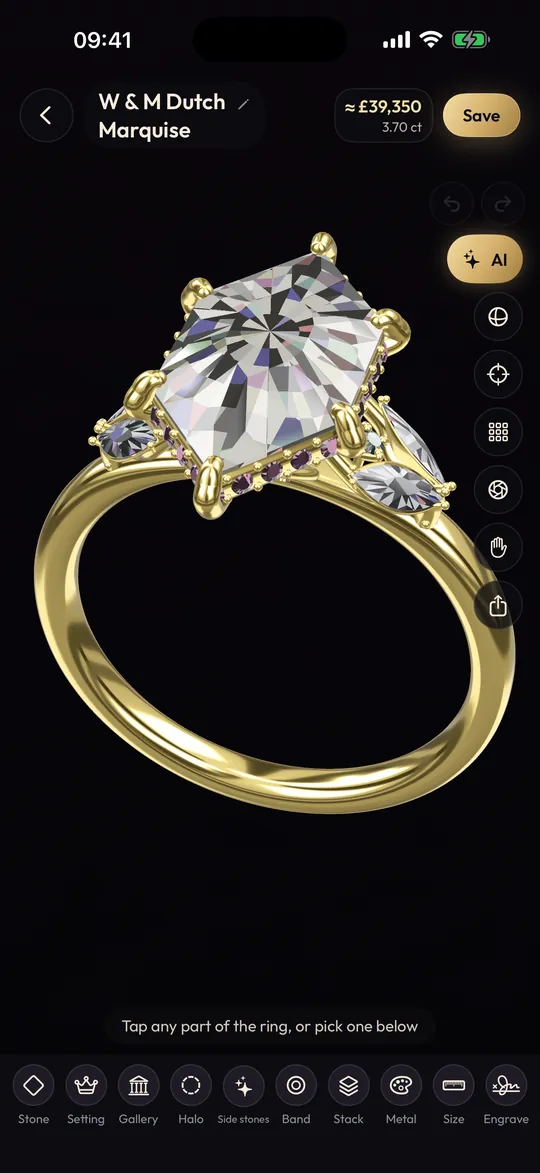
Because so many NZ jewellers make in-house, arriving with a clear 3D design saves time on both sides. Ring Studio is a free app for iPhone, iPad and Android (in English), and works like this:
- Pick a stone shape and carat; choose an oval or emerald cut, for example, and set it east-west if you like a modern look.
- Choose a low profile setting such as a bezel if you are outdoorsy, or a 6-prong head for classic sparkle.
- Try a band: plain, pavé, twisted, knife edge or bypass, and set the width.
- Preview yellow, white or rose gold and platinum. Pounamu and pāua aren't in the app, so design the metalwork and talk to your jeweller or carver about the inlay.
- With Pro, scan your hand beside a bank card to estimate the size, then share the ring code with your jeweller.
A short checklist
- Size in letters, measured at room temperature, more than once.
- Metal and karat written on the receipt.
- Diamond grading report from a recognised lab; see diamond certificates.
- Insurance valuation from the jeweller, kept with your policy.
Frequently asked questions
What ring sizes are used in New Zealand?
New Zealand uses the same letter sizes as the UK and Australia, with half sizes. A NZ M½ is roughly a US 6½ and about 53 mm in circumference.
Does New Zealand have hallmarking?
There is no compulsory independent hallmarking in New Zealand. Stamps like 750 or 18ct are applied by the maker or importer, so ask for the metal to be stated on your receipt.
How much is an engagement ring in New Zealand?
As a rough estimate many couples spend between about 2,500 and 9,000 New Zealand dollars. Lab-grown diamonds have brought the cost of a larger stone down sharply.
Can a pounamu ring be an engagement ring?
Some couples do choose pounamu (New Zealand greenstone) for a ring or wear a carved pendant alongside a ring. Pounamu is a taonga of Ngāi Tahu, so buy authenticated New Zealand stone from a reputable carver.
What rights do I have if my ring is faulty in New Zealand?
Under the Consumer Guarantees Act, goods must be of acceptable quality and match their description, so you can seek a repair, replacement or refund for faults. Change of mind is not covered unless the store offers it.