 Ring Studio
Around the world
Engagement Rings in the UK: Sizes, Prices & Traditions
Engagement rings in the UK are sized in letters (A to Z+), worn on the left ring finger and, if they weigh more than a gram of gold, must carry a hallmark from one of four Assay Offices. Here is what that means when you buy or design one.
On this page
- UK ring sizes: letters, not numbers
- Hallmarking: the UK's strongest consumer protection
- 9ct, 18ct or platinum?
- How and when people get engaged in Britain
- What does an engagement ring cost in the UK?
- Where to buy: high street, Hatton Garden or online
- Your consumer rights, in brief
- Design a UK engagement ring in Ring Studio
- Quick checklist before you buy
- Ring size system
- Letters A to Z, with half sizes (e.g. L½) and Z+1 upwards
- Which hand
- Left ring finger for both rings
- Common metals
- Platinum, 18ct white and yellow gold, 9ct for value
- Hallmarking
- Compulsory above set weights (gold 1 g, platinum 0.5 g)
- Rough spend
- Often £1,500 to £6,000, but very wide (estimate)
UK ring sizes: letters, not numbers
British jewellers use an alphabetical scale set out in British Standard BS 6820. Each full letter is roughly 1.25 mm of inside circumference, and most jewellers stock half sizes too. Australia, New Zealand, Ireland and South Africa use the same letters, which helps if you are buying from a jeweller in one of those countries.
The table below converts the most common sizes. Use it as a guide; for a ring you will wear every day, get measured with a proper sizer or use our ring size converter.
| UK letter | US / Canada | EU (circumference mm) | Inside diameter (mm) |
|---|---|---|---|
| H | 4 | 46.8 | 14.9 |
| J½ | 5 | 49.3 | 15.7 |
| L½ | 6 | 51.9 | 16.5 |
| N½ | 7 | 54.4 | 17.3 |
| P½ | 8 | 57.0 | 18.1 |
| R½ | 9 | 59.5 | 18.9 |
| T½ | 10 | 62.1 | 19.8 |
| V½ | 11 | 64.6 | 20.6 |
A wide band (5 mm and up) usually needs half to a full letter larger than a slim one. If you are buying as a surprise, our guide to finding a ring size secretly covers borrowing a ring and the string trick's pitfalls. For a full cross-reference with Japanese and Indian sizes, see the ring size chart.
Hallmarking: the UK's strongest consumer protection
The Hallmarking Act 1973 makes it an offence to describe an item as gold, silver, platinum or palladium unless it carries an approved hallmark, above small weight exemptions (1 g for gold and palladium, 0.5 g for platinum, 7.78 g for silver). Testing is done independently by one of four Assay Offices: London (Goldsmiths' Company), Birmingham, Sheffield and Edinburgh.
A full UK hallmark has three compulsory parts:
- Sponsor's mark: the initials of the maker or importer in a shield.
- Fineness mark: the purity in parts per thousand, such as 375, 585, 750 or 950.
- Assay Office mark: the leopard's head (London), anchor (Birmingham), rose (Sheffield) or castle (Edinburgh).
A date letter and the traditional pictorial marks (a crown for gold, an orb for platinum) are optional extras. Our hallmarks guide shows how to read one with a loupe. Dealers must also display the Assay Offices' notice explaining the marks, so ask to see it if you are unsure.
9ct, 18ct or platinum?
The UK is unusual in how much 9ct gold it sells. In the US the minimum for "gold" is 10k; here 9ct (375) is legal and popular for budget pieces. For engagement rings, though, buyers tend to trade up.
| Metal | Fineness mark | Gold or platinum content | What it is like to wear |
|---|---|---|---|
| 9ct gold | 375 | 37.5% | Hard, affordable; paler yellow, can dull over time |
| 14ct gold | 585 | 58.3% | Less common in UK shops; a good middle ground |
| 18ct gold | 750 | 75% | The UK standard for fine rings; richer colour |
| Platinum | 950 | About 95% | Naturally white, dense, develops a soft patina |
White gold is normally rhodium plated and will need re-plating every year or two; platinum does not. If you are weighing the two, our platinum vs white gold comparison goes through cost and upkeep, and gold karats explained covers why 18ct is softer but warmer than 9ct.
How and when people get engaged in Britain
Custom here is fairly relaxed. A surprise proposal with a ring is still the most familiar picture, but plenty of couples now choose the ring together, or propose with a placeholder and design the real one afterwards. Asking a partner's parents for permission is a courtesy some still observe rather than an expectation.
A few customs are distinctly British or Irish:
- Leap day proposals. Folklore says a woman may propose on 29 February. It is a light-hearted tradition rather than a rule.
- Inherited rings. Family stones are commonly reset; the UK has a large antique and Victorian ring trade. See redesigning an inherited ring.
- Ring order on the day. The wedding band sits closest to the heart, so many brides wear the engagement ring on the right hand during the ceremony, then move it back on top.
- Men's bands. Most grooms in the UK now wear a wedding ring, often a plain band in platinum or 18ct gold.
What does an engagement ring cost in the UK?
There is no reliable single "average", and figures quoted in the press vary widely depending on who was surveyed. As a rough estimate, many UK buyers spend somewhere between £1,500 and £6,000, with plenty spending less and a minority much more. The stone drives most of it.
| Ring (rough estimates, late 2026) | Typical UK price range |
|---|---|
| Lab-grown diamond solitaire, about 1 ct, 18ct gold | £800 to £2,500 |
| Natural diamond solitaire, about 0.5 ct, 18ct gold or platinum | £1,200 to £3,500 |
| Natural diamond solitaire, about 1 ct, good quality | £4,000 to £12,000+ |
| Plain wedding band, 18ct or platinum | £300 to £1,500 |
These vary by retailer, diamond quality and metal prices, which have moved a lot in recent years. Lab-grown diamond prices have fallen sharply, which is why a 1 ct lab stone can cost less than a half-carat natural one. Our engagement ring cost guide and budget calculator break it down further, and lab-grown vs natural explains the trade-off.
Where to buy: high street, Hatton Garden or online
- High street chains: convenient, easy returns, finance options; designs are mostly ready-made.
- Jewellery quarters: London's Hatton Garden and Birmingham's Jewellery Quarter have dense clusters of independent jewellers and setters, good for bespoke work and comparing quotes in one afternoon.
- Independent jewellers: found in most towns; often happy to make a design you bring them.
- Online retailers: wide stone choice and sharp pricing; check the returns policy and that the stone is graded by a recognised lab. Our guide to buying online safely lists the checks.
Your consumer rights, in brief
Under the Consumer Rights Act 2015, goods must be of satisfactory quality, fit for purpose and as described, so a stone or metal that is not what you were told gives you a claim. If you buy online or by phone, you generally have 14 days to cancel after delivery, but items made to your specification, which includes most bespoke rings, are usually exempt. Paying £100 to £30,000 by credit card can also give extra protection. This is a general summary, not legal advice; Citizens Advice and GOV.UK have the details.
Design a UK engagement ring in Ring Studio
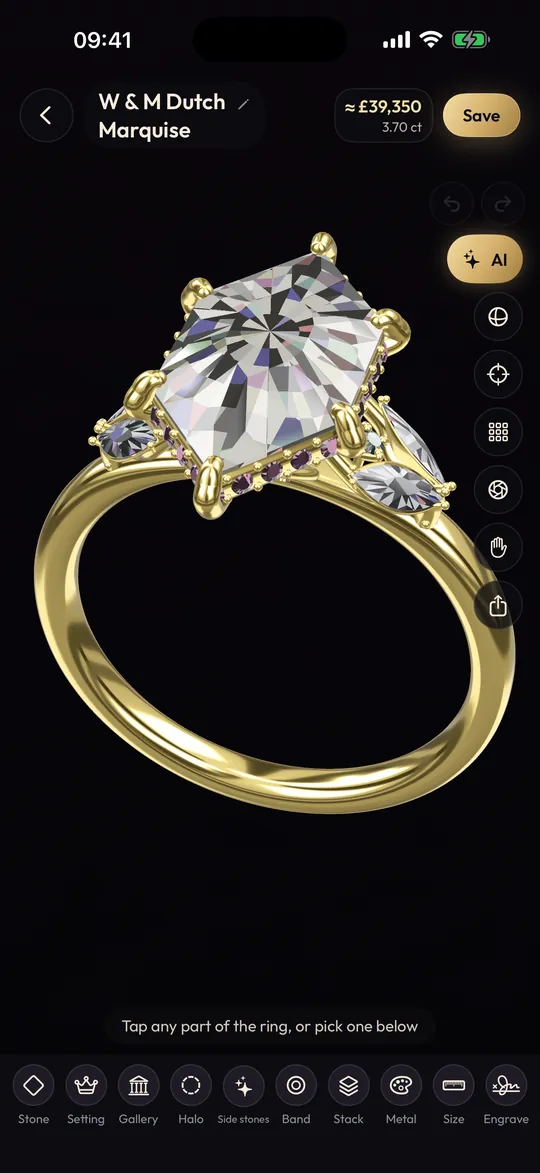
Ring Studio is a free 3D ring designer for iPhone, iPad and Android. It is a design tool rather than a shop, which suits the UK's bespoke culture: you arrive at a Hatton Garden or local jeweller with a precise design instead of a folder of screenshots.
- Pick a shape and carat, for example an oval at 1 ct, and set it north-south or east-west.
- Choose a setting (4, 6 or 8 prongs, bezel and more) and a band such as plain, pavé or knife edge.
- Switch between platinum, white, yellow and rose gold to see the colour. The app doesn't offer a karat choice, so agree 9ct, 18ct or platinum with your jeweller.
- Watch the live price estimate as you change the stone and metal. It is a comparison tool, not a UK quote.
- With Pro, scan your hand with a bank card for scale to estimate the size, try the ring on live, and send the ring code to your jeweller so they open the exact design.
You can also just describe the ring ("platinum hidden halo with a thin pavé band") and let the AI ring designer build it in 3D, then refine it by chatting.
Quick checklist before you buy
- Check the hallmark, or ask when it will be assayed if the ring is being made.
- Get the stone's grading report and match the number on it.
- Confirm the ring size in letters and whether resizing is included later.
- Ask whether the price includes a matching wedding band, and if the setting allows one to sit flush.
- Insure it from the day you collect it; our ring insurance guide covers the options.
Frequently asked questions
What is the average ring size in the UK?
Most women's ring fingers fall between UK J and N, and most men's between Q and V. Treat that only as a starting point, because fingers vary a lot and the right size changes with band width.
Is 9ct gold good for an engagement ring?
9ct is 37.5% gold, so it is hard-wearing and affordable but slightly paler in colour and more prone to tarnish than 18ct. Many UK couples choose 18ct (75% gold) or platinum for a ring worn every day.
Do all gold rings sold in the UK have to be hallmarked?
Gold items over 1 gram must be hallmarked by a UK Assay Office before they can be described as gold. Platinum has a 0.5 gram threshold and palladium 1 gram, so almost every engagement ring qualifies.
Which hand is the engagement ring worn on in the UK?
The left hand, on the fourth finger. On the wedding day the band usually goes on first, closest to the hand, with the engagement ring moved back on top.
Can I return an engagement ring bought online in the UK?
For most standard items bought online you normally have 14 days to cancel after delivery. Rings made to your own specification are usually excluded, so check the retailer's terms before ordering a custom piece.