 Ring Studio
Buying an Engagement Ring Online Safely
Buying an engagement ring online safely comes down to five checks: a retailer you can verify, an independent grading report for the exact stone, a high-resolution video of that stone, clear written return and resizing terms, and a payment method with buyer protection. Do those and online can be an excellent way to buy.
On this page
- The advantages and risks of buying online
- Step 1: Check the retailer is real and reputable
- Step 2: Get the grading report for the actual stone
- Step 3: Judge the stone from video, not just grades
- Step 4: Get the ring size right
- Step 5: Read the returns, warranty and shipping terms
- Step 6: Pay safely
- Lab-grown diamonds online: extra checks
- Red flags when buying a ring online
- Design before you shop
- When the ring arrives
- Must-haves
- Lab report for that stone, video, clear returns
- Verify
- Report number on the lab's own site
- Pay with
- Credit card or a method with buyer protection
- Red flags
- No address, stock photos only, bank transfer only
The advantages and risks of buying online
Online jewellers often list thousands of loose diamonds, show 360° videos, and keep prices keen with lower overheads. The risks are that you can't hold the ring, judging sparkle on a screen is hard, sizing is guesswork, and fraudulent sellers do exist. None of these is a reason to avoid buying online; they're reasons to be methodical.
Step 1: Check the retailer is real and reputable
- A physical business address and a landline or support line, not just a form.
- Company registration details (in the UK, you can look up a company on Companies House).
- Independent reviews over a long period, not only on their own site.
- Clear policies on returns, warranty, resizing and shipping insurance.
- Prices that are plausible. If a large natural diamond is listed far below every comparable stone, ask why.
Step 2: Get the grading report for the actual stone
Every listing for a significant diamond should link to an independent grading report, most commonly from GIA or IGI. Then:
- Look the report number up on the lab's own website (not a link supplied by the seller). GIA offers a public report check.
- Check measurements, shape, carat and grades on the listing match the report.
- Confirm whether the stone is natural or lab-grown; the report states it.
- On arrival, ask a local jeweller to read the girdle inscription under magnification.
Our diamond certificates guide and GIA vs IGI comparison explain what the reports mean.
Step 3: Judge the stone from video, not just grades
Two diamonds with identical reports can look different. Watch the real video of the stone (not a generic one) and look for:
- Brightness across the whole face as it rotates, without large dark areas.
- Bow tie shadows in ovals, pears and marquises; a faint one is normal, a heavy one is not.
- Visible inclusions, especially dark ones near the centre. Online videos are magnified, so a speck on screen may be invisible in life, but you want to know where it is.
- Spread. Compare millimetre measurements, not just carats. A shallow-looking stone may be cut too deep.
Ask customer service for extra photos or an expert's opinion on light performance; good retailers will oblige. The 4Cs guide helps you prioritise.
Step 4: Get the ring size right
Size is the biggest practical risk online. Measure properly with a ring that fits the right finger or a sizer, and read our guide to measuring your ring size at home. A printable ring sizer is a useful check. Note which size system the retailer uses: UK letters, US numbers and EU circumference differ (see the ring size chart). Then confirm whether the first resize is free and whether the design can be resized at all.
Step 5: Read the returns, warranty and shipping terms
- Returns. How many days? Is a resized or engraved ring still returnable? In the UK, the statutory cancellation right for distance purchases typically excludes goods made to the buyer's specification.
- Shipping. Fully insured, tracked, with a signature required. Ask for a discreet package.
- Warranty. What's covered (manufacturing faults, loose stones) and whether it needs periodic inspections.
- Resizing and upgrades. Free first resize? Trade-in credit?
Step 6: Pay safely
Use a credit card where possible. In the UK, Section 75 of the Consumer Credit Act generally makes the card provider jointly liable for purchases costing between £100 and £30,000. Other countries have their own chargeback rules. Avoid bank transfers, cryptocurrency or gift cards to sellers you don't know. This is general information, not financial advice.
Lab-grown diamonds online: extra checks
Many online retailers sell both natural and lab-grown diamonds. Lab-grown prices have fallen sharply, so make sure the listing, the report and the invoice all say clearly which you're buying. Lab-grown reports state the growth method in many cases, and the girdle inscription usually identifies the stone as laboratory-grown. If a "natural" diamond is priced like a lab-grown one, ask questions before you pay.
Red flags when buying a ring online
- Stock photos only, with no video of the specific stone.
- "Certified" by the seller's own lab, or a report that can't be verified.
- Pressure tactics: countdown timers on a single stone, "last one" messages.
- Bank transfer only, or a discount for paying by transfer.
- No returns on non-custom items, or vague, hard-to-find terms.
- Social media sellers with no traceable business.
Design before you shop
Online ring builders show one retailer's settings and stock. If you design the ring first, independently, you can compare that exact design across retailers and local jewellers. Ring Studio, a 3D ring design app for iPhone, iPad and Android, is built for this:
- Build the ring in 3D from shape, stone, carat, setting, halo, gallery, band and metal, or describe it to the AI designer.
- Check the live price estimate to see roughly what you should expect to pay (an estimate for comparison, not a quote).
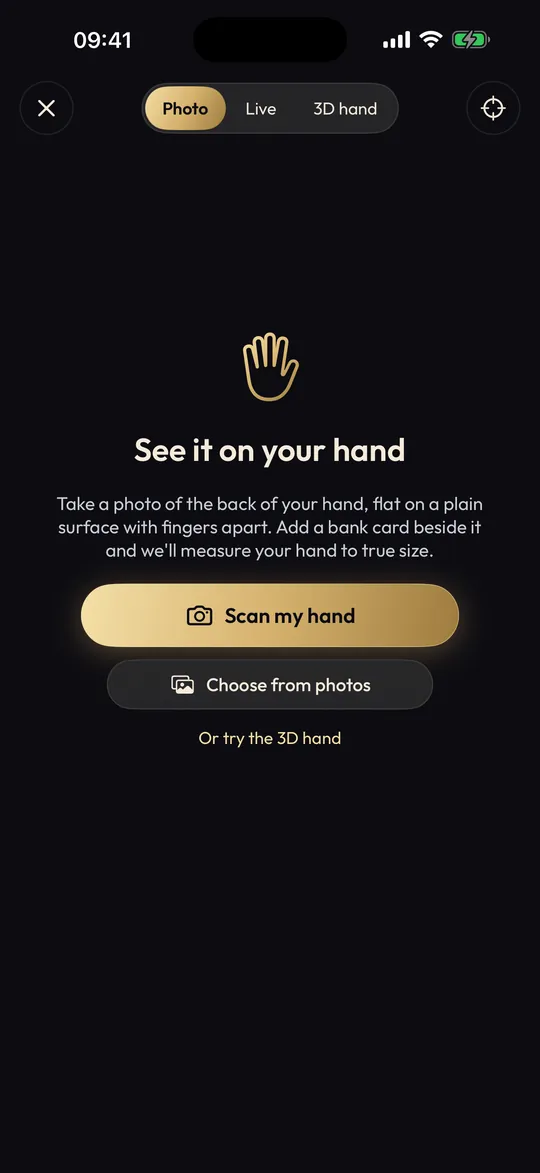
- With Pro, scan your hand to estimate your ring size and try the ring on with the camera, which reduces online sizing guesswork.
- Share a ring code or screenshots to ask several sellers to quote for the same design.
Ring Studio doesn't sell rings, so there's no stock to push. Our comparison of Ring Studio vs online ring builders explains the difference.
When the ring arrives
- Film yourself opening the parcel, in case of a dispute.
- Check the stone, metal and engraving match the order.
- Check the hallmark (UK) and the report number inscription with a jeweller.
- Try it on at different times of day; fingers swell in the heat.
- Arrange insurance immediately. See engagement ring insurance.
- Keep the box and paperwork until the return window closes.
For the wider buying process, including where to buy and how to compare quotes, read our engagement ring buying guide.
Frequently asked questions
Is it safe to buy an engagement ring online?
It can be, if you buy from an established retailer with verifiable contact details, insist on an independent lab report for the stone, and pay with a method that offers buyer protection.
How do I know a diamond bought online is real?
Check the grading report number on the lab's own website, make sure the report matches the stone's measurements, and have the stone's girdle inscription checked by a local jeweller on arrival.
Can I return an engagement ring bought online?
Usually, within the retailer's return window, but engraved, resized or custom-made rings are often excluded. Read the policy before buying and keep all packaging and paperwork.
How do I get the ring size right when buying online?
Measure carefully using a ring that fits or a ring sizer, use the retailer's size chart, and check whether the first resize is free. Avoid designs that can't be resized if you're unsure.
What payment method is safest for an online ring purchase?
A credit card generally gives the strongest protection. In the UK, Section 75 can cover purchases between £100 and £30,000. Avoid bank transfers to unfamiliar sellers.