 Ring Studio
Prices
How Much Does an Engagement Ring Cost?
How much an engagement ring costs depends far more on the centre stone than anything else: as a rough guide in late 2026, a lab-grown diamond ring can cost under £1,000 ($1,200), while a 1 carat natural diamond ring usually runs from about £3,500 to well over £10,000 ($4,500 to $13,000+). Below is a breakdown by stone, size and setting, with the factors that push a price up or down.
On this page
- Engagement ring cost at a glance
- Why lab-grown and natural prices are so far apart
- What moves the price of an engagement ring
- Typical setting costs
- What about "average" engagement ring spend?
- Compare costs by designing the ring first
- Getting the most ring for your money
- Engagement ring costs in the UK vs the US
- Biggest cost driver
- The centre stone: carat, cut, colour, clarity and natural vs lab-grown
- Setting (solitaire)
- Roughly £500-£1,500 / $600-$1,800
- Lab-grown 1 ct ring
- Roughly £900-£2,500 / $1,100-$3,000
- Natural 1 ct ring
- Roughly £3,500-£12,000+ / $4,500-$15,000+
- Status of figures
- Rough retail estimates, late 2026; they vary by retailer and market
Engagement ring cost at a glance
An engagement ring is two purchases bundled together: a stone and a mount. The mount (the metal band, prongs and any small diamonds) has a fairly predictable cost. The centre stone does not. It can be a few hundred pounds or more than a car, and two stones that look similar across a room can be priced thousands apart because of small differences in grading.
The table below shows complete rings (stone plus a simple solitaire setting in 18k gold or 14k gold) at three quality tiers. They are rough retail estimates, late 2026, rounded, and assume a well-cut round diamond with a recognised grading report.
| Centre stone | Lab-grown (GBP) | Lab-grown (USD) | Natural, commercial quality | Natural, fine quality |
|---|---|---|---|---|
| 0.5 ct | £700-£1,800 | $800-$2,200 | £1,300-£2,800 / $1,600-$3,500 | £2,800-£5,000 / $3,500-$6,500 |
| 1 ct | £900-£2,500 | $1,100-$3,000 | £3,500-£6,000 / $4,500-$7,500 | £6,000-£15,000 / $7,500-$19,000 |
| 1.5 ct | £1,100-£3,000 | $1,300-$3,700 | £6,000-£10,000 / $7,500-$12,500 | £10,000-£30,000 / $12,500-$38,000 |
| 2 ct | £1,300-£3,800 | $1,600-$4,500 | £9,000-£16,000 / $11,000-$20,000 | £16,000-£55,000 / $20,000-$70,000 |
"Commercial" here means roughly I-J colour and SI clarity; "fine" means roughly D-G colour and VVS-VS clarity with an excellent cut. Ranges overlap because retailers price very differently, and because a single grade step can move a natural stone's price a long way. For the details at each size, see the pages on 1 carat ring prices and 2 carat ring prices.
Why lab-grown and natural prices are so far apart
Lab-grown diamonds are real diamond, with the same hardness (10 on the Mohs scale) and the same optical properties as mined stones. What differs is supply. Production has expanded quickly and lab-grown prices have fallen steeply over the last few years, to the point where they now sit far below natural diamonds of the same size and grade. Natural prices have also been under some pressure, but nowhere near as dramatically.
The practical result is that a budget that buys a modest natural stone can buy a much larger lab-grown one. The trade-off is resale value: lab-grown stones have very little, and natural stones sell back for well below their retail price too. Our lab-grown vs natural comparison goes through the pros and cons, and lab-grown diamond prices covers how that market works.
What moves the price of an engagement ring
The 4Cs of the centre stone
Carat weight has the biggest effect, and price climbs faster than weight: a 2 carat stone usually costs well over twice a 1 carat stone of the same grade. Cut quality decides how bright the stone looks, colour runs from D (colourless) downwards, and clarity measures inclusions. Our guide to the 4Cs explains how to trade them off; the short version is to prioritise cut and be flexible on colour and clarity grades you cannot see with the naked eye.
Shape
Round brilliants usually cost the most per carat because cutting them wastes more rough. Ovals, pears, cushions and emerald cuts are often cheaper at the same weight, and elongated shapes also look larger from above. See oval engagement rings for one popular example.
Certification
A stone graded by a well-regarded lab costs more than an ungraded one, and reports from different labs are not always interchangeable. The diamond certificates guide explains what to look for.
Retailer type
High street and luxury brand jewellers carry showroom costs and brand premiums. Online retailers and independent bench jewellers often charge less for the same grades, though service and after-care vary.
Setting complexity and metal
Every extra small diamond needs setting by hand, so halos, pavé and hidden halos add labour as well as stones. Metal cost is roughly the weight of the ring multiplied by the current price per gram of the alloy, and gold and platinum prices move daily. Platinum is denser than gold, so the same design uses more metal by weight. See platinum vs white gold for the practical differences.
Typical setting costs
| Setting style | Rough cost (GBP) | Rough cost (USD) |
|---|---|---|
| Plain solitaire, 14k-18k gold | £500-£1,500 | $600-$1,800 |
| Plain solitaire, platinum | £800-£2,000 | $900-$2,500 |
| Pavé band or hidden halo | £1,000-£2,800 | $1,200-$3,500 |
| Classic halo with pavé band | £1,400-£3,500 | $1,700-$4,500 |
| Three stone (side stones extra) | £900-£2,500 plus stones | $1,100-$3,000 plus stones |
These are rough retail estimates, late 2026, using natural melee in the pavé; lab-grown melee can bring them down. Bespoke designs cost more again; see custom engagement ring costs.
What about "average" engagement ring spend?
You will see average spend figures quoted in many articles. They come from wedding surveys whose samples, methods and countries differ, and the figures they report vary widely year to year. They also mix lab-grown and natural purchases, which now sit in completely different price bands. An average tells you little about what is right for you, so we do not quote one. A better starting point is your own budget; the engagement ring budget guide and the ring budget calculator help you work one out.
Compare costs by designing the ring first
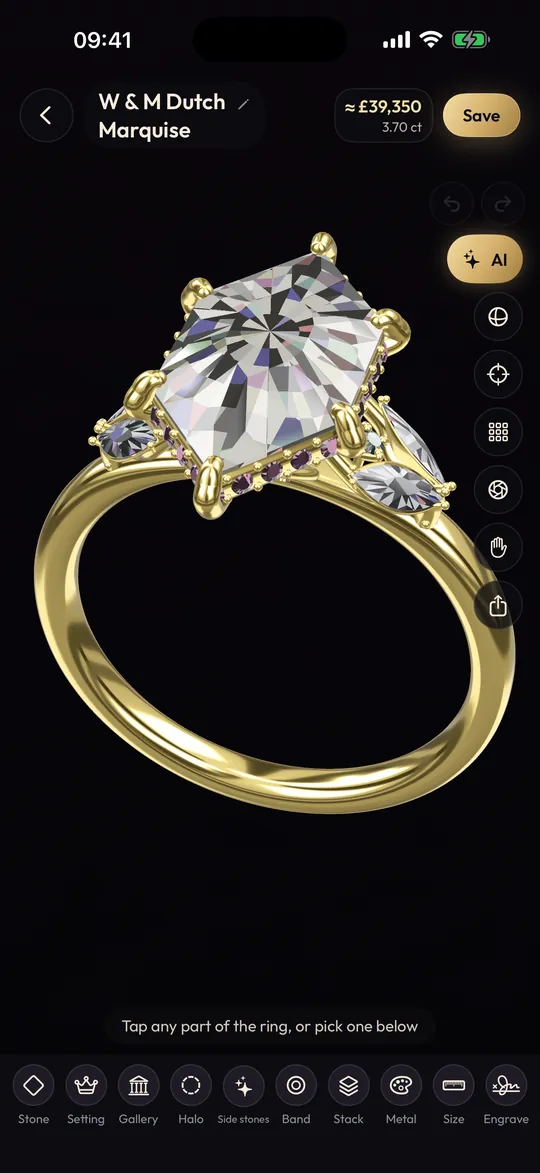
It is much easier to understand a quote when you already know which parts of the design cost money. In Ring Studio you can build the ring in 3D and watch a live price estimate change as you swap things:
- Pick a stone shape and set the carat size, then switch between natural and lab-grown diamond.
- Change the metal between yellow, white and rose gold and platinum.
- Try a plain solitaire, then add a hidden halo or pavé band and see the difference.
- Save the versions you like and share the ring code with a jeweller for a real quote.
The estimate is there for comparing designs, not a quote; jewellers set their own prices. The ring price estimator page explains how it works.
Getting the most ring for your money
- Buy just under popular weights (0.9 ct instead of 1.0 ct): the size difference is invisible but the price drop can be significant.
- Choose an elongated shape for more visible size per carat.
- Pick near-colourless (G-H) and eye-clean clarity rather than paying for top grades.
- Consider 14k or 18k gold over platinum if budget is tight.
- Compare at least three retailers with the same grading report details.
More ideas are in ways to save money on an engagement ring.
Engagement ring costs in the UK vs the US
Comparing prices across the Atlantic is trickier than converting the currency. UK prices include 20% VAT in the ticket price, while US prices are normally shown before state sales tax. The UK market leans towards 18k gold and platinum, while 14k gold is the standard in the US, which makes many US settings a little cheaper. Retailer margins and import costs differ too. Use the figures on this page as separate local guides rather than exact conversions. Country pages such as engagement rings in the UK and engagement rings in the US cover local customs and sizes.
Verdict
As of late 2026, a good-looking engagement ring can cost anywhere from under £1,000 to tens of thousands. The stone decides most of it: lab-grown diamonds are now dramatically cheaper than natural, and every step up in carat costs more than the last. Decide your budget first, then design to it.
Frequently asked questions
How much should you spend on an engagement ring?
There is no correct amount. Spend what you can afford without debt you will resent, then decide where the money matters most to you: stone size, stone quality, metal or design detail.
Is a 1 carat engagement ring expensive?
With a natural diamond, usually yes: expect roughly £3,500 to £12,000 ($4,500 to $15,000) for a 1 carat ring depending on quality and retailer. With a lab-grown diamond the same look can cost under £1,500 ($2,000).
Why are lab-grown diamond engagement rings so much cheaper?
Production of lab-grown diamonds has scaled up and their prices have fallen steeply in recent years. They are chemically and optically diamond, but they do not carry the rarity premium of mined stones.
Does the setting add much to the cost?
A simple solitaire setting often adds £500 to £1,500 ($600 to $1,800). Halos, pavé bands and intricate custom work can add several thousand, and platinum costs more than gold for the same design.
Do engagement ring prices differ between the UK and the US?
Yes. UK prices include 20% VAT in the sticker price while US prices are usually shown before sales tax, and the two markets differ in typical gold karats and retailer margins, so direct currency conversion is only a rough guide.