 Ring Studio
How to Set an Engagement Ring Budget
To set an engagement ring budget, start from what you can comfortably pay without debt you will resent, subtract the extras people forget (wedding bands, insurance, resizing), then decide how to split the rest between stone and setting. Here is a practical method, with rough late-2026 examples of what each budget buys.
On this page
- Step 1: work out what you can actually spend
- Step 2: subtract the costs people forget
- Step 3: decide what matters most
- Step 4: split the budget between stone and setting
- What different budgets buy in late 2026
- Step 5: test your budget against real designs
- Step 6: keep a buffer and shop around
- Budgeting as a couple
- Start from
- What you can comfortably pay, not a salary rule
- Remember
- Wedding bands, insurance, resizing, valuation
- Biggest lever
- Natural vs lab-grown diamond
- Tools
- Ring budget calculator and live price estimate
- Example figures
- Rough retail estimates, late 2026
Step 1: work out what you can actually spend
A ring budget is a personal finance decision first and a jewellery decision second. Look at your savings, regular outgoings and the other big costs coming up: a wedding, a move, a deposit on a home. A useful question is: "What could I spend and still feel fine about it in a year?" That number is your ceiling.
Ignore rules of thumb tied to salary. The famous "three months' salary" figure came from diamond advertising, not financial advice; see the three months' salary rule for its history. Averages from wedding surveys are not a guide either: the figures reported vary widely year to year and by country, and they now mix natural and lab-grown purchases in very different price bands.
Step 2: subtract the costs people forget
| Extra cost | Rough range (GBP) | Rough range (USD) |
|---|---|---|
| Wedding bands (two plain gold) | £500-£2,000 | $600-$2,500 |
| Insurance (per year) | Depends on value; often a small percentage | Same |
| Valuation for insurance | £50-£150 | $50-$150 |
| Resizing after the proposal | £30-£150 | $40-$200 |
| Engraving | Free-£150 | Free-$200 |
Rough estimates, late 2026. Also note that UK prices include VAT, while US prices usually exclude sales tax, which is added at checkout and varies by state. Details: wedding ring costs, insurance and resizing.
Step 3: decide what matters most
Every ring balances four things: stone size, stone quality, metal, and design detail. Rank them. Some people want a big stone and do not mind a plain band; others want a modest stone in an intricate platinum setting. Most importantly, decide natural or lab-grown. Lab-grown diamond prices have fallen steeply in recent years and are now far below natural, so this one choice can change what your budget buys more than anything else. The lab-grown vs natural comparison helps.
Step 4: split the budget between stone and setting
There is no fixed split, but these patterns are common:
- Natural diamond solitaire: the stone takes most of the money; the setting is a smaller share.
- Lab-grown diamond or moissanite: the setting may cost as much as or more than the stone.
- Halo, pavé or custom design: the setting share rises because of small stones and labour.
The ring budget calculator lets you play with these splits quickly.
What different budgets buy in late 2026
| Budget | Lab-grown diamond | Natural diamond |
|---|---|---|
| Up to £1,000 / $1,200 | About 0.5-1 ct solitaire in 9k-14k gold | Small stone (around 0.2-0.3 ct) or coloured stone |
| £1,000-£2,500 / $1,200-$3,000 | 1-2 ct in 14k-18k gold, or 1 ct with halo or platinum | Around 0.3-0.5 ct, sensible grades |
| £2,500-£5,000 / $3,000-$6,500 | 2 ct+ with platinum or pavé, upgraded design | Around 0.5-0.9 ct, good grades |
| £5,000-£10,000 / $6,500-$13,000 | Large stone in a fully custom design | Around 1 ct, mid to fine grades |
| £10,000+ / $13,000+ | Rarely needed | 1.5 ct+ or top grades |
These are rough retail estimates, late 2026, for well-cut round stones; elongated shapes look larger for the same money. Prices vary by retailer, and precious metal prices move. See 1 carat ring prices for detail.
Step 5: test your budget against real designs
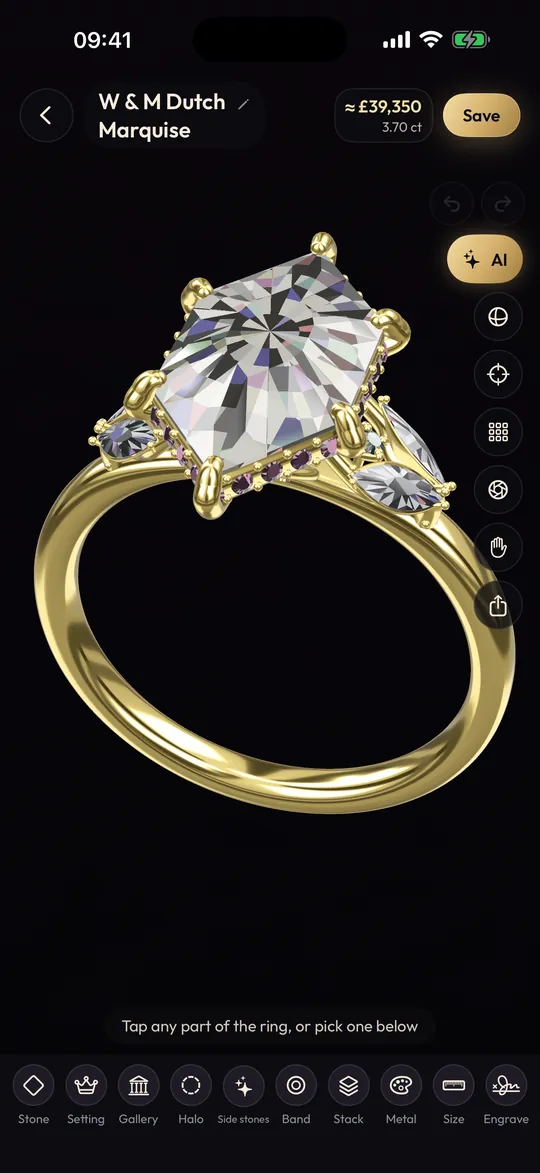
Numbers are abstract until you see the ring. In Ring Studio you can design a ring in 3D and watch the live price estimate update as you change the stone, carat, natural or lab-grown, and metal. Try your ideal ring first, then make one change at a time (a smaller carat, gold instead of platinum, no halo) and see which compromise you would barely notice. The estimate is for comparing designs, not a quote. Save a few versions, then share the ring codes with jewellers for real prices. The ring price estimator page explains more.
Step 6: keep a buffer and shop around
- Tell jewellers a figure slightly below your ceiling so there is room to adjust.
- Get at least two or three quotes for the same specification.
- Ask what is included: certification, sizing, after-care, warranty.
- If you use finance, know the full cost, including what happens after any interest-free period.
For more ways to stretch a budget, read ways to save money on an engagement ring and the full engagement ring buying guide.
Budgeting as a couple
More couples now choose the ring together, which makes budgeting simpler: you can agree a figure openly and decide jointly where to spend. If you are planning a surprise, you can still learn priorities without giving the game away, by noting which rings your partner admires, or asking a close friend. Our guide on how to choose an engagement ring covers style and fit, and the ring style quiz is a low-pressure way to discover preferences.
Verdict
A good engagement ring budget starts with your finances, not a rule. Set a ceiling, subtract the extras, choose natural or lab-grown, and test the trade-offs on real designs before you shop.
Frequently asked questions
How much should I budget for an engagement ring?
Whatever you can afford without straining your finances or starting married life in debt. Salary-based rules are marketing rather than advice; your savings, other goals and what your partner values matter more.
What is a reasonable engagement ring budget?
There is no single reasonable figure. As rough late-2026 estimates, around £1,000 to £2,000 ($1,200 to $2,500) buys an attractive lab-grown diamond ring, while natural 1 carat rings generally start in the low thousands and go up steeply.
Should I tell the jeweller my budget?
Yes. A good jeweller will show you the best options within it and suggest where to save. You do not have to tell them the absolute maximum; leave yourself some headroom.
Is it OK to finance an engagement ring?
Finance is a personal decision. If you do use it, understand the total cost including interest and fees and the terms after any interest-free period. Paying from savings avoids those costs.
How do I split the budget between the stone and the setting?
For a natural diamond, the stone often takes most of the budget. For a lab-grown diamond or moissanite, the setting can be the bigger share. Decide which matters more to you, size, quality or design, and allocate accordingly.