 Ring Studio
Guides
How to Work With a Jeweller on a Custom Ring
To work with a jeweller on a custom ring, arrive with a clear brief (shape, size, setting, metal, budget, deadline), choose a maker whose past work matches your taste, and approve each stage in writing: the stone, the CAD render and the final fit. Good communication matters more than any single design choice.
On this page
- Typical timeline
- 4-8 weeks after design approval
- Usual deposit
- Around a third to a half, plus stone cost
- Approve in writing
- Stone, CAD render, final specification
- Your best tool
- A clear visual brief with measurements
Finding the right jeweller for a custom ring
Not every jeweller does bespoke work, and those that do often have a signature. Start by looking at their portfolio: if every ring they show is a chunky, high-polish modern piece and you want a delicate Edwardian-style ring, keep looking. Good signs include:
- A workshop on site or a named bench jeweller and setter, rather than everything outsourced anonymously.
- Photographs of finished rings from several angles, including the side profile and the gallery underneath.
- Clear explanation of how they source stones and whether they offer natural and lab-grown options.
- Willingness to show a CAD render before anything is cast.
- Membership of a trade body (such as the National Association of Jewellers in the UK) and a registered hallmark sponsor mark, though neither guarantees great design.
Visit two or three. You are hiring a collaborator for several weeks, so how they listen matters as much as their prices.
How to write a brief a jeweller can use
The clearer your brief, the more accurate the quote and the fewer revisions you will need. A strong brief answers each of these:
| Item | Example |
|---|---|
| Centre stone | Oval lab-grown diamond, about 1.5 ct, F-G colour, VS clarity, east-west |
| Setting | Six double-claw prongs, hidden halo, low profile |
| Band | 2 mm, tapered towards the stone, pavé on the top half |
| Metal | 18k yellow gold band, white claws |
| Wedding band | Must allow a straight band to sit flush |
| Personal details | Initials under the stone, date engraved inside |
| Ring size | UK M (US 6) |
| Budget and date | £3,500 all in, needed by 1 March |
If any terms are unfamiliar, the ring design glossary and parts of a ring explain gallery, shoulders, basket, shank and the rest. Pictures help, but a collage of five different rings can confuse: say exactly which element of each reference you like.
Questions to ask a jeweller before you commit
- Will I see a CAD render or a printed model before casting? How many revisions are included?
- Who sources the stone, and will I see it (or its report and video) before it is set?
- What is the finished metal weight likely to be? (Lighter is cheaper but less durable.)
- What is the deposit, when is the balance due, and what happens if I cancel?
- Does the quote include VAT, hallmarking, engraving and a valuation?
- Is the first resize free? Can this design be resized?
- What warranty or aftercare do you offer, such as prong checks and re-plating?
- Will the ring sit flush with a wedding band, and will you make the band too?
The stages of a custom ring project
1. Consultation and quote
You discuss the brief and the jeweller gives a quote, often as a range until the stone is chosen. Expect them to push back on anything impractical, such as a very thin band under a heavy stone or exposed points on a pear.
2. Stone selection
For diamonds, you will usually be shown several options with grading reports. Compare them in person or by video; cut quality matters more than the report alone suggests. Our diamond 4Cs guide helps here.
3. CAD design and approval
The jeweller or their CAD designer models the ring to your stone's real measurements and sends renders. Check proportions carefully: head height, band width, how the band meets the setting. This is the cheapest point to change things. Our guide to jewellery CAD design fees explains typical charges.
4. Making
The design is printed, cast, cleaned up, stones set and the piece polished. The detail is in how custom rings are made.
5. Collection
Try it on, check the fit, look at it in daylight, and make sure you receive the grading report, valuation and receipt.
Keeping the budget under control
Custom rings are not automatically more expensive than shop rings, but costs creep. The common causes are upgrading the stone mid-project, adding pavé "while we're at it", switching to platinum late, or asking for extra CAD revisions after approval. Decide your priorities up front: if the stone matters most, keep the setting simple. Custom engagement ring cost breaks down where the money goes.
Ask the jeweller to quote two versions: your ideal, and a version with one or two economies (14k instead of 18k, lab-grown instead of natural, a plain band instead of pavé). Seeing the difference side by side makes the decision easy.
Bringing a Ring Studio design to your jeweller
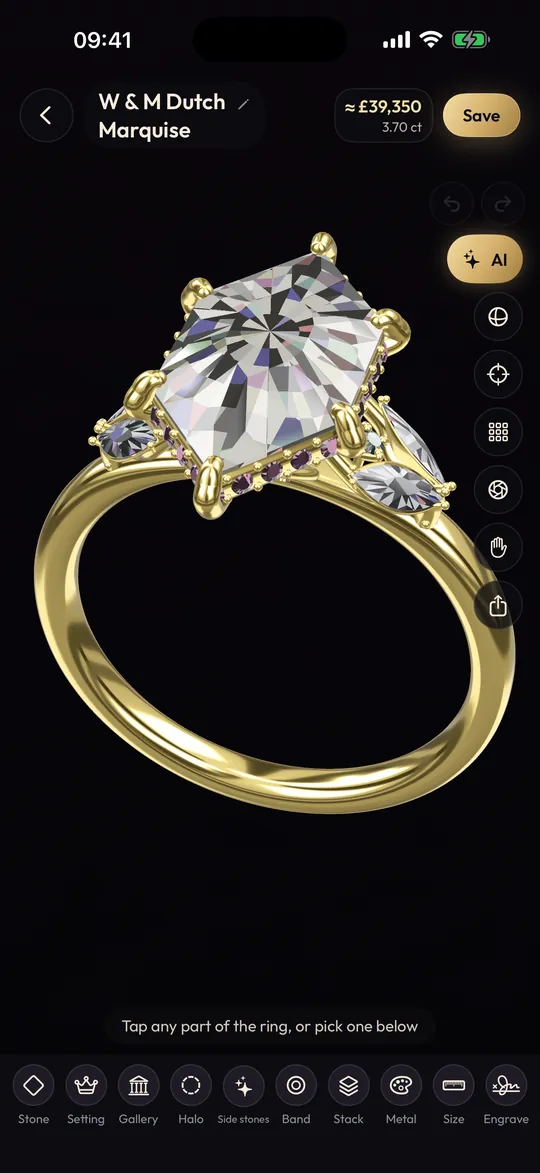
Many people struggle to describe a ring in words, and jewellers spend a lot of consultation time working out what a client means. Ring Studio was built to close that gap. It's a 3D ring design app for iPhone, iPad and Android where you assemble the ring yourself:
- Choose from up to 28 stone shapes, set the carat and orientation, and pick the stone type.
- Choose prongs (4, 5, 6 or 8, with round, claw, double or petite tips), bezel, lotus or compass settings, a halo and a gallery style.
- Choose the band style, width and taper, and the metal, including two-tone with Pro.
- Add hidden initials or an inside engraving if you want them.
- Share a ring code (Pro) so the jeweller opens the identical design in Ring Studio and can rotate it, or send screenshots from several angles.
Ring Studio isn't manufacturing CAD and doesn't export production files. Your jeweller rebuilds the design in their own CAD to your stone's real dimensions, but they start from an unambiguous picture of what you want. Jewellers interested in using it with clients can read about Ring Studio for jewellers.
When things don't go to plan
Most custom projects go smoothly, but if the ring isn't what you approved, raise it calmly and specifically, referencing the approved render or written specification. That is why getting approvals in writing matters. Reasonable jewellers will correct genuine errors; if they won't, UK buyers can look at consumer rights guidance from official sources such as Citizens Advice. Small changes of mind after casting usually cost extra, so take your time at the CAD stage.
Related reading
If you're still deciding whether bespoke is worth it, read custom vs off-the-shelf rings. If you're bringing an heirloom stone, see redesigning an old or inherited ring. And for the bigger picture of choosing a style, how to choose an engagement ring covers each decision in order.
Frequently asked questions
How much does it cost to have a jeweller design a ring?
Many independent jewellers fold design time into the quote for the finished ring; some charge a separate design or CAD fee, often credited if you go ahead. The total depends mostly on the stone and metal.
How long does a custom ring take?
Typically four to eight weeks from approving the design, longer if the jeweller is sourcing a particular stone or is busy before Christmas and Valentine's Day.
What should I bring to my first jeweller appointment?
Reference images or a 3D design, your budget, the ring size if you know it, a deadline, and any jewellery whose style the wearer loves. A ring code or screenshots from a design app make the brief precise.
Can I bring my own diamond to a jeweller?
Many jewellers will set a client's stone, though some won't accept liability for damage during setting. Ask before you buy a loose stone elsewhere.
Do jewellers make you pay a deposit for a custom ring?
Most do, commonly around a third to a half of the price, plus sometimes the full stone cost up front. Get the deposit terms and what happens if you cancel in writing.