 Ring Studio
Three Stone Engagement Rings
A three stone engagement ring sets a centre stone between two smaller side stones, often said to stand for past, present and future. Getting the size ratio and shape of the side stones right is what makes one look balanced.
On this page
- How a three stone ring is constructed
- Choosing side stones: shapes compared
- Getting the size ratio right
- How three stones affect apparent size
- Durability and care
- Wedding bands for three stone rings
- How much does a three stone ring cost?
- Designing a three stone ring in Ring Studio
- Is a three stone ring right for you?
- What it is
- A centre stone flanked by two smaller stones
- Classic pairings
- Oval with pears; emerald with tapered baguettes; round with rounds
- Size ratio
- Each side roughly 25-35% of the centre's weight
- Durability
- Good; three larger stones, each individually set
- Band pairing
- Curved or chevron band usually needed
- Cost impact
- Higher than a solitaire with the same centre
How a three stone ring is constructed
Each stone usually has its own prongs or bezel, and the three heads are joined in a shared gallery so they sit in a line across the finger. Sometimes neighbouring stones share prongs, which lets them sit closer together and shows more stone. The side stones are typically set slightly lower than the centre so it stands proud.
Three variables decide whether the ring looks elegant or awkward: the shape of the side stones, their size relative to the centre, and the gap between them.
Choosing side stones: shapes compared
| Side stone | Look | Pairs well with |
|---|---|---|
| Rounds | Soft, classic, very sparkly | Round, oval, cushion |
| Pears | Romantic, curved, adds width | Oval, round, cushion |
| Tapered baguettes | Clean lines, Art Deco feel | Emerald, asscher, radiant, oval |
| Trillions | Bold triangles, lots of spread | Round, cushion, princess, asscher |
| Half moons | Hug the centre, modern | Oval, cushion, emerald |
| Kites, shields, epaulettes | Geometric and distinctive | Step cuts, radiant |
Our pages on tapered baguette rings and trillion engagement rings go further into those two side stone styles.
Getting the size ratio right
There is no fixed rule, but these ranges are a sensible starting point when you discuss proportions with a jeweller:
- Centre-dominant: each side stone around 20 to 25% of the centre's carat weight. The centre clearly leads.
- Balanced: each side around 30 to 40%. This is the look most people picture.
- Even: side stones nearly matching the centre. Bold and very wide; can overwhelm small fingers.
Measure in millimetres as well as carats. Side stone shapes spread differently: a pear of the same weight as a round looks bigger face-up, so you may need lower-weight pears to keep the same visual balance.
How three stones affect apparent size
The side stones extend the head across the finger, so the ring has more presence than a solitaire with the same centre. They do not make the centre itself look bigger the way a halo does; if anything, larger side stones make the centre look relatively smaller. If the centre is your priority, keep the sides modest.
Durability and care
Three individually set stones are robust: they are larger and held more securely than pavé. Check prongs annually, especially on the outer sides of the side stones, which take knocks first. Pointed side stones such as pears and trillions should have protected tips. Dirt collects between the stones, so brush gently between the heads when you clean.
Wedding bands for three stone rings
The wide head means a straight band rarely sits completely flush. A chevron band or gently curved band that follows the outline of the side stones is the usual answer. Alternatively, a slightly raised gallery lets a straight band tuck partly underneath. Settle this before the engagement ring is made, as raising a head afterwards is real work.
How much does a three stone ring cost?
You are paying for three stones and three heads. As an estimate, matched side stones of decent quality can add anywhere from a few hundred to several thousand pounds depending on their size, whether they are natural or lab-grown, and how closely they need to match in colour. Lab-grown side stones are now much cheaper than natural ones. A common way to keep the budget in check is a slightly smaller centre stone, since the sides add presence. Prices vary by retailer, quality and market. Our solitaire vs three stone comparison runs through the trade-off.
Designing a three stone ring in Ring Studio
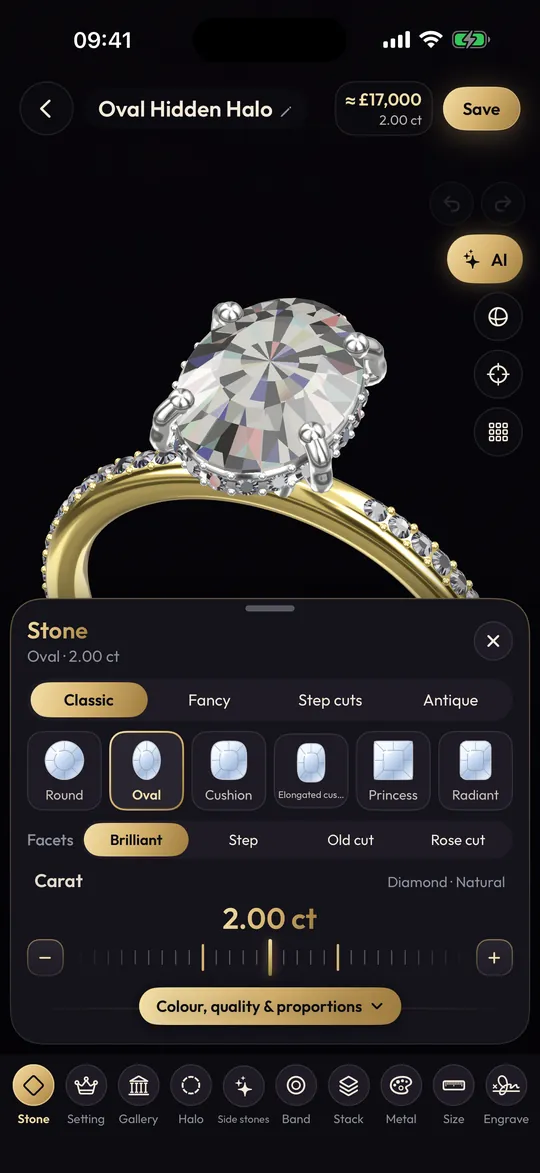
- Choose your centre stone shape and carat and a prong setting.
- Open side stones and pick three stone for matching rounds, or pears, baguettes or kites for shaped side stones.
- Rotate the ring to check the spacing and the side profile.
- Choose a plain band for a clean line or a pavé band for more sparkle.
- Open the wedding band stack and try a curved or chevron band beneath it.
For more unusual side stones, such as trillions or half moons, Ring Studio Pro lets you place your own extra stones anywhere on the ring and pick their shape from the full set of 28. You can also describe it to the AI: "emerald cut with tapered baguettes in yellow gold".
Is a three stone ring right for you?
It suits people who want more presence than a solitaire with a meaning attached, and who prefer a few substantial stones to many tiny ones. If you mainly want the centre to look larger, compare it with a halo in our three stone vs halo guide. For more ways to flank a centre stone, see side stone engagement rings, and for a classic step-cut trio, the emerald cut guide.
Frequently asked questions
What does a three stone ring symbolise?
The common meaning is past, present and future, though some couples see it as two people and their shared life. It is a tradition rather than a rule, so you can give it your own meaning.
What size should the side stones be on a three stone ring?
A popular starting point is side stones with a combined weight of around half to two thirds of the centre stone, so each side stone is roughly a quarter to a third of the centre's weight. Smaller sides emphasise the centre; closer sizes make a bolder, more even ring.
Which side stones go best with an oval?
Pears are the most popular partner for an oval because their curves follow its outline. Tapered baguettes give a crisper, more vintage look, and trillions add width.
Can you wear a wedding band with a three stone ring?
Yes, but the wider head often leaves a gap with a straight band. A curved or chevron band designed to follow the side stones usually sits closest.
Is a three stone ring more expensive than a solitaire?
It costs more than a solitaire with the same centre stone because you are buying two extra stones and more setting work. You can offset this by choosing a slightly smaller centre, since the side stones add presence.
Keep reading
 Trillion Engagement RingsTrillion engagement ring guide: curved vs straight triangle cuts, history, sizes in mm, protecting the corners, sourcing…Chevron Wedding BandsChevron wedding bands dip into a V to nest under a pointed stone or stand alone as a statement. See V depths, pairings, …