 Ring Studio
Trillion Engagement Rings
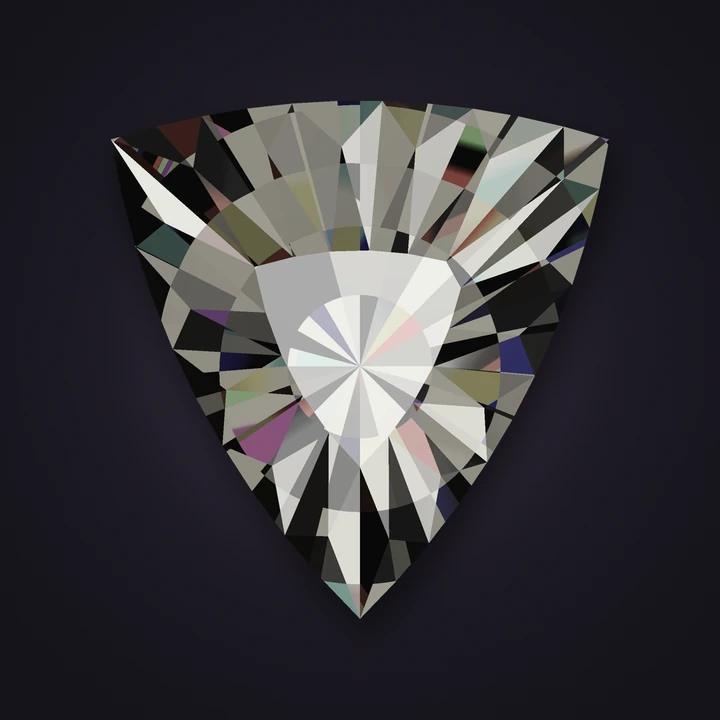
A trillion engagement ring features a triangular diamond, usually with slightly curved sides and a brilliant facet pattern. Cut shallow, it faces up large for its weight and makes a bold, geometric centre stone, though it is more often seen as side stones.
On this page
- A short history of the triangle cut
- Curved vs straight trillions
- Trillion carat to mm chart
- What to look for in a trillion
- Sourcing a trillion centre stone
- Best settings and prong placement
- Wedding band pairing
- Trillion pros and cons
- How much does a trillion ring cost?
- Living with a trillion ring
- Designing a trillion ring in Ring Studio
- Related geometric shapes
- Facets
- Often 31 or 50 for brilliant trillions; step-cut versions exist
- Length-to-width
- About 1.00 (equilateral)
- Look
- Bold triangle, wide spread, bright when well cut
- Best settings
- 3 V-prongs or bezel; often used as side stones in three stone rings
- Price vs round
- Usually lower per carat; large well-cut centre trillions are scarce
A short history of the triangle cut
Triangular diamonds have existed for centuries, but they were rarely bright: old triangles were often step cut or simple and followed the natural shape of macle (twinned) crystals. Modern brilliant-faceted trillions were developed in the twentieth century, and the "trilliant" name was trademarked in the United States in the 1960s. Because of that trademark, "trillion" and "trillian" became the everyday names, and you'll see all three used interchangeably.
As side stones, trillions became a staple of three stone rings from the 1980s onward. As centre stones, they remain unusual, which is exactly why people who want something geometric choose them.
Curved vs straight trillions
Curved (convex) trillions have slightly bowed sides, which give a fuller outline and help the stone look softer. These are the usual choice for centre stones. Straight-sided (uncurved) trillions are crisper and sit neatly against a round or oval centre, so they are the common side stone. Some cutters make concave versions, which are less common.
Trillion carat to mm chart
Approximate side length for brilliant-cut centre trillions. Shallow cuts spread more; deeper ones less.
| Carat | Approx. side length | Face-up impression |
|---|---|---|
| 0.50 ct | 5.6 mm | Spans slightly wider than a 0.5 ct round |
| 0.75 ct | 6.4 mm | Bold for the weight |
| 1.00 ct | 7.0 mm | Spans wider than a 1 ct round |
| 1.50 ct | 8.0 mm | Strong geometric statement |
| 2.00 ct | 8.8 mm | Wide; corners need sturdy prongs |
| 3.00 ct | 10.0 mm | Very wide across the finger |
As side stones, trillions are usually much smaller, often in the range of a few tenths of a carat for a matched pair beside a 1 to 2 carat centre.
What to look for in a trillion
- Symmetry: all three sides and angles should match. A lopsided triangle is easy to see.
- Windowing: shallow trillions can show a glassy, see-through area in the middle where light passes straight through. Look for even sparkle across the stone.
- Corner thickness: points with a knife-thin girdle are fragile.
- Clarity at the corners: feathers near a point affect durability.
- Colour: trillions hide colour reasonably well thanks to brilliant faceting, though corners can show tint; G to H suits white metal.
- Matching pairs: for side stones, size, outline and colour should match closely.
For a centre trillion above a carat, ask for a video under normal room light. Windowing that is hidden in studio photos shows up quickly in daily wear.
Sourcing a trillion centre stone
Most trillions in stock at jewellers are small side stones. Large, well-cut natural trillions exist but are a niche item; you may need a dealer who can search or have one cut. Lab-grown trillions in centre sizes are easier to find and much cheaper, as lab-grown prices have fallen sharply. Trillion-cut sapphires and other coloured gems are also widely available.
Best settings and prong placement
A triangle wants three prongs, one V-shaped prong wrapping each point. A bezel is the most protective and suits the modern look. Ring Studio doesn't have a 3 prong or V-prong head; the closest option is a bezel, and you can ask your jeweller to convert the design to three V-prongs.
As side stones, trillions point outward either side of a round, oval, cushion or emerald centre in a three stone ring. They widen the look of the ring and add sparkle at the shoulders.
Wedding band pairing
A centre trillion's point can stop a straight band from sitting flush, depending on orientation. A curved or chevron band follows the point neatly. With trillion side stones, a straight band usually sits well.
Trillion pros and cons
| Pros | Cons |
|---|---|
| Bold, unusual geometry | Three exposed points |
| Spreads large for its weight | Can show windowing if too shallow |
| Excellent as side stones | Large centre stones are hard to source |
| Often good value per carat | Wide stones can feel bulky on small fingers |
How much does a trillion ring cost?
Small trillion side stones are relatively inexpensive, though matched pairs cost more because of the labour involved. Large natural centre trillions are priced individually by specialist dealers. Lab-grown trillions cost much less, as lab-grown prices have fallen sharply. Expect a bezel or custom three-prong head to cost a little more than a standard four-prong solitaire. All figures vary by retailer and market.
Living with a trillion ring
A centre trillion is wide relative to its length, so it can feel bulkier on slim fingers than its carat weight suggests. Try a paper template or a 3D try-on first. Have the corner prongs checked once or twice a year, and take the ring off for gym work or gardening to protect the points.
Designing a trillion ring in Ring Studio
Trillion is one of Ring Studio's Pro shapes.
- Choose Trillion in the stone tray and set the carat.
- Pick a bezel setting for full corner protection.
- Toggle north-south and east-west orientation to see how the triangle sits on the finger.
- Try a knife edge band to match the sharp geometry.
- For a three stone look, place your own trillion stones beside a round or oval centre (placing stones is a Pro feature).
The AI ring designer also understands descriptions like "a bezel-set trillion on a thin yellow gold band", which is a fast way to get started.
Related geometric shapes
If you like angles, also look at the kite and shield cuts. For a softer romantic triangle, the heart shares the point but adds lobes. More ideas are in unique engagement rings.
Frequently asked questions
What is a trillion cut diamond?
A trillion, also called trilliant or trillian, is a triangular cut with three equal sides. Centre stones usually have gently curved sides and brilliant faceting; side stones often have straight sides.
Are trillion diamonds good for engagement rings?
Yes, if you like a bold, geometric look and protect the three corners with prongs or a bezel. They are more common as side stones, so a large centre trillion may need to be sourced specially.
Do trillion diamonds look bigger than round ones?
Usually. They are cut relatively shallow, so a 1 carat trillion can measure around 7 mm per side, spanning a little wider than a 6.5 mm round of the same weight.
Why are there different names for trillion cuts?
The name trilliant was trademarked in the US in the 1960s, so the trade adopted trillion and trillian as generic terms for triangular brilliants.
Do trillion cuts chip easily?
Their three points are exposed and relatively thin, so they can chip if knocked. V-shaped prongs at each corner or a full bezel give the best protection.
Keep reading
 Heart Shaped Engagement RingsHeart engagement ring guide: why symmetry and size matter, carat-to-mm chart, prong placement to protect the point, band…
 Kite Engagement RingsKite engagement ring guide: what a kite cut is, its Art Deco roots, approximate sizes, sourcing a custom or lab-grown ki…
 Shield Engagement RingsShield engagement ring guide: what a shield cut is, its Art Deco origins, approximate sizes, custom and lab-grown sourci…Three Stone Engagement RingsThree stone engagement ring guide: side stone sizes and shapes that balance the centre, pears vs baguettes vs trillions,…Bezel Set Engagement RingsBezel set engagement ring guide: full vs half bezels, how a metal rim affects sparkle and size, best shapes, durability,…Unique Engagement RingsUnique engagement ring ideas: unusual cuts, coloured stones, east-west and toi et moi layouts, hidden details and custom…