 Ring Studio
Guides
Engagement Ring Mistakes to Avoid
The engagement ring mistakes to avoid are mostly about rushing and guessing: choosing carat over cut, skipping an independent grading report, ignoring how a wedding band will sit, buying a design too fragile for daily life, and guessing the ring size badly. Here are fifteen common errors and how to sidestep each.
On this page
- Most costly
- Carat over cut; no independent report
- Most regretted
- Design that doesn't fit their style or life
- Most overlooked
- Wedding band fit and insurance
- Easiest fix
- Start early and design before you buy
Mistakes with the diamond
1. Choosing carat over cut
Cut decides how much light a diamond returns. A poorly cut 1.2 ct can look darker and even smaller face-up than an excellent 1.0 ct, because deep stones hide weight underneath. For round diamonds, aim for an Excellent (GIA) or Ideal cut grade, and look at a video of the actual stone. Our diamond cut grades guide explains what to look for.
2. Paying for invisible grades
D colour and Flawless clarity cost a premium you can't see. For most people, G-H colour and VS2-SI1 clarity in a brilliant cut look identical to the top grades without magnification. Step cuts such as emerald and asscher show more, so go a little higher there. See diamond clarity and diamond colour.
3. Skipping an independent grading report
A seller's own "certificate" isn't independent. For any diamond of real value, insist on a report from a recognised lab such as GIA or IGI and check the inscription on the girdle matches. Read diamond certificates explained.
4. Buying exactly on a round number
Prices jump at popular weights like 1.00 ct and 1.50 ct. A 0.90-0.95 ct stone looks virtually the same and can cost noticeably less. Our ways to save money page lists other levers like this.
5. Not understanding lab-grown versus natural
Both are real diamonds. Lab-grown costs much less up front; natural carries rarity and tends to hold value better, though neither is a reliable investment. Mistakes happen when people choose without understanding resale, or pay natural-diamond prices for a stone they assume is natural without checking the report. See lab-grown vs natural diamonds.
Mistakes with the design
6. Choosing for yourself instead of the wearer
It's easy to buy the ring you find beautiful. Look at the jewellery the wearer actually wears every day: metal colour, scale and style. If you're unsure, ask a friend, or encourage them to drop a hint.
7. Ignoring how the wedding band will sit
Low settings, wide halos, east-west stones and bezels can stop a straight band sitting flush against the engagement ring, leaving a gap. Plan both rings together, or budget for a curved or contour wedding band.
8. A design that doesn't suit their life
A tall six-claw setting with a marquise on a 1.5 mm pavé band is beautiful and impractical for a nurse, chef or climber. Think about hands-on work and hobbies; our guide to rings for an active lifestyle helps.
9. Going too thin to save money
Ultra-thin bands and tiny prongs reduce metal weight and price, but they bend and wear. A band around 1.8-2.2 mm and solid prongs will last decades longer.
10. Unprotected points
Pear, marquise, princess and kite shapes have points that chip if exposed. Make sure each point sits in a V-prong or bezel.
11. Following every trend at once
One current detail on a classic base ages well. Five trends stacked together date quickly. Our engagement ring trends page has more on this.
Mistakes with buying and timing
12. Leaving it too late
Custom rings take six weeks or more, resizing takes a week or two, and engraving adds time. Starting three months out removes almost every compromise.
13. Guessing the ring size wildly
A ring several sizes out is a resize, and some designs (full eternity, intricate pavé, tension settings) can't easily be resized. Use our guide to finding the ring size secretly and the ring size chart. If unsure, size up slightly.
14. Not comparing like with like
"1ct diamond in white gold" isn't a specification. Compare quotes with identical stone grades, lab reports and metal. The engagement ring buying guide lists what each quote should state.
15. Forgetting insurance and paperwork
Rings get lost, often before the proposal. Insure from the day you collect it and keep the receipt, report and valuation together. See engagement ring insurance.
Mistakes when buying online
Buying without seeing a video of the actual stone, assuming returns cover engraved or custom pieces, and paying by bank transfer to an unfamiliar seller are the classic online errors. Our guide to buying an engagement ring online safely covers each one.
Mistakes after the proposal
A few errors happen once the ring is on. Wearing it straight away for the gym or a beach holiday, skipping the resize because "it's only a bit loose", forgetting to list the ring on an insurance policy, and cleaning it with toothpaste are all common. Our engagement ring care guide covers safe cleaning and when to have prongs checked.
How designing first avoids most of these
Many of these mistakes come from buying a ring you've only imagined or seen in one flattering photo. Ring Studio, a 3D ring design app for iPhone, iPad and Android, lets you test the design before money changes hands:
- See how high the setting sits and whether the band is too thin by rotating the ring in 3D.
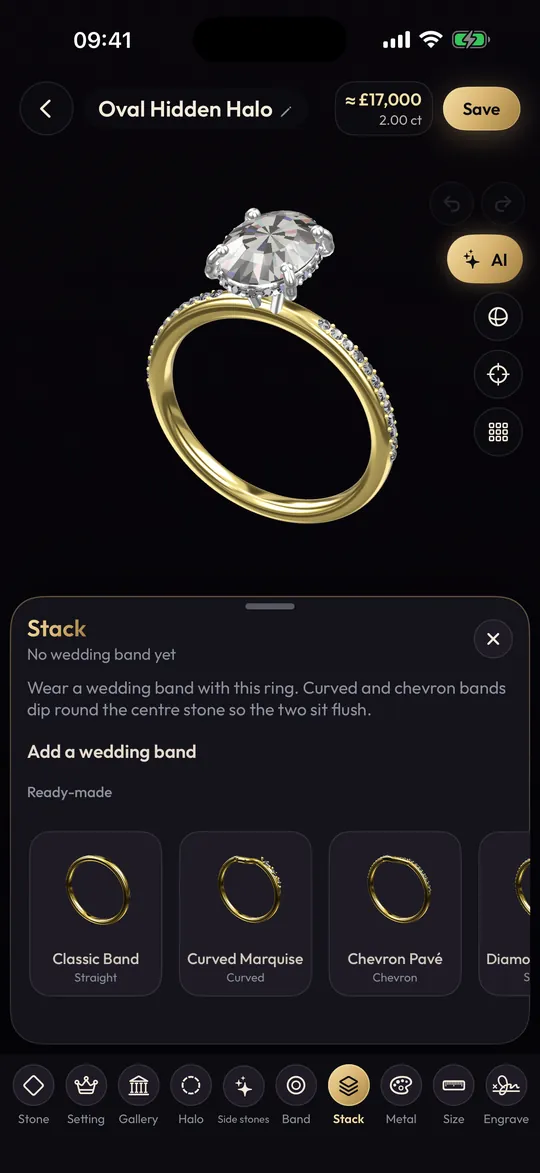
- Stack a wedding band with the engagement ring, above or below, and choose a straight, curved or chevron contour so it sits flush (Pro).
- Compare 4 prongs with 6 or a bezel for security.
- Watch the live price estimate to see which choices drive cost (an estimate, not a quote).
- Try the ring on your hand with the camera, and estimate ring size with a hand scan (Pro).
Then share a ring code (Pro) or screenshots with your jeweller so every quote is for the same design.
A pre-purchase checklist
- Independent lab report, inscription matches.
- Cut grade checked, video seen.
- Design suits their style and their work.
- Wedding band fit considered.
- Band width and prongs sturdy enough.
- Ring size checked; resizing terms known.
- Full specification in writing; returns and warranty understood.
- Insurance arranged from collection day.
Frequently asked questions
What is the biggest mistake when buying an engagement ring?
Prioritising carat weight over cut quality. A well-cut smaller diamond often looks brighter and even larger face-up than a poorly cut bigger one.
Is it a mistake to buy an engagement ring without a certificate?
For any diamond of meaningful size, yes. Without an independent grading report you can't compare stones fairly or prove what you bought for insurance.
Should the engagement ring match the wedding band?
It doesn't have to match, but the two must physically sit together comfortably. Some settings leave a gap or need a curved band, so plan both together.
Is buying an engagement ring too small or too big a mistake?
It's fixable but worth avoiding. Sizing up is generally safer than too small, and some designs such as full eternity bands can't easily be resized.
Is a thin band a mistake for an engagement ring?
Very thin bands (under roughly 1.5-1.8 mm) look delicate but can bend or wear through over years, particularly with a heavy stone. A slightly sturdier band lasts longer.