 Ring Studio
Halo vs Solitaire: Which Engagement Ring Style Is Right for You?
Halo vs solitaire comes down to one trade-off: a halo makes the centre stone look larger and adds sparkle for less money, while a solitaire shows the stone on its own, is easier to clean and pairs with almost any wedding band. Neither is better; they suit different priorities.
On this page
- Short answer
- Halo for maximum size and sparkle per pound; solitaire for a clean, classic look and easy band pairing
- Size effect
- A halo can make the centre stone look roughly a size larger face-up
- Upkeep
- Solitaire is simpler; a halo has many more small stones to check
- Wedding band
- Solitaire takes almost any band; a halo often needs a curved or contoured band
Halo vs solitaire at a glance
| Halo | Solitaire | |
|---|---|---|
| What it is | Centre stone framed by a ring of small stones | A single centre stone, nothing else on the head |
| Face-up size | Looks larger than the centre stone | Shows the true size of the stone |
| Sparkle | Lots of small flashes from the frame | All attention on the centre stone's own light return |
| Cost for the same look | Usually lower | Usually higher (bigger centre needed) |
| Cost for the same centre | Higher | Lower |
| Maintenance | More stones and prongs to check | Minimal |
| Snagging | Wider head, more edges | Depends on setting height and prongs |
| Wedding band fit | Often needs a curved band | Sits with almost any band |
| Style feel | Glamorous, vintage, statement | Classic, minimal, understated |
How much bigger does a halo make the stone look?
A halo works by extending the area that sparkles. If you set a 1 carat round brilliant, which measures about 6.4-6.5 mm across, inside a single row of small diamonds, the outer edge of the halo might measure around 8.5-9.5 mm depending on the melee size and the gap. To the eye, especially from a little distance, the whole head reads as one bright shape.
That is why halos became so popular: they deliver presence without the steep jump in price that comes with a bigger centre stone. Look at the carat size chart and you will see that going from 1 to 1.5 carats only adds about a millimetre in diameter, yet price per carat rises sharply. A halo can give a similar visual gain for the cost of some small stones and extra metalwork.
The flip side is honesty of scale. Up close, it is obvious which part is the centre stone. Some people love the combined effect; others feel it distracts from a stone they paid good money for.
Sparkle and character
A solitaire lets the centre stone do all the work. With a well-cut diamond or a richly coloured sapphire, that is often the most beautiful option: you see the stone's own pattern of light and dark, its cut quality and its colour without competition.
A halo adds busy, scintillating sparkle around the edge. It can also be used to change a stone's outline (a round halo around a cushion, for example) or to add contrast: a diamond halo around a blue sapphire is a classic look for exactly that reason.
Cost: where the money goes
Price comparisons depend on what you hold constant:
- Same centre stone: the halo ring costs more. You pay for perhaps 12-20 small stones plus the extra setting work.
- Same visual size: the halo is usually cheaper, because a smaller centre with a halo can match the spread of a larger solitaire.
With lab-grown diamond prices having fallen sharply over recent years, the gap between "bigger centre stone" and "smaller stone with a halo" has narrowed for lab-grown buyers. For natural diamonds and fine coloured stones, the halo's value argument is still strong. See engagement ring costs for realistic ranges.
Durability, snagging and upkeep
A solitaire has one stone and four to six prongs (or a bezel). There is little to go wrong, and it is quick to clean. A halo multiplies the small parts: each melee stone is held by tiny beads or prongs that can wear down over years of daily knocks. Lost halo stones are a common repair, though usually an inexpensive one.
Halos also make the head wider, which can catch on knitwear or gloves. If you work with your hands a lot, a low-profile solitaire or a hidden halo may suit you better. Our guide to rings for an active lifestyle goes deeper.
Pairing with a wedding band
This is one of the most overlooked differences. A solitaire's narrow head usually allows a straight band to sit right against it. A halo's wider base often leaves a gap with a straight band, so many people choose a curved or contour wedding band that wraps around it. Plan the pair together if a flush fit matters to you.
Choose a halo if... choose a solitaire if...
Choose a halo if you want the most face-up size and sparkle for your budget, you love a glamorous or vintage look, you want to add contrast around a coloured stone, or you want to make a modest centre stone feel more substantial.
Choose a solitaire if you have invested in a beautiful centre stone and want it seen on its own terms, you prefer minimal design, you want the easiest cleaning and fewest repairs, or you want the freedom to wear almost any wedding band beside it.
If you are torn, a hidden halo is the middle ground: it looks like a solitaire from the top and reveals a band of sparkle from the side.
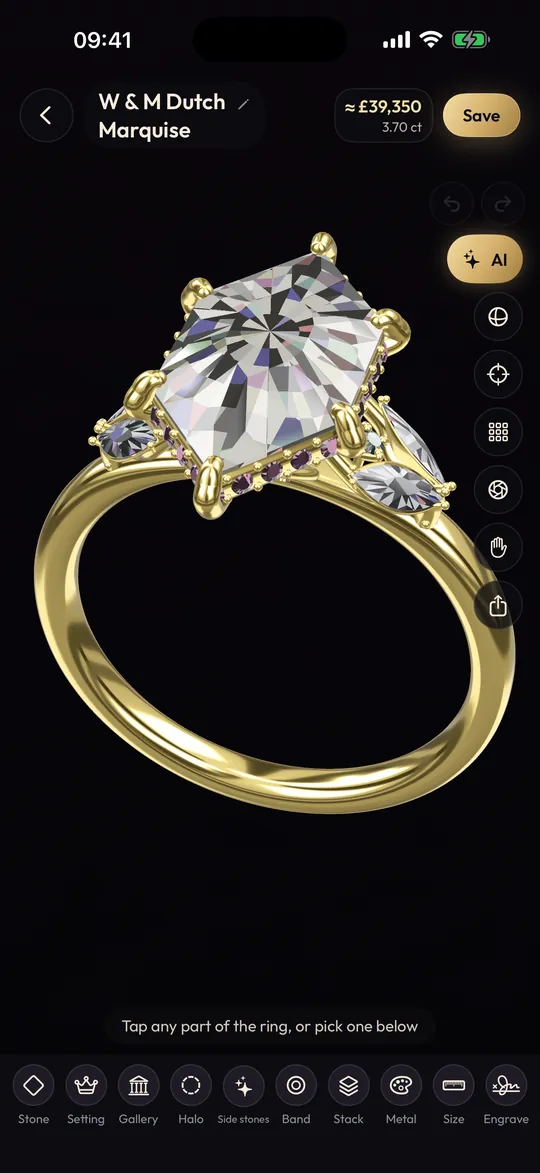
Compare a halo and a solitaire in Ring Studio
The quickest way to settle this is to see both versions of the same ring. In Ring Studio:
- Pick your centre stone shape and set a carat size you are realistically considering.
- Leave the halo option on none to see the solitaire, then rotate the ring and look at it from the top and side.
- Switch the halo to classic halo and compare. Try the hidden halo too.
- Drop the carat size down and watch the live price estimate move, to see whether a smaller stone with a halo matches the look of a larger solitaire for you.
- With Pro, stack a wedding band against each version to check how flush it sits.
You can also describe the ring to the AI ("oval solitaire in platinum, now add a halo") and switch back and forth in conversation.
Mistakes to avoid
- Choosing a halo purely to look bigger, then feeling disappointed by the centre stone up close. Look at both from arm's length and from a few centimetres away.
- Forgetting the wedding band. Design the stack before you commit.
- Going for a very thin solitaire band with a large stone. It can look top-heavy and may wear faster.
Verdict
Pick a halo if visual size and sparkle per pound matter most and you are happy with a little more maintenance. Pick a solitaire if you want a clean, classic ring that shows off one stone and plays well with any band. If you want both, a hidden halo is the compromise worth trying first.
Frequently asked questions
Does a halo make a diamond look bigger?
Yes. A ring of small stones around the centre extends the area of sparkle, so the face-up look is noticeably wider than the centre stone alone. How much depends on the size of the halo stones and how tightly they sit, but a halo commonly reads as a stone a size or more larger.
Is a solitaire or halo more expensive?
For the same overall face-up size, a halo is usually cheaper because the small melee stones cost far less per carat than a bigger centre stone. For the same centre stone, a halo costs more than a solitaire because you are paying for the extra stones and setting labour.
Are halo rings going out of style?
Halos were extremely popular through the 2010s and have since shared the spotlight with simpler solitaires and hidden halos. They remain a mainstream choice, and the classic shape-matching halo has a long history going back to Art Deco and earlier cluster designs.
Is a halo ring harder to maintain?
Somewhat. More small stones means more prongs or beads that can snag or loosen and more crevices for dirt. A jeweller check every six to twelve months and regular gentle cleaning keep a halo looking bright.
Can you wear a straight wedding band with a halo ring?
Often yes, but a halo sits wider at the base, so a straight band may leave a gap. A curved or contoured band, or a halo set high enough for a band to slide underneath, gives a flush fit.